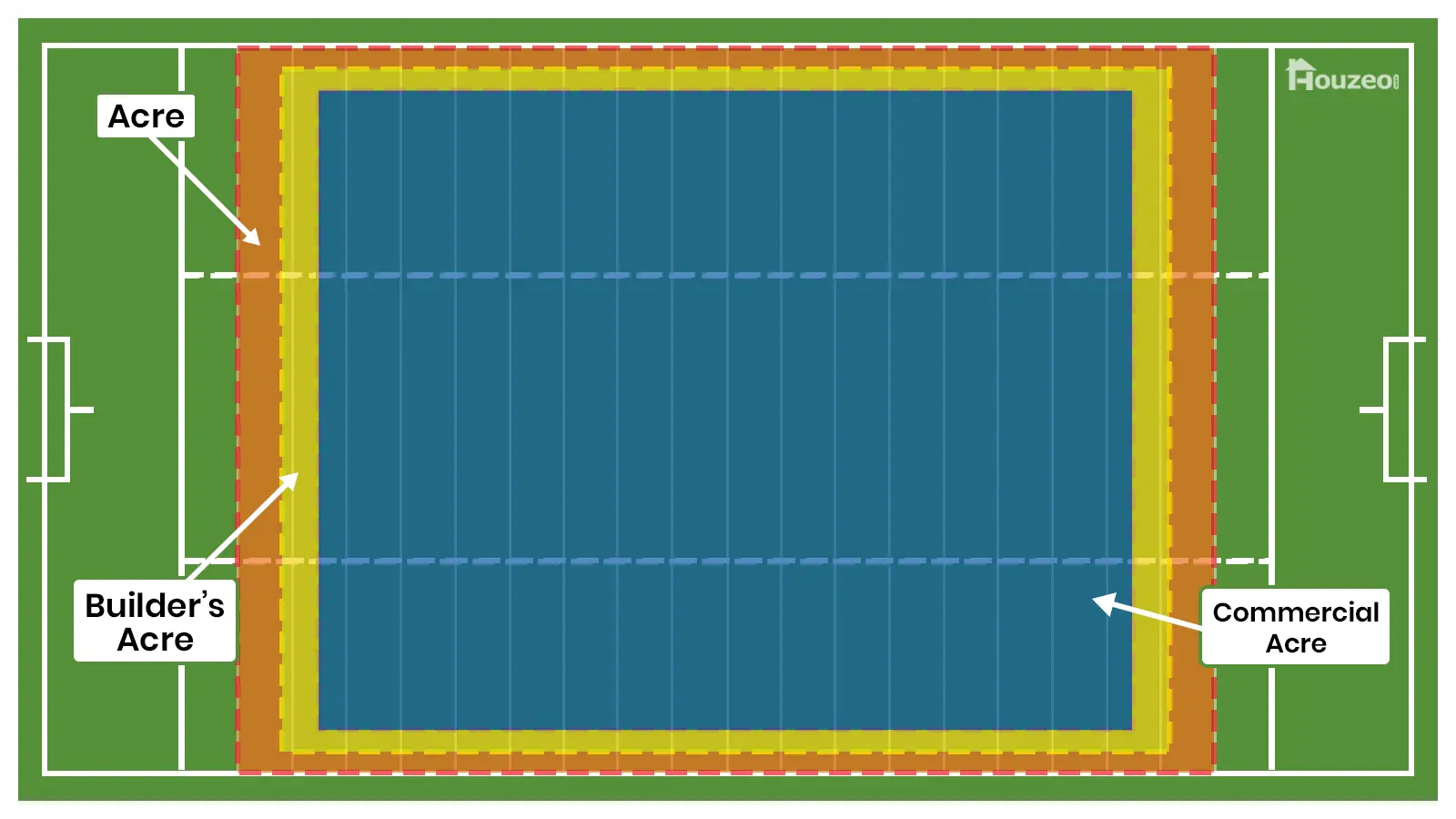
If you’ve ever wondered how big is an acre, it is exactly 43,560 square feet. An acre, the standard unit of land measurement in the USA, can be visualized as a football field, without the end zones. A standard acre covers roughly 90% of that space.
That mental image alone can help you make smarter decisions before investing in land. The U.S. has two additional acre types used in real estate and development: the Builder’s Acre at 40,000 sq. ft. and the Commercial Acre at about 36,000 sq. ft.
Houzeo is America’s best home buying and selling platform.
For Home Sellers: List your home for a Flat Fee, and save 2.5% to 3% on the listing agent commission! That’s thousands of dollars extra in your pocket.
For Home Buyers: Houzeo has the most number of homes for sale in the U.S. Start your dream home search now!
Yes! You can list your home for sale or search millions of homes on the Houzeo mobile app!
Download now on the Apple App Store or the Google Play Store.



Key Takeaways
- An acre is exactly 43,560 square feet or 4,840 yards, roughly 90% of a standard American football field.
- A Builder’s Acre (40,000 sq. ft.) is used in residential development while a Commercial Acre (about 36,000 sq. ft.) accounts for public infrastructure like roads and drainage.
- While the average U.S. acre costs $20,238, residential land can range from $10,000 in rural states to millions in urban areas like Washington D.C.
- Multiple factors drive land value, including location, zoning, accessibility, utility availability, topography, and existing improvements.
What Is an Acre?
An acre is a unit of land measurement commonly used in the United States and other countries that follow the imperial system. It is the standard unit used in real estate, agriculture, and land development to measure plot sizes.
Meanwhile, acreage refers to the total area of a piece of land measured in acres. It does not refer to a fixed size but simply describes the number of acres a property contains.
For example, when someone says a property has “large acreage,” they mean the land spans a significant number of acres.
How Big Is an Acre of Land in Different Units?
An acre is exactly 43,560 square feet or 4,840 square yards. If you are still unsure about the scale of an acre, use this breakdown to get a better understanding.
| Unit | Area | Acres Equivalent |
|---|---|---|
| Feet | 43,560 sq. ft. | 1 |
| Yards | 4,840 sq. yd. | 1 |
| Meters | 4,046.86 sq. m. | 1 |
| Hectares | 0.404686 hectares | 1 |
| Kilometers | 0.00404686 sq. km. | 1 |
| Miles | 0.0015625 sq. miles | 1 |
Typically, people use square feet to measure the size of a home. However, when you move out of the city or decide to buy your own land, an acre becomes the go-to measurement unit. This is why knowing how to convert an acre to sq. ft. is essential.
When converting square footage to acres, use the standard conversion factor of 43,560. This number represents the total square footage in one standard acre.
To calculate the number of acres, divide your total square footage by 43,560:
Acres = Total Square Feet/43,560
You can also use a free online square feet to acres calculator for quick and accurate results.
Alternatively, to convert acres to square feet, multiply the number of acres by 43,560.
Square Feet = Number of Acres × 43,560
What Does an Acre Look Like?
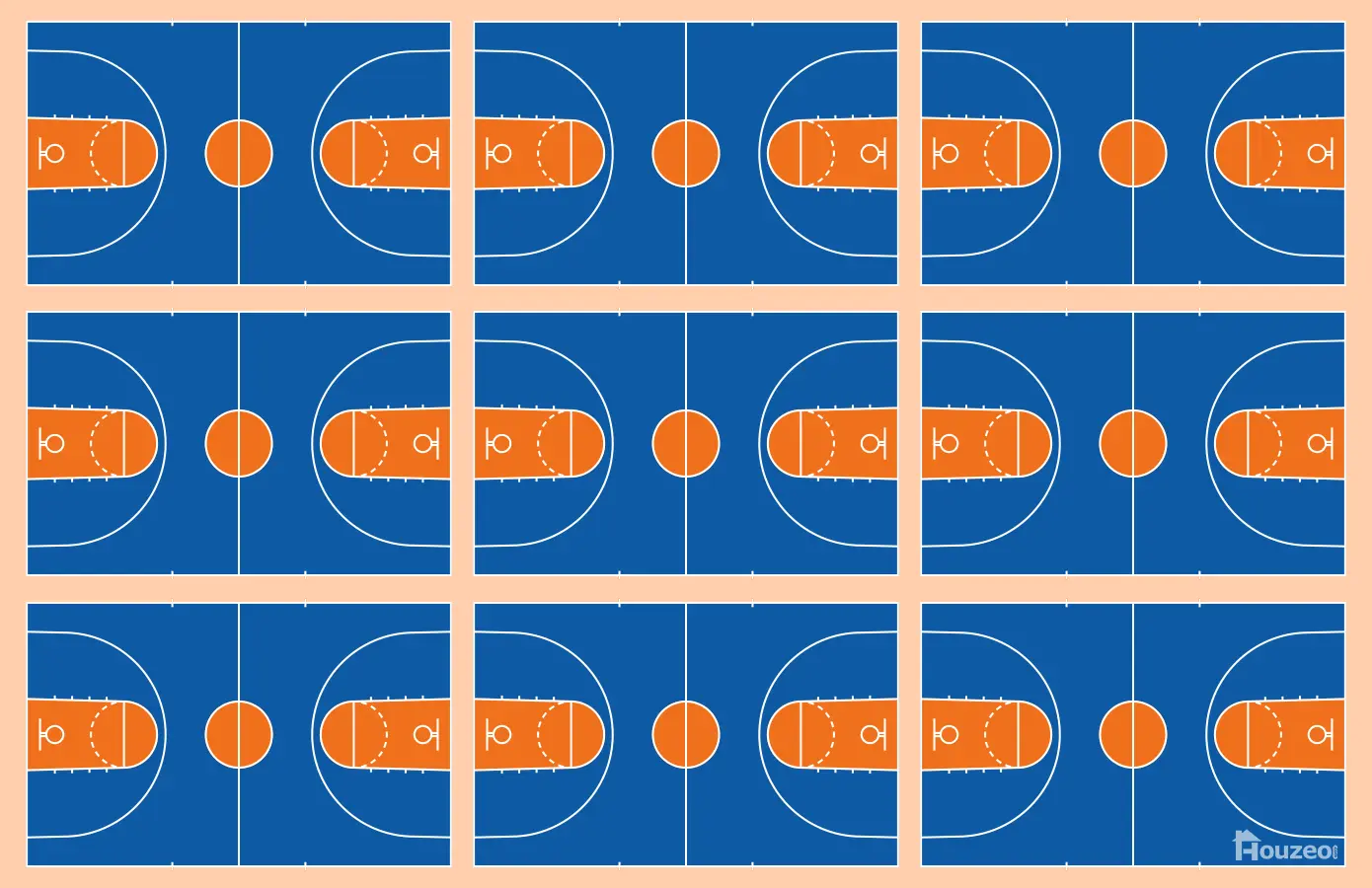
An acre looks almost as big as the footprint of the Lincoln Memorial, including the retaining wall. This measures just over an acre (1.1 acres or 48,049 sq. ft). To visualize that area, you can also imagine roughly 9 NBA basketball courts or 16 tennis courts laid side-by-side.
Another way to imagine an acre is to visualize 18 average-sized homes of 2,400 square feet each when placed next to each other. Alternatively, the same area can accommodate approximately 48 average-sized apartments, each measuring 900 square feet.
Since an acre is a measure of area, it has no standard dimensions. However, it is commonly visualized using two standard models:
- The Historical Rectangle: Historically, an acre was defined as one furlong by one chain ($660 ft * 66 ft). A furlong was the distance an oxen team could plow without resting, while the width represented what could be finished in a day.
- The Square Acre: If imagined as a perfect square, an acre measures approximately 208.7 feet on each side.
Yes, in the modern world, an acre is the same everywhere (43,560 sq. ft. or 4,840 sq. yd.). But historically, its size shifted significantly across different regions.
- Scottish Acre: Roughly 1.26 standard acres or 54,760 square feet.
- Irish Acre: Roughly 1.62 standard acres or 70,560 square feet.
- Cheshire Acre: Roughly 2.12 standard acres or 92,160 square feet.
These differences stem from each region historically developing its own methods for measuring land. They were later phased out to ensure uniformity in taxation and land records.
Types of Acres
Before you purchase a piece of land, keep one thing in mind, an acre doesn’t always mean the standard 43,560 square feet in the U.S. Depending on its intended use, an acre can be categorized into two types: the Builder’s Acre and the Commercial Acre.
1. Builder’s Acre
A Builder’s Acre is a simplified measurement often used in residential development. Since the standard acre is a messy number (43,560 sq. ft.), builders frequently round it down to 40,000 sq. ft. to make calculations easier.
This simplified measurement provides the developer with a buffer. The “extra” 3,560 sq. ft. can be set aside for practical adjustments like sidewalks, setbacks, and small easements.
However, some developers have used the “Builder’s Acre” unethically in marketing. This has led to lawsuits for misrepresenting the land size. It is vital to confirm whether a quoted “acre” refers to the standard or the simplified Builder’s Acre.
2. Commercial Acre
A Commercial Acre is a non-standardized legal and financial term. When a large plot is turned into a commercial zone, the developer must give up land for public streets, alleys, and large-scale drainage systems or retention ponds.
Due to these adjustments, a commercial acre generally measures 36,000 sq. ft., about 83% of a standard acre. This “net” usable land, what remains after dedicating a portion to public use, is then used for site and building planning.
How Much Does One Acre of Land Cost on Average?
In the U.S., the average cost of an acre of land is $20,229. However, this cost varies depending on multiple factors, such as the land’s location, intended usage, and geographical conditions.
Average Cost of Residential Land
The value of residential land is rising rapidly in the U.S. Currently, the average cost of an acre of land purchased to build a home is $28,055.
While an acre of residential land is priced highest in the District of Columbia at $3,794,283, the same costs only about $12,269 in neighborhoods like Heritage Hills in Oklahoma. Keep in mind that you will also have to factor in the cost to build a home.
Calculate the Cost to Build a House in the US 


Your estimated cost to build a house is:
Average Cost of Agricultural Land
Similar to residential land, the price of farmland is on the rise in the U.S. The average cost of an acre of agricultural land is sitting at $8,739.
At present, Rhode Island has the most expensive agricultural land, priced at $63,219 per acre of land. Meanwhile, New Mexico has the cheapest agricultural land, priced at $2,864 per acre of land.
Key Factors That Influence Land Prices
Land prices are shaped by a combination of location, infrastructure, zoning, and market dynamics. Whether you are buying a small residential lot or a large rural tract, understanding what drives land value can help you avoid overpaying and make a more informed investment.
- Location: Plots in urban regions cost more than the ones in rural areas. For instance, upstate New York land costs less than one in Manhattan.
- Accessibility: Frontage refers to the portion of land that directly borders or faces a road. A piece of land with direct frontage costs more than one that has a rugged access.
- Utility: A land that can easily be hooked up with water supply, sewage, electricity, and other amenities is typically more expensive than ones that are not.
- Zoning: Zoning regulations tell you what you can and cannot do with your land. Depending on whether a piece of land is designated for residential development or agriculture, the cost will vary.
- Topography: A flat, clear land is more valuable than one with tricky topography like a steep ravine, rocky ledges, etc.
- Market Conditions: Land prices are heavily driven by supply and demand. For instance, in a high-demand, land-scarce neighborhood like Williamsburg in Brooklyn, prices will far exceed those in a rural area like Westminster in Vermont where land is plentiful.
- Constructions: If there is anything that’s already built on the property, like a barn, well, or a fence, it adds to its cost. In contrast, a raw, vacant land with no constructions is bound to cost less.
How Many Acres Do You Need to Build a Home?
You need about 1/5th of an acre or approximately 8,500 to 8,800 square feet to build a home. To estimate your ideal land size, start by calculating your family’s space needs. Then, choose land based on how you want to build a house to match your vision.
You can also use the land-to-building ratio to estimate your ideal land size. This ratio, which ranges between 2.5:1 and 3.5:1, compares lot size to home size. For a home with 0.15-acre footprint, the ideal land size in acres should be between 0.375 and 0.5.
Use this formula to calculate:
Land size = Land-to-building Ratio * Building Footprint.
Common Acre Sizes for Different Property Types
There are standard measurements people follow when purchasing acreage based on their intended property type.
- Subdivision Lots (0.1-0.25 acres): Subdivision lots tend to have a small backyard and a driveway. However, the homes tend to be very close to each other.
- Estate Lots (0.5-2 acres): Estate lots offer a bit more space. This allows the property owners to have some space for a large garden, a pool, and privacy.
- Homestead (1-5+ acres): Homesteads or mini farms are known to be self-sufficient. They have enough room for a large garden, a small orchard, and some livestock.
- Rural Homes (2-10 acres): Rural homes can easily accommodate a large house, a vegetable garden, a small coop, and a workshop.
- Hobby Farm (5-10 acres): Unlike a homestead, a hobby farm focuses on a specific interest like a small vineyard. They typically require more land than a rural home.
- Small Farms (40-150 acres): A small farm is big enough for a stable or a barn. You can own your own agricultural business and may even qualify for agricultural tax exemptions.
- Recreational Land (20-100+ acres): A recreational land is a property designed for outdoor activities and entertainment. Here, what matters isn’t the building but the terrain.
- Ranches (160-1,000+ acres): A ranch is a large, extensive farm for raising livestock. The land is generally used for grazing cattle, sheep, or horses.
Acreage or Home Size: What Matters More?
When you buy a home, you may face a choice: more land (acreage) or a larger house? You should weigh what both offer before making an informed choice.
Benefits of More Acreage
- More Outdoor Space and Expansion Potential: You get ample outdoor space for a patio, garden, pool, guesthouse, recreation, and much more.
- More Privacy: More land puts natural distance between you and the street, reducing noise. Fewer neighbors also mean greater seclusion for outdoor activities and relaxation.
- Lower Property Tax: Many states base property taxes on home size or square footage. So, a larger land size with a smaller home might lead to lower taxes.
Benefits of Bigger Homes
- More Functional Spaces: In a bigger home, you have the luxury of more dedicated rooms. These allow you to assign specialized zones for work, wellness, and entertainment.
- Storage and Organization: Bigger homes give you more area for storage, such as a pantry, attic, or basement space. These allow you to store away holiday items until they are needed.
- Higher Resale Ceiling: While land appreciates, the square footage of a home is generally what influences a property’s price. If the plot is ever put up for sale, a larger home could possibly increase the property’s price as a whole.
How to Make Smart Land Decisions?
Knowing a land’s size is the first step toward making a confident, informed purchase. Once you understand how big an acre of land is, you can better plan what you want to do with it, whether that’s building a home, farming, or any other future development.
Before finalizing any land purchase, consider getting a land survey done. It confirms the exact size, shape, and legal boundaries of the plot, helping uncover potential issues early and protecting your investment from future disputes.
If buying land feels like too big a commitment, you can also purchase an existing home. They typically offer stronger appreciation value and are easier to resell due to established neighborhoods and infrastructure.
» Houzeo Reviews: Find out what customers have to say about Houzeo – USA’s best home-buying and selling website.