Florida’s condominium prices have fallen steadily since 2023, erasing much of what the pandemic boom added.
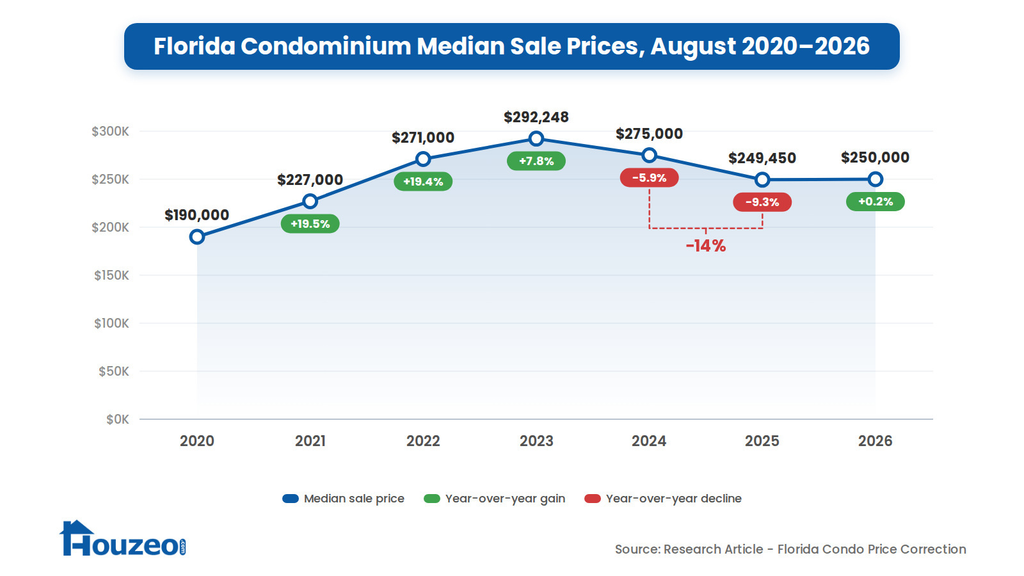
We analyzed Houzeo’s Florida housing market data and found that the statewide median condo sale price fell from $292,248 in August 2023 to $250,000 in August 2026.
That’s a 14.5% decline, or $42,248 less than three years ago.
Single-family houses, however, have held up much better: the median sale price in August was $415,000 in both 2023 and 2026. Condo prices have taken a much bigger hit, even though rising ownership costs and slower sales affected both property types.
But the latest numbers suggest the decline may be slowing. Condo prices barely changed between August 2025 and August 2026, while the number of condos available for sale also fell compared with a year earlier.
Still, it’s too soon to say the market has turned a corner. Buyers continue to face high ownership costs, and fewer homes for sale don’t automatically mean prices will start rising again.
As 2027 approaches, the question is whether condo prices have finally hit bottom or whether there’s room for them to fall further.
Key Takeaways
- Florida condo prices are down 14.5% since August 2023. The median sale price fell from $292,248 to $250,000. Meanwhile, the median price of single-family homes remained at $415,000 in both periods.
- Condo inventory increased 73.7% from August 2023 to August 2026, despite falling 9.2% over the most recent 12 months.
- Condo sales declined 30.4% between August 2023 and August 2026.
- Months of condo supply rose from 3.9 to 9.8 months, leaving buyers with considerably more choice than three years earlier.
- The median condo price rose just 0.2% year over year in August 2026, suggesting that the declines seen in earlier comparisons may be moderating.
Florida’s Condo Prices Rose 54%, But That Boom Had an Expiration Date
In August 2020, the median sale price of a condominium was $190,000. By August 2023, it was up by 54% to $292,248.
What followed was the opposite: the market lost momentum in 2023, recorded two consecutive August-to-August declines, and showed signs of stabilizing only in 2026.
Realtor.com reported a similar trend in November 2025, finding that Florida’s median condo sale price had fallen 14% from its July 2023 peak based on deed records.
That finding is close to Houzeo’s 14.5% decline from August 2023 to August 2026. The two articles use different observation periods and data sources, so they are not directly comparable.
Different data, same conclusion: Florida condos experienced a significant correction after 2023.
Condo Prices Fell, but Florida’s Single-Family Homes Held Steady
You’d expect a slowdown to hit condos and single-family homes in broadly similar ways. It didn’t.
Florida’s single-family median home price was $415,000 in August 2023. Three years later, it was still $415,000. The intervening August readings were $410,000 in both 2024 and 2025. (Worth noting: $415,000 in August 2026 buys less than $415,000 did in August 2023. In inflation-adjusted terms, flat nominal prices represent a real decline of roughly 10-12%. Single-family homes held their sticker price, not their purchasing power.)
Condos, meanwhile, experienced a much larger retreat.
The price gap between condos and single-family homes has also grown. In August 2023, the median single-family home sold for about 42% more than the median condo. By August 2026, that number was 66%.
That doesn’t mean every condo lost 14.5% of its value relative to a comparable house. The mix of properties sold in each category shifts over time, which can move the median independently of individual home values.
Still, the widening gap suggests condos face pressures beyond general affordability: HOA fees, shared building maintenance, rising insurance, and potential special assessments—costs that don’t apply to most single-family homes.
Florida Condo Inventory Is Still 74% Higher Than in 2023
In August 2023, 23,494 condominiums were available for sale. By August 2025, that number rose to 44,928 homes.
The market flipped: sellers are now competing for buyers, not the other way around.
Inventory subsequently declined to 40,799 in August 2026. That’s 9.2% lower than a year earlier, but still 73.7% higher than in August 2023.
| August | Condos available for sale | Months of supply | Reported days on market |
| 2023 | 23,494 | 3.9 | 72 |
| 2024 | 42,899 | 9.0 | 99 |
| 2025 | 44,928 | 10.2 | 112 |
| 2026 | 40,799 | 9.8 | 104 |
In three years, condo supply increased from less than four months to nearly ten months.
With more condos on the market, buyers can be more selective. Florida Realtors’ August 2026 housing-market report independently documented declining inventory and signs of stabilization. Its combined condo-townhouse category had 7.7 months of supply, while Houzeo’s condo-only category recorded 9.8.
Which is exactly why condo-only numbers matter, and mixing them with townhouses understates the problem.
Buyers Have More Condos to Choose From, but Fewer Are Buying
Rising inventory can mean more sellers are listing, fewer buyers are closing, or both. Houzeo’s real estate market data shows that sales haven’t recovered: 4,178 condo sales in August 2026, down 30.4% from 6,000 in August 2023. Sales also fell 5.5% compared with August 2025.
Condos are taking longer to sell, too. The average reported selling time rose from 72 days in August 2023 to 112 days in August 2025, before improving slightly to 104 days in August 2026.
Buyers also appear to have more room to negotiate. The average sale-to-list price ratio declined from 96.48% in August 2023 to 94.35% in August 2026. This means condos are selling for a smaller share of their listed prices, although it doesn’t necessarily reflect discounts from their original asking prices.
So, while Florida’s condo market is showing some signs of improvement, sales remain slower, homes take longer to sell, and buyers have more negotiating power than they did three years ago.
But slower sales and longer selling times don’t fully explain why buyers are staying away. A bigger factor: owning a Florida condo has become significantly more expensive.
Why Owning a Florida Condo Has Become More Expensive in 2026
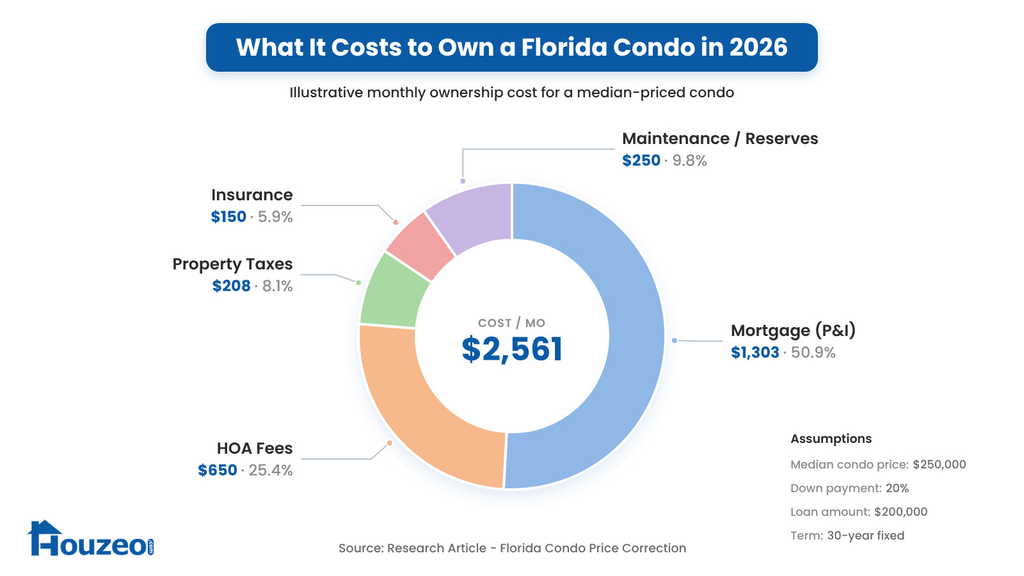
High mortgage rates have hit both property types. But condo buyers face costs that single-family buyers usually don’t: HOA fees, building insurance, reserve contributions, and special assessments for major repairs.
Following the 2021 Surfside condominium collapse, Florida tightened its building inspection requirements. Under the new rules, certain older buildings must undergo structural inspections, and qualifying associations must assess how much they need to set aside for future repairs.
At North Miami’s Cricket Club condominium complex, owners encountered a $30 million special assessment for building repairs. According to Axios, citing The Wall Street Journal, one owner who purchased a unit for $119,000 in 2019 sold it for $110,000 in April 2024, after initially listing it for $350,000.
It’s a sharp example of how repair obligations can tank resale values and why a lower asking price doesn’t necessarily mean a more affordable home.
Redfin also identified substantial variation in association fees, building ages, and flood exposure. In February 2025, Redfin reported that median condo prices in inland Florida rose 5.4% year over year, while prices declined 4.8% along the Gulf Coast and 3% along the Atlantic Coast.
This shows that Florida’s condo market isn’t struggling everywhere. While these factors don’t tell us exactly how much they’ve contributed to the 14.5% statewide price decline, they show why two homes with similar price tags can have very different ownership costs.
Florida Condo Prices Have Stopped Falling. Will It Last?
The latest figures provide the strongest argument that the correction may be entering a different phase. August 2025’s statewide condo median was $249,450. In August 2026, it was $250,000.
That’s a year-over-year increase of only $550, or approximately 0.2%; a change small enough to fall within normal measurement variation. Still, compared with the steeper declines of prior years, the direction matters.
Other numbers are also moving in a better direction. Fewer condos are on the market than a year ago, homes are selling slightly faster, and the average sale-to-list price ratio has improved from 93.92% to 94.35%.
And Houzeo isn’t the only one seeing signs of improvement.
Florida Realtors reported that its combined condo-townhouse median rose 2.8% year over year to $298,000 in August 2026. Inventory in that category also declined. While the two reports use different methods and property categories, both suggest that the pressure on prices may be easing.
But there’s still reason to be cautious. Condo sales are still below earlier levels, buyers have plenty of properties to choose from, and homes are taking longer to sell than they did three years ago.
One flat year isn’t proof of a bottom. But it’s the first real sign that buyers and sellers may be finding a new equilibrium. And the worst of the correction could be behind us.
Houzeo’s 2027 Prediction: Florida Condo Prices Could Rise 2%-4%
After three years of declining median prices, Florida’s condo market is beginning to show signs of stabilization. Inventory has fallen, properties are selling somewhat faster, and median prices have remained nearly unchanged over the past year.
Based on these trends, Houzeo expects Florida’s median condo sale price to rise by 2%-4% in 2027. Using August 2026’s $250,000 median as the benchmark, that would place the August 2027 median around $255,000-$260,000.
But that forecast depends on a few things. Inventory needs to keep declining, sales must hold steady, and mortgage rates, insurance premiums, and other ownership costs shouldn’t rise significantly.
If those conditions don’t hold, for example, if mortgage rates rise further, insurance costs spike, or condo associations pass large assessments, prices could remain flat or decline again.
Methodology
This report was researched and analyzed by Jai Chavan, Digital Marketing Manager at Houzeo. Jai Chavan researches housing market patterns, consumer behavior, and real estate affordability using Houzeo’s housing-market data, proprietary platform insights, and publicly available industry research.
The analysis uses Houzeo’s historical Florida housing-market data, accessible on Houzeo’s Florida Housing Market page, covering monthly statewide observations from January 2020 through August 2026. The dataset includes median sale prices, homes sold, active listings, new listings, months of supply, days on market, and sale-to-list price ratios for both condominiums and single-family residences across Florida.
August observations are compared across years to minimize seasonal differences. Percentage changes are calculated from the reported monthly figures. Median sale prices reflect the pool of properties sold during each period, not changes in individual property values.
The 2027 outlook considers historical price movements, inventory trends, sales activity, and broader market conditions. Houzeo’s projected 2-4% increase in the median condo sale price is a conditional forecast based on current trends, not a statistically validated prediction. The analysis does not establish causation or account for every factor affecting individual property values.
Statewide figures may differ significantly from city- and neighborhood-level trends. External research from Florida Realtors, Redfin, Realtor.com, and Axios provides additional industry context but does not independently validate Houzeo’s calculations.
External Sources
1. Realtor.com, “Florida Condo Prices See Sharpest Drop in 15 Years,” November 25, 2025
2. Redfin, “Florida Condo Prices Are Holding Up Best Away From the Coast,” February 24, 2025
3. Florida Realtors, “Florida Housing Market: Median Prices Hold Steady, Pace Eases,” September 2026
6. Axios Miami, “Safety Regulations Are Pushing Miami Condo Owners Out,” May 15, 2024
About Houzeo Research
Houzeo Research analyzes proprietary real estate platform data alongside public housing, demographic, and economic datasets to identify emerging trends in how Americans search for, buy, sell, and value homes. By combining real-time consumer behavior with housing-market data, Houzeo Research provides a closer look at the decisions and patterns shaping the U.S. housing market.
Our research uses anonymized and aggregated platform data. Individual users are never identified, and findings are presented with methodology and limitations to distinguish observed behavior from broader nationwide trends.