Forget the McMansion. The American dream has changed in 2026.
Houzeo buyers are gravitating toward flexible spaces, outdoor living, lower monthly running costs, and locations beyond major city cores. These patterns are broadly consistent with findings from national research by NAR, NAHB, Zillow, and the U.S. Census Bureau.
This article extends two earlier Houzeo studies and adds a new layer to the analysis of buyer behavior in 2026. The Home Buyer Report analyzed how buyers search, save, and engage with homes.
The American Home Buyer Profile covered who is buying.
This piece answers the next question: what do buyers want?
1. The Spare Bedroom Is Getting a Second Job
70% of bedroom-specified searches on Houzeo targeted 2- or 3-bedroom homes, while only 10% targeted 4+ bedrooms. Favorites collections have names such as “2bd, 1bath houses” and “$400,000 Max – 2 bed – 1.5 bath.”
11 filtered searches specifically included a guest house, which can provide additional space for guests and often doubles as a studio or office. [2]
The combination suggests a practical compromise: buyers still want space that can handle work, guests, or changing household needs; however, they are not necessarily shopping for a dedicated office plus multiple spare bedrooms.
The National Data Backs Houzeo’s Finding
In NAHB’s survey of 3,000+ recent and prospective buyers, 66% said they would prefer a home with exactly one home office and 13% wanted two or more. [4]
But the office is also one of the first rooms buyers are willing to give up. Among buyers inclined to accept a smaller home, 53% would shrink the home office, ahead of the dining room (52%). [5]
Remote work is not going away. Stanford and NBER researchers estimate that work-from-home days made up about a quarter of all paid U.S. workdays in 2025. [6]
👉 What does this mean? Remote work may have earned a permanent place in the home, but that doesn’t mean it deserves its own room. In a 2- or 3-bedroom home, the spare bedroom can turn into a flex room: guest room on weekends, workspace on weekdays.
2. The Most-Wanted Room Is Outside
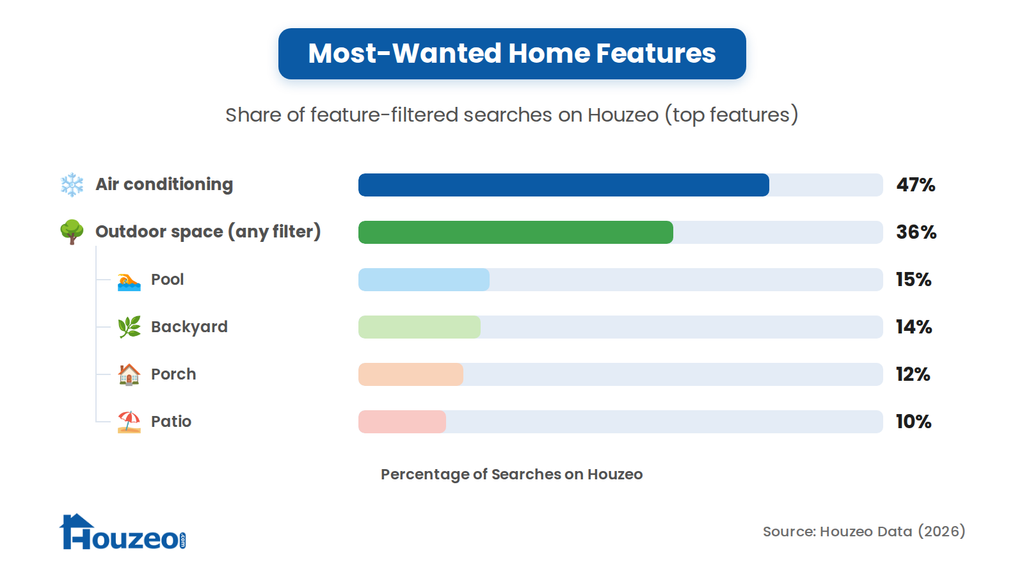
186 of 881 Houzeo saved searches (21%) used at least one feature filter. Among those, outdoor space was the second-most common requirement after air conditioning. [2]
| Houzeo feature filter | Searches | Share of feature-filtered searches |
|---|---|---|
| Air conditioning | 87 | 47% |
| Any outdoor filter (pool, backyard, porch, or patio) | 67 | 36% |
| Pool | 27 | 15% |
| Backyard | 26 | 14% |
| Porch | 22 | 12% |
| Patio | 18 | 10% |
Source: Houzeo saved searches, Jan–Sep 2026. A search can include more than one filter.
Buyers also filter for land around the house:
- 60 searches (7%) set a minimum lot size. The median minimum was 21,780 sq ft, or half an acre.
- 28 searches required at least one acre.
- 73 searches (8%) required garage parking.
- 30 searches required both air conditioning and an outdoor feature.
Favorites collections tell the same story in buyers’ own words, with names like “Pool and fireplace!!!” [2]
The pattern found in Houzeo’s data is broadly consistent with national buyer research.
National Research Says Outdoor Space Isn’t Just Nice to Have
Zillow’s buyer research ranked air conditioning as the most important home characteristic, with 83% of buyers calling it very or extremely important. [9]
NAHB’s most-wanted list is led by a patio, tied with a laundry room at 86% of buyers rating it essential or desirable. Three more outdoor features make the list: exterior lighting (82%), a front porch (81%), and landscaping (80%). [8]
Zillow found 70% of buyers rated private outdoor space, such as a patio, deck, or yard, very or extremely important. [9] In fact, in their 2025 Zeitgeist review of natural-language searches, they found that interest in pools, patios, fireplaces, yards, fenced yards, and gardens increased, while searches for mansions and acreage fell. [7]
👉 What does this mean? Outdoor space has emerged as a priority among Houzeo users and in national buyer research. For buyers balancing space and affordability, outdoor space can add usable living area without adding another interior room.
3. The Price Tag Isn’t the Whole Cost of a Home
Air conditioning is the most-used feature filter on Houzeo: 87 searches, or 47% of all feature-filtered searches, more than double the next filter (washer-dryer, 40). [2] That tracks with where Houzeo buyers are looking: Florida, Texas, and Arizona are all in the top eight states.
Houzeo buyers also screen for monthly running costs in both their filters and their messages: [2]
- 55 searches set a minimum year built: The median minimum year was 1990, and 24 required a home built in 2000 or later. Year built provides a rough signal of construction era, but it does not directly measure energy efficiency.
- 41 searches (5%) capped HOA fees, including 9 that required no HOA at all.
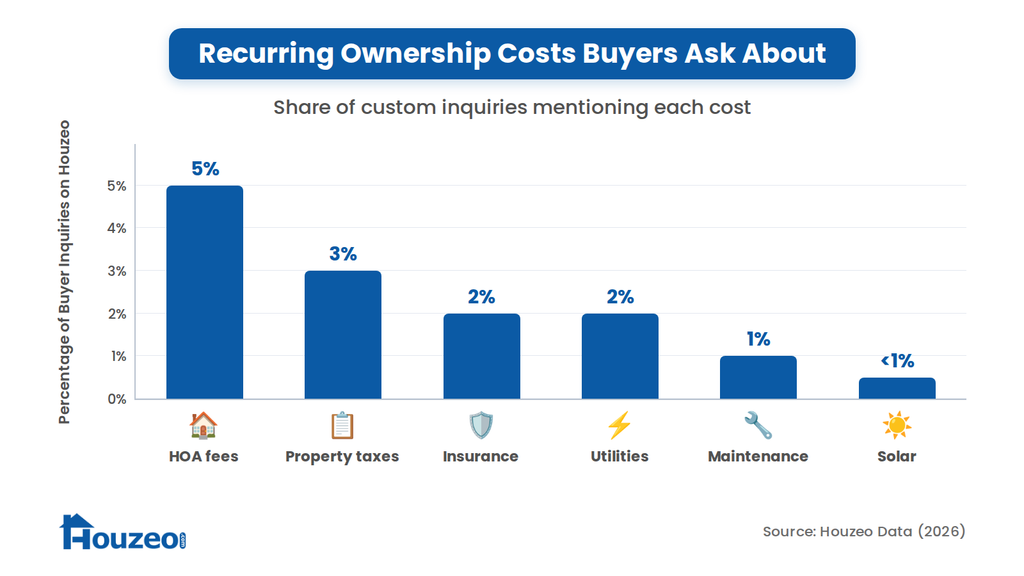
- About 1 in 10 buyers who wrote a custom inquiry (64 of 614) asked about recurring costs: HOA dues, lot or land rent, taxes, insurance, or utilities. One buyer wrote: “Is the HOA $1000 per month? If it is, don’t bother responding.”
National Research Shows Buyers Care About What Comes After Closing
The national findings also show a similar pattern seen at Houzeo:
- Efficient windows are a near-universal want: ENERGY STAR windows have been rated essential or desirable by at least 83% of buyers in every NAHB survey since 2007. ENERGY STAR appliances follow at 80%. [8] [11]
- Buyers are asking about energy efficiency: In NAR’s 2025 Residential Sustainability Report, the share of agents who said clients never ask about energy upgrades fell from 57% to 29% in one year. [12]
- Agents think energy efficiency metrics increase listing value: 58% of Realtors said promoting energy efficiency in a listing adds value. Windows, doors, and siding were the green features clients cared about most. [12]
- Resilience features are trending in Zillow listings: Mentions of whole-home batteries rose 62%, EV chargers 34%, and solar panels 18% year over year. Separately, 86% of recent buyers said at least one climate-resilient feature was very important. [10]
👉 What does this mean? For buyers concerned about ownership costs, built-in efficiency can reduce the need for immediate upgrades. For sellers, documented upgrades (window age, HVAC efficiency, a year of utility bills) can make those benefits easier for buyers to assess.
4. The Search Is Moving Beyond the City Limits
Most buyers are purchasing outside city cores, and Houzeo data shows them choosing between specific suburbs rather than between metros.
Only 14% of the 4,811 buyer inquiries with a known location were for homes in the 50 largest U.S. cities; 86% were for homes in suburbs, smaller cities, towns, and rural areas. Favorites show buyers running structured, suburb-by-suburb comparisons inside a chosen metro: [2]
- One Bay Area buyer built 17 city-named collections, including Mountain View, Redwood City, Oakland, Menlo Park, Berkeley, and Palo Alto.
- Another compared 10 Orange County cities.
- A South Florida buyer kept 6 collections across Wellington, Melbourne, Boca Pointe, Deerfield Beach, Delray Beach, and Coral Springs.
- A Texas buyer kept 5 collections across Houston and Spring.
The Houzeo pattern is directionally consistent with NAR’s national transaction data, although the geographic definitions differ.
NAR Says Buyers Are Choosing Suburbs and Small Towns
In NAR’s 2025 Profile of Home Buyers and Sellers (July 2024–June 2025), only 14% of buyers purchased in an urban or central city, down from 16% the year before. [3]
| Where recent buyers purchased | Share |
|---|---|
| Suburb or subdivision | 44% |
| Small town | 24% |
| Rural area | 15% |
| Urban or central city | 14% |
| Resort or recreation area | 3% |
Source: NAR 2025 Profile of Home Buyers and Sellers.
NAR’s data suggests that neighborhood choice involves more than commute time alone.
Neighborhood quality (59%), convenience to friends and family (47%), and overall affordability (35%) were the top factors in choosing a neighborhood. The median distance moved was 20 miles, down from 50 miles in the 2022 report. [3]
Census data points the same way. The Census Bureau’s Vintage 2025 estimates show population gains in major metros concentrated on the outer edges, while New York City lost 12,196 residents between July 2024 and July 2025. [1] [15]
👉 What does this mean? In real estate, location matters the most. But in 2026, the location is the suburb, not the metro. Buyers pick a region first, then shop individual communities on quality, price, and proximity to people they know.
5. There Isn’t One “Next Austin”: Buyer Interest is Spreading Out
Population growth is increasingly showing up in midsize cities and outer portions of major metros, while Houzeo buyer activity spans secondary cities, exurbs, and smaller markets. Houzeo searches concentrate in the Sun Belt and spread beyond its biggest metros. [2]
| Rank | State | Share of Houzeo searches |
|---|---|---|
| 1 | Florida | 13.1% |
| 2 | Texas | 8.2% |
| 3 | North Carolina | 5.7% |
| 4 | Georgia | 5.2% |
| 5 | Tennessee | 4.8% |
| Top 5 combined | 37.0% |
Inquiries, the step where a buyer contacts an agent, books a tour, or makes an offer, show where that interest lands: [2]
- The same five states account for 34% of inquiries, close to their 37% share of searches.
- Inquiries are spread across 2,100+ cities: The 10 most-inquired cities together account for just 7% of all inquiries. There isn’t a single replacement market. Buyer interest is highly fragmented geographically.
- Smaller markets are more affordable: The median list price of homes buyers inquired about was $235,000 outside the 50 largest cities and $280,000 inside them, a 16% gap.
- Florida’s demand is spread statewide: Florida’s 707 inquiries covered 195 cities; Jacksonville, Tampa, and Miami drew only 14% combined. Ocala, Lakeland, Cape Coral, and Sarasota each drew 15 or more.
- North Carolina buyers on Houzeo ignored its biggest cities: Its 210 inquiries covered 98 cities, and Charlotte and Raleigh drew only 7% combined. Greensboro (11) drew more than either, and Durham, Waxhaw, Zebulon, Wilmington, and Hickory each drew at least as many as Raleigh.
- Texas inquiries reach the exurbs, including Georgetown, Conroe, Katy, Kyle, and Fulshear, one of the Census Bureau’s five fastest-growing cities.
- Lifestyle filters point to small-town and rural living: Cheap homes (55), tiny homes (51), historic (29), cabins (28), farms (10), and farmhouse (10). Free-text searches include “mountains of nc” and “rural, vintage home with privacy.”
The Census Sees Growth Beyond the Biggest Cities
The Census Bureau’s Vintage 2025 city estimates, released May 14, 2026, show the sharpest slowdown at the top: [1] [15]
- Cities and towns with a population of 250,000 or more averaged a gain of 2,048 residents in 2024–25, down from 7,699 the year before. Their growth rate fell from 0.9% to 0.3%.
- Midsize cities of 5,000–49,999 averaged 0.7% growth, down modestly from about 1%.
- All five of the fastest-growing cities with 20,000+ residents were in Texas: Celina (+24.6%), Fulshear (+21%), Princeton (+18.1%), Melissa (+14.5%), and Anna (+10.2%). Four of them are exurbs north of Dallas-Fort Worth.
- Charlotte added 20,731 residents, the largest numeric gain of any U.S. city.
👉 What does this mean? Per activity on Houzeo, buyers are not leaving the Sun Belt metros. They are moving down the map within it, toward exurbs, secondary cities, and small towns where a 2- or 3-bedroom home with a yard is still affordable.
But search interest isn’t migration.
Houzeo’s buyer data captures where people are exploring homes; the Migration Trends report examines where Americans are actually moving.
What This Means for Buyers, Sellers, and the Industry
The 2026 wish list favors homes that are flexible, offer outdoor living, are affordable, and are located in areas attracting buyer interest.
Buyers
- Judge homes by usability, not bedroom count. A 3-bedroom with a flexible room may be more useful than a 4-bedroom that pushes the buyer beyond budget.
- Put a value on outdoor space. A patio or yard adds living area for far less than interior square footage.
- Federal 25C and 25D credits generally no longer apply to qualifying improvements made after 2025. [14] Check current federal, state, and utility incentives before planning upgrades. Ask for utility bills and the age of windows and HVAC.
- Compare suburbs directly. Save one collection per community, the way Houzeo’s buyers do.
Sellers
- Stage the spare bedroom as an office or guest room, and maybe call it a flex room in the listing.
- Lead your photos with the patio, porch, pool, or yard.
- Mention efficiency upgrades, utility costs, HOA dues, and taxes in the listing remarks and any green MLS fields.
- Price for a value-conscious buyer. Of the 261 Houzeo buyers who made offers with a recorded financing type, 51% offered all cash. The median offer came in at 88% of list price, and about three in four offers were below list. [2]
Agents and builders
- Market townhomes, condos, and smaller single-family homes as first-choice products, not compromises.
- Pair smaller floor plans with finished outdoor space and flex rooms.
- Use green MLS fields. Nearly half of agents with access to them don’t use them. [12]
So, Who Is Actually Buying in 2026?
The 2026 buyer pool is older, and first-time buyers now make up a record-low share of purchases. That demographic shift provides an important context for the new buyer wishlist.
The median buyer age reached a record 59, first-time buyers fell to 21% of the market (the lowest since NAR began tracking in 1981), and repeat buyers made up 79% of purchases. [13]
The distinction helps explain why the same housing market can produce very different priorities: a repeat buyer with equity may approach features differently from a first-time buyer constrained by affordability.
Houzeo’s data shows both groups at work: single-story (26) and 55+ community (10) filters sit alongside favorites collections named “future home 2027” and “only husband and me in 2027.” [2]
Pre-approval requests provide a more specific look at buyers who have taken a financing-related step. Among 365 Houzeo buyers who requested purchase pre-approval: [2]
- 93% plan to use the home as a primary residence; 5% as an investment property.
- 87% want a single-family home, even though 70% of saved searches that set a home type also include other home types.
- 45% plan to buy immediately or within 30 days, and 51% say they are already making offers.
- 37% report a credit score below 620.
The contrast between broad search behavior and pre-approval activity is worth watching.
Among buyers requesting pre-approval, 87% wanted a single-family home, even though home-type searches were broader.
For the full breakdown of who is buying homes in 2026, see the American Home Buyer Profile.
Methodology and Limitations
This analysis combines anonymized and aggregated Houzeo buyer activity data with publicly available housing datasets and national research to examine how digital home-search behavior has changed in 2026. It was conducted by Jai Chavan, Digital Marketing Manager at Houzeo, who researches housing market trends, consumer behavior, and digital real estate using proprietary Houzeo platform data and public housing datasets.
Houzeo figures come from the 2026 Home Buyer Report: a sample of 881 saved property searches and 656 favorites collections created by 900+ Houzeo users across 51 U.S. states and territories, January through September 2026, plus 5,201 buyer inquiries submitted January 1 to September 1, 2026 (3,146 agent contacts, 1,125 showing requests, 501 offers, and 429 pre-approval leads). [2] Data is anonymized and aggregated under Houzeo’s Privacy Policy.
- City-level inquiry figures exclude 390 inquiries with no recorded location. “50 largest cities” uses city-proper names (all five NYC boroughs counted as New York City) matched to Census population rankings; suburbs and townships with their own names count as outside.
- Offer figures use 419 valid offers from 261 buyers, after excluding 48 placeholder offers (offer or listing price under $1,000) and 34 offers with no recorded financing type; offer-to-list ratios cover 284 offers on listings of $50,000 or more, excluding ratios below 30% or above 150%.
- Pre-approval figures cover 365 unique buyers who requested pre-approval for a home purchase, counting each buyer’s first request. Message figures count unique buyers who wrote more than the default inquiry text; no names or contact details are published.
- Findings of this report are behavioral signals from Houzeo’s digital home-shopping audience, not a national survey of all U.S. buyers.
- Houzeo filters do not include home-office or energy-efficiency options, so those sections rely on indirect signals and national research.
Sources
- Inman, “Where the buyers are going: America’s fastest-growing cities,” May 20, 2026
- Houzeo, The 2026 Home Buyer Report, September 2026
- National Association of Realtors, 2025 Profile of Home Buyers and Sellers, November 2025
- NAHB Eye on Housing, “Most Home Buyers Want One, Medium-Sized Home Office,” April 2024
- NAHB Eye on Housing, “Top Compromises Buyers Will Make to Reach Homeownership,” May 2024
- Stanford Report, “Survey indicates work-from-home is here to stay,” March 2025
- Zillow, “Zillow Zeitgeist 2025: How America searched for homes this year,” December 2025
- NAHB Eye on Housing, “Outdoor Features & a Laundry Room Among Most Wanted Features, April 2024”
- Zillow Research, Consumer Housing Trends Report 2024: Buyers
- Zillow, “New technology, old-world style: Zillow reveals 2025’s home trends,” November 2024
- NAHB Eye on Housing, “Home Buyers Preferences for Window and Door Features, September 2024”
- National Association of Realtors, 2025 REALTORS Residential Sustainability Report, September 2025
- National Association of Realtors, “2026 Home Buyers and Sellers Generational Trends Report,” April 2026
- IRS, FAQs on modification of sections 25C, 25D and others under P.L. 119-21
- U.S. Census Bureau, Vintage 2025 city and town population estimates and “Population Gains in Metro Areas Driven Largely by Growth in the Exurbs, ” May 14, 2026
About Houzeo Research
Houzeo Research analyzes proprietary real estate platform data alongside public housing, demographic, and economic datasets to identify emerging trends in how Americans search for, buy, sell, and value homes. By combining real-time consumer behavior with housing-market data, Houzeo Research aims to provide a closer look at the decisions and patterns shaping the U.S. housing market.
Our research uses anonymized and aggregated platform data. Individual users are never identified, and findings are presented with methodology and limitations to distinguish observed behavior from broader national trends.