Florida’s housing market is recovering. Unless you live in one of the cities where it isn’t.
In Fort Lauderdale, the median home sale price is up 21.4% since September 2023. In Jacksonville, it hasn’t changed. And in Panama City Beach, it’s down 20.2%. That’s a 41.6-point gap inside one state.
We analyzed Houzeo’s housing-market data across 68 Florida cities, covering historical trends from 2020 through September 2026. The split was closer than we expected: 35 cities recorded higher median prices than three years ago, while 32 recorded lower prices.
So, if you’re buying or selling a home in Florida, the question isn’t whether the state’s housing market is recovering.
It’s whether yours is.
Key Takeaways
- Florida’s housing recovery is uneven: 32 of 68 Florida cities (47%) had lower median sale prices in September 2026 than in September 2023. Another 35 were higher, and one was unchanged.
- Miami’s median sale price is $650,000 in September 2026, up 6.6% over three years. Jacksonville’s median remained unchanged at $305,000 between September 2023 and September 2026.
- Coastal markets experienced substantial changes: Panama City Beach fell 20.2%, Venice declined 18.9%, and Marco Island dropped 18.6% over the three-year comparison.
- Higher prices don’t necessarily mean a strong “seller” market: Miami recorded 11.6 months of supply in September 2026, compared with 3.8 months in Jacksonville.
- Your local market matters more than the state average: Price direction, available inventory, selling times, and negotiating conditions differ considerably between Florida cities.
Florida’s Housing Market Is Stabilizing, but the Recovery Is Uneven
At the state level, Florida’s September 2026 housing numbers look relatively stable.
According to Florida Realtors, the median sale price of an existing single-family home was $415,000 in September, up 1.2% from a year earlier. Meanwhile, the median condo-townhouse price declined 1.8% to $293,500. [1] [2]
Single-family sales fell 3.5% year over year, while condo-townhouse transactions were almost unchanged.
But statewide numbers are hard to interpret because they combine dozens of housing markets with very different price points, property types, and buyer conditions. Houzeo’s city-level data illustrates just how different those outcomes can be.
Among the 68 Florida cities analyzed for this article, 35 have seen higher median prices than in September 2023, while 32 have seen lower prices. One remains unchanged.
Florida Home Price Changes by City: September 2023 vs. September 2026
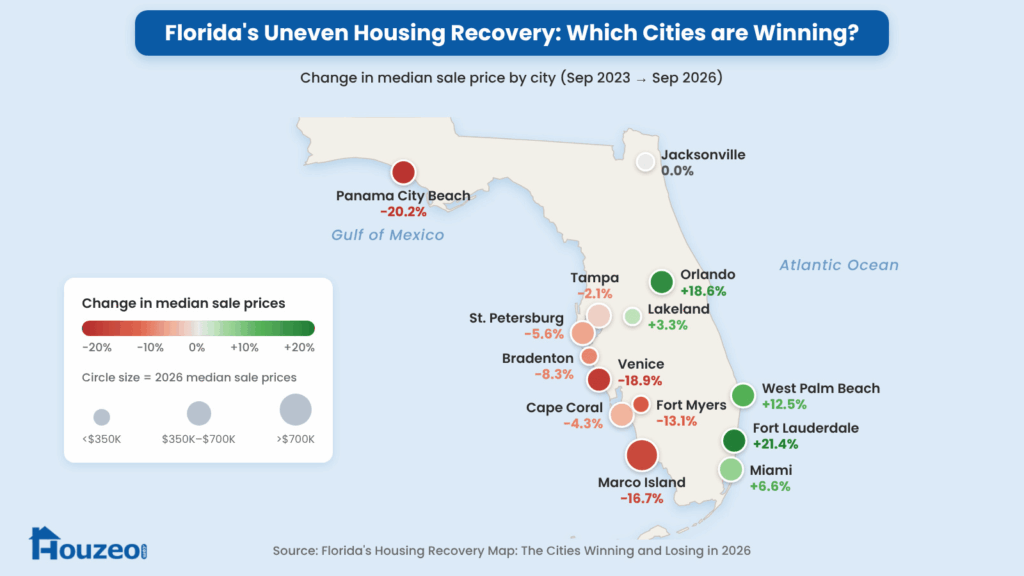
The image and table show only 14 of the 68 cities analyzed. Download the Florida Housing Market Research Dataset (2023–2026) for every city’s median sale price, inventory, months of supply, and share of homes sold above asking.
| Florida city | Sep 2023 median price | Sep 2026 median price | 3-year change |
| Fort Lauderdale | $515,000 | $625,000 | +21.4% |
| Orlando | $350,000 | $415,000 | +18.6% |
| West Palm Beach | $400,000 | $450,000 | +12.5% |
| Miami | $610,000 | $650,000 | +6.6% |
| Lakeland | $305,000 | $315,000 | +3.3% |
| Jacksonville | $305,000 | $305,000 | 0.0% |
| Tampa | $470,000 | $460,000 | -2.1% |
| Cape Coral | $397,000 | $380,000 | -4.3% |
| St. Petersburg | $450,000 | $425,000 | -5.6% |
| Bradenton | $360,000 | $330,000 | -8.3% |
| Fort Myers | $387,750 | $337,000 | -13.1% |
| Marco Island | $1,056,250 | $860,000 | -18.6% |
| Venice | $525,000 | $425,995 | -18.9% |
| Panama City Beach | $445,000 | $355,000 | -20.2% |
Put simply, Florida doesn’t have one housing market right now. Prices are climbing in some cities, flat in others, and down sharply in a few.
It’s where they’re rising, where they’re falling, and whether those changes are improving conditions for buyers. Five patterns stood out when we broke the data down by city.
Finding 1: Fort Lauderdale, Orlando, West Palm Beach, and Miami Have Held Their Price Gains
Fort Lauderdale recorded the largest increase among these four cities, and the largest on the list, with its median increasing by $110,000 in three years.
- Fort Lauderdale: Median sale price increased 21.4%, from $515,000 to $625,000.
- Orlando: Median increased from $350,000 to $415,000, up 18.6%.
- West Palm Beach: Median rose 12.5%, from $400,000 to $450,000.
- Miami: Median increased 6.6%, from $610,000 to $650,000.
Some cities have held on to substantial median price gains, even though the prices across the broader Florida real estate market have barely moved. But these are median prices of homes sold, not changes in the values of identical properties. A greater share of expensive homes selling in one period can push the median prices higher.
Either way, buyers here are paying noticeably more than they did in 2023.
Finding 2: Jacksonville’s Home Prices Haven’t Budged, While Several Other Cities Lost Ground
Not every Florida housing market has maintained its 2023 prices.
- Jacksonville: Median remained unchanged at $305,000.
- Tampa: Median declined 2.1%, from $470,000 to $460,000.
- St. Petersburg: Median was down 5.6%, from $450,000 to $425,000.
- Cape Coral: Median price decreased 4.3%, from $397,000 to $380,000.
- Bradenton: Median price declined 8.3%, from $360,000 to $330,000.
So, if you’re buying a home in any of these cities, you could be entering a market where the median price has barely changed in three years, or one where recent transactions are occurring at noticeably lower prices.
None of this shows up in the statewide median.
Finding 3: Some Coastal Markets in Florida Have Seen Prices Fall by Nearly 20%
Coastal markets experienced significant price declines. Panama City Beach in the Panhandle fell the most, while the Southwest Florida housing market saw notable corrections in Fort Myers, Venice, and Marco Island.
- Panama City Beach: Median declined 20.2%, from $445,000 to $355,000.
- Venice: Median down by 18.9%, from $525,000 to $425,995.
- Marco Island: Median declined 18.6%, from $1,056,250 to $860,000.
- Fort Myers: Median decreased 13.1%, from $387,750 to $337,000.
Not every coastal city fell, though. Miami and Fort Lauderdale both posted gains over the same period.
One possible contributor to declining sales is the cost of ownership, including homeowners insurance, flood coverage, property taxes, and maintenance.
Condo owners also have to account for HOA fees, reserve contributions, and special assessments when calculating their monthly housing costs.
Following the 2021 Surfside collapse, Florida tightened inspection and reserve requirements for condominium buildings. [4] [5] Florida Realtors reported 7.7 months of condo-townhouse supply statewide in September 2026, compared to 4.4 months for single-family homes.
These rising costs make a coastal home less affordable. Buyers don’t want to buy homes on the coast, and sellers keep reducing prices to sell. However, this analysis doesn’t establish how much they contributed to price changes in individual cities.
Finding 4: Rising Home Prices Don’t Always Mean a More Competitive Housing Market
Some Florida cities recorded substantial home price increases since 2023 while remaining relatively buyer-friendly markets.
- Miami: Median prices increased 6.6%, but the city had 11.6 months of supply in September 2026, across all property types. Only 4.67% of homes sold above asking.
- Miami Beach: Prices rose 9.9%, despite 10.8 months of supply and just 1.97% of homes selling above list price.
- Fort Lauderdale: The median increased 21.4%, but the market had eight months of supply, and only 6.63% of homes sold above asking.
- Pompano Beach: Prices increased 9.3%, with 7.2 months of supply and 7.55% of sales occurring above list price.
Jacksonville flips the pattern. Its median price hasn’t changed since September 2023, yet it had only 3.8 months of supply, and 15.84% of homes sold above asking. Houzeo’s data also shows homes are selling 5 days faster than last year, suggesting that buyers are still competing for properties despite stable prices.
Then there’s Clermont. Its median declined 5.3% over three years, but nearly 19% of homes sold above list price in September 2026. Houzeo data shows a 12.8% annual increase in sales and a decline in months of supply from 3.9 to 3.2, suggesting that competition has strengthened even as median prices have fallen.
So, essentially, if you’re buying in Miami Beach, you may have more opportunities to negotiate than someone purchasing a home in Clermont, despite Miami Beach’s stronger historical price growth.
Price growth shows how transaction medians have changed. Months of supply, selling times, and above-list sales offer a different perspective on competition.
In other words, prices can rise while buyers still hold the upper hand.
Finding 5: Sixteen Florida Cities Are Rebounding, but Prices Remain Below 2023 Levels
In 16 of the 68 cities analyzed, median sale prices increased between September 2025 and September 2026 but remained below September 2023 levels.
- Tampa: Prices increased 5.7% over the past year but remain 2.1% below September 2023.
- St. Petersburg: Median prices rose 6.3% year over year but are still down 5.6% over three years.
- Cape Coral: Prices increased 5.6% in the past year but remain 4.3% below their 2023 level.
- Fort Myers: The median increased 3.7% year over year but is still 13.1% lower than in 2023.
- Tarpon Springs: Prices jumped 8.2% over the past year but remain 11.7% below September 2023.
- Venice: Prices increased just 0.4% year over year, following a three-year decline of 18.9%.
And the reverse is happening elsewhere.
Pembroke Pines recorded a 4.4% annual decline, despite remaining 12.7% above its September 2023 median. Lakeland’s median declined 1.3% over the past year but remains 3.3% higher than three years earlier.
If you only look at the annual figures, Tampa and St. Petersburg would appear to be recovering. But one year of gains doesn’t erase two years of losses. A rebound isn’t the same thing as a full recovery.
Buyers should note that one year of price growth doesn’t necessarily mean a city is back to its 2023 level; check price trends over the last five years. And if you’re selling your home, a year of rising prices doesn’t automatically mean your local market has recovered all its earlier losses.
What Florida’s Uneven Recovery Means if You’re Buying or Selling in 2027
Florida heads into 2027 with a split market. Some cities have maintained higher median sale prices. Others remain below their 2023 levels. And even where prices are increasing, buyers may still have room to negotiate.
If you’re planning to buy a home in Florida, look at your city’s recent sales, how many comparable properties are available, how many days homes spend on the market, and whether homes are selling close to their asking prices.
In a market with a larger inventory and longer selling times, you may have more room to compare properties and negotiate. In a market with limited supply and a higher share of above-list sales, you’ll likely face competition.
If you’re selling your Florida home, make sure your home’s asking price reflects competition in your local market, not simply Florida’s statewide median from last year. Get a CMA.
Florida may find a new balance. The question is whether your city has found its own.
Methodology
This report was researched and analyzed by Jai Chavan, Digital Marketing Manager at Houzeo, using Houzeo’s historical Florida housing-market data and publicly available industry research.
The analysis examined 92 city-level datasets covering monthly observations from January 2020 through September 2026, subject to available records. The published three-year comparison focuses on 68 cities reporting at least 100 sales in September 2026 and having the necessary historical observations.
The dataset contains median sale prices, sales counts, active listings, new listings, months of supply, reported days on market, percentages of homes sold above list price, and average sale-to-list price ratios. Separate datasets for condominiums, townhouses, and single-family residences were also available.
We compared September 2023 and September 2026 to reduce seasonal differences. Three-year percentage changes were calculated as:
Percentage change = [(September 2026 median ÷ September 2023 median) – 1] × 100
The analysis uses monthly transaction medians, not repeat-sales indices. Therefore, changes in median sale prices do not necessarily represent changes in the value of individual homes.
The 100-sale threshold reduces the influence of very small monthly samples but does not guarantee statistical representativeness or complete geographic coverage.
City-level reporting boundaries and MLS coverage may differ from external providers. The study does not establish that a particular factor caused local prices to rise or fall. City figures should be interpreted as Houzeo-reported market measures, with external research providing broader context rather than independently verifying every historical observation.
The dataset reports Houzeo’s covered-market observations. Differences in MLS coverage, geographic boundaries, and property classification may produce results that differ from other providers.
External Sources
- Florida Realtors, “Florida’s Housing Market Continues Recent Trends in September and Q3 2026,” October 2026
- Florida Realtors, “Florida Housing Market Holds Steady in September,” October 2026
- Florida Realtors, “Florida Condo Sales Rise 3.1% in Third Quarter,” October 2026
- Florida Department of Business and Professional Regulation, “Condominium Inspections and Reserve Studies”
- Florida Legislature, “Florida Statutes §718.112: Condominium Association Governance and Reserve Requirements”
About Houzeo Research
Houzeo Research analyzes housing-market data, proprietary platform insights, and publicly available industry research to examine trends in home prices, affordability, buyer behavior, and real estate transactions.
Its research combines historical market observations with industry context to help buyers, sellers, and housing-market observers understand how real estate conditions differ across the United States.
Want to cite this report?
Media inquiries: Jai Chavan (jai.chavan@houzeo.com)
How to cite this report: Houzeo Research, “Florida’s Housing Market Isn’t Recovering Everywhere. Here’s What 68 Cities Reveal,” November 2026, [URL]. Please link to this page when using the data.