


An acre is exactly 43,560 square feet, about 90% the size of an American football field. It’s a standard unit of lot size measurement in the USA. When you know how big is an acre, you can plan your land use smarter.
Moreover, the size of an acre allows you to find land that fits your needs. Our Quick Listing Tool makes land search and price comparison easy. So start your search with confidence.
How to Understand Acre Size?
Imagine 9 NBA courts combined as a visual representation of an acre. An acre of land is nearly as large as a full football field. It can fit up to 16 tennis courts or 2 to 5 average homes with yards. Use these comparisons to make square feet to acres conversion easier.
If still unsure how many yards are in an acre or how many square feet are in an acre, use this breakdown to get clear on its measurements.
| Unit | Area | Acres Equivalent |
| Feet | 43,560 sq. ft. | 1 |
| Yards | 4,840 sq. yd | 1 |
| Meters | 4,046.86 sq. m. | 1 |
| Hectares | 0.404686 hectares | 1 |
| Kilometers | 0.00404686 sq. km. | 1 |
| Miles | 0.0015625 sq. miles | 1 |
What Is a Commercial Acre?
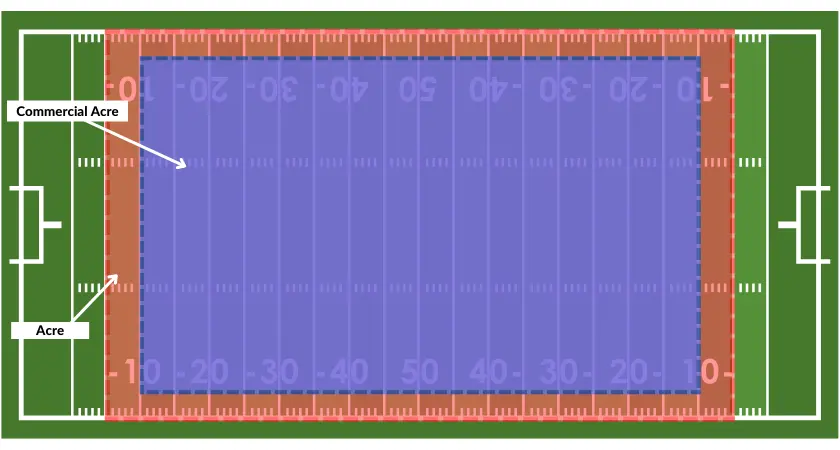
It explains how big is an acre in commercial use. It measures 36,000 square feet, smaller than a standard 43,560 square feet. A commercial acre is about 83% of a standard acre used for site and building planning.
Moreover, commercial acres exclude sidewalks, roads, and alleys, which reduces usable space. Use exact figures for how many square feet are in an acre for accurate project planning. Here’s a visual representation of a commercial acre compared to a standard one:
What Is the Average Cost of an Acre of Land Now?
In the U.S., the average cost of an acre of land is $17,500. However, it is heavily influenced by the location and land type. For instance, it’s $4,545 in Wyoming and $85,633 in Rhode Island.
Factors Affecting Land Prices
Many buyers overlook key factors that impact land prices. A clear insight about these variables can assist you to make smarter decisions:
- Infrastructure: Lands with water supply, sewage, electricity, roads, and other amenities are typically expensive.
- Terrain: Flat fertile land costs more than rocky or uneven plots.
- Location: Plots in urban regions cost more than the ones in rural areas. For instance, upstate NY costs less, has more land and fewer people than Manhattan.
- 🤔 Did You Know? Agricultural land is generally the most affordable and cost-effective entry point in US real estate averaging $3,380 per acre.
How Big Is an Acre When You Plan to Build a Home?
A typical single-family uses 1/5th of an acre or 8,700 square feet. To estimate your ideal land size, calculate your family’s space needs. Then choose land based on how you want to build a house to match your vision.
You can also use the land-to-building ratio to estimate your ideal land size. This ratio ranges between 2.5:1 and 3.5:1 and compares lot size to home size. For a 0.15 acre home, the land size should be between 0.375 and 0.5 acres. Use this formula to calculate:
Land size = Land-to-building Ratio * Home Size.
Acreage or Home Size: Which Matters More?
When you buy a home, you may face a choice—more land or a larger house. Here are the pros and cons to help you compare acreage versus home size. You should weigh in the pros and cons of choosing acreage over home size to make an informed decision.
Pros 👍
- More Outdoor Space and Expansion Potential: You get ample outdoor space for a patio, garden, pool, guesthouse, recreation, and much more.
- More Privacy: You can enjoy an increased buffer from neighborhood and street noise. Moreover, fewer neighbors offer you more seclusion for outdoor activities and relaxation.
- Lower Property Tax: Many states base property taxes on home size or square footage. So, a larger land size with a smaller home might lead to lower taxes.
Cons 👎
- Extra Upkeep: Larger plot size requires higher maintenance, such as extra efforts to mow, clean and landscape.
- Increased Expenses: Property taxes and utility costs often rise with bigger land sizes.
- Reduced Indoor Space: A bigger plot size might require you to compromise on the home size and interior upgrades.
- Limited Nearby Facilities: Homes on large plots often have limited access to local facilities and services.
How to Make Informed Land Decisions?
Smart land choices begin with precise knowledge about how big is an acre and what you can do with it. That way, you can plan your home, layout, or any other future land use.
To ensure accuracy, a land survey helps you confirm exact size, shape and the legal boundaries of your plot. This step uncovers issues early and protects your property from future disputes.


