Once San Francisco’s crown jewel, the Millennium Tower is now infamous for two terrifying words, sinking and tilting. This shift in reputation from a premier address to an engineering red flag has left the 58-story landmark at the center of a mounting structural and legal crisis.
Resting on a foundation of soft “Bay Mud” rather than solid bedrock, the building’s instability raises serious questions about long-term safety and property values.
In a city gripped by the shadow of the San Andreas and Hayward faults, this isn’t just a real estate scandal; it’s a seismic countdown. As San Francisco waits for the inevitable “Big One,” the world is watching to see if Millennium Tower will survive the impact, or become the city’s most expensive catastrophe.
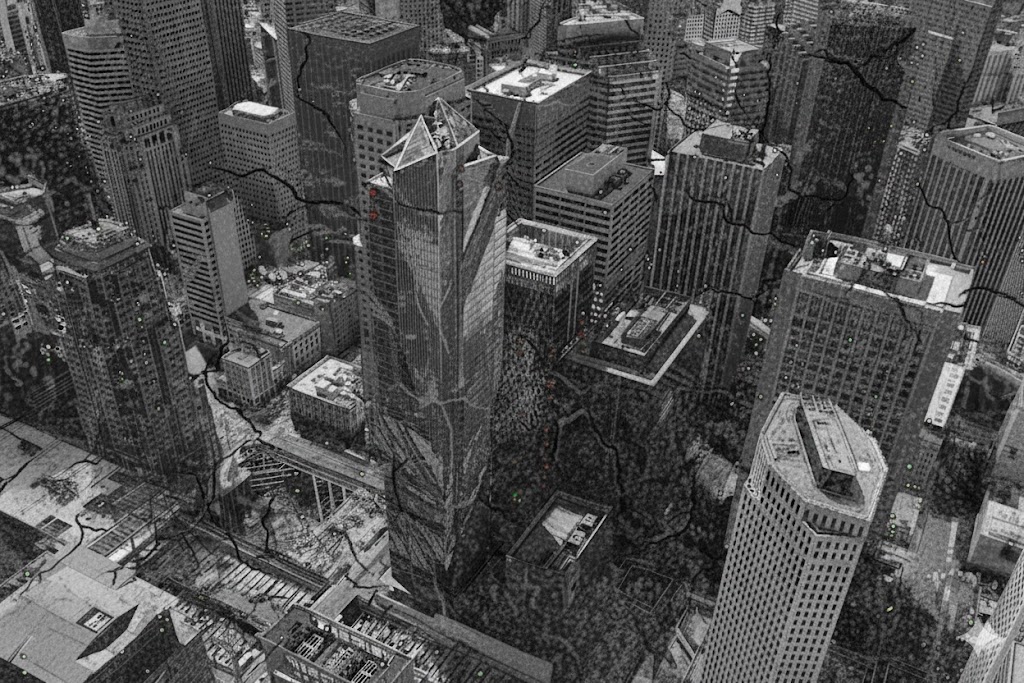
San Francisco’s Millennium Tower: Why Has It Become One of the City’s Biggest Real Estate Controversies?
Launched in 2005 at 301 Mission Street in San Francisco, Millennium Tower was designed as a symbol of luxury living. It quickly reshaped the city’s skyline, drawing eager buyers who hailed it as a dream address. However, the tower later became the center of ongoing engineering and legal concerns.
Millennium Partners, through its entity Mission Street Developer LLC, developed the tower. From the start, the building showed signs of tilting and settling. These early warning signs later became the heart of the Millennium Tower controversy. However, developers did not publicly admit the problem until 2015, when they confirmed that the structure was still sinking and leaning.
As of today, Millennium Tower is a 58-story building that has reportedly sunk more than 18 inches and continues to lean approximately 29 inches toward its northwest corner.
What Are Some of the Hidden Risks Beneath The Millennium Tower?
San Francisco’s luxury high-rises are, in many ways, sitting on a loaded gun. Millennium Tower looms over nearby buildings, quietly raising concerns about the safety of the entire neighborhood.
So what really went wrong?
Early Warning Signs Beneath the Surface
Just one year after its completion, reports revealed water intrusion and flooding deep within the tower’s foundation. The news sent alarm bells ringing across San Francisco and raised serious doubts about construction quality, safety standards, and regulatory oversight.
Key concerns included:
- Flooding and water intrusion in the foundation
- Possible construction flaws
- Missed warning signs by regulators
The Threat to Nearby Landmarks
The tower’s continued movement has raised red flags for neighboring buildings, including the Salesforce Tower and major developments along Fremont Street. Although its lean is only about one-fourth of a degree, far less than the Tower of Pisa, even a small tilt in a dense downtown area can become dangerous during earthquakes.
Major risks include:
- Impact on nearby high-rise structures
- Increased earthquake vulnerability
- Long-term stability concerns
Hidden Fire and Safety Hazards
After residents reported foul odors, inspections uncovered serious structural problems. Investigators found that parts of the curtain wall had pulled away from the building, creating gaps that could allow fire and smoke to spread quickly between floors.
Safety issues identified:
- Detached curtain wall sections
- Gaps between building components
- Faster spread of fire and smoke
Signs That the Crisis Isn’t Over
While engineers say the tower’s sinking and leaning have slowed, they have not fully stopped. Residents still report shattered windows during strong winds, showing that the structure remains under stress.
Ongoing warning signs:
- Continued movement
- Wind-related window damage
- Persistent structural pressure
Then came the blame game!
Developers pointed fingers at the nearby Transbay Transit Center, blaming its massive excavation and dewatering work. According to them, the project altered underground pressure and soil conditions, accelerating the tower’s dangerous sinking and tilt.
But was that truly the root cause, or just a convenient excuse? The response that followed would reshape the tower’s future and cost more than anyone expected: a $100 million retrofit.
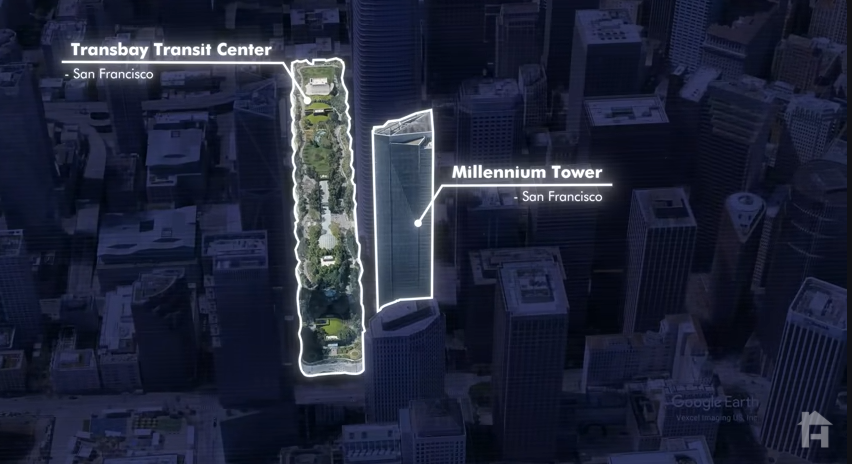
$100 Million Retrofit Launched to Fix Millennium Tower
A daring retrofit began in 2018, with 52 massive piles drilled to bedrock in a bid to save the tower’s sinking foundation. The plan was a desperate gamble to redistribute the building’s massive load directly into the bedrock. Engineers were essentially trying to build a brand-new foundation for a 645-foot skyscraper while the world watched to see if it would hold.
New problems emerged when engineers began digging, as they needed to construct underground shoring walls to extend the foundation. Adding to these concerns, tall-building foundation expert Harry Poulos¹ suggested that the tower may be leaning against an underground retaining wall. This hidden support could explain why the building continues to tilt sharply toward the west.
To contain the damage, engineers made a surprising move: they slashed the number of new foundation support piles from 52 to just 18. Why? Because the more piles they pushed into the bedrock, the more the building started to tilt.
In other words, every attempt to steady the tower appeared to nudge it further off balance.
By May 2018, the situation had clearly crossed into dangerous territory. The tower was no longer just leaning but it was tilting faster, with warning signs flashing red.
Veteran engineer Bob Pyke², told NBC that digging for the “fix” actually accelerated the disaster. Essentially, the very attempt to save the building triggered a new phase of this high-stakes engineering crisis.
A retrofit is a major structural upgrade designed to strengthen a building after problems are
discovered. In the case of Millennium Tower, it was meant to stop the sinking and tilting by
anchoring the structure deeper into stable ground. Engineers drilled massive steel piles into bedrock
and used powerful jacks to rebalance the tower.
But retrofits are risky, expensive, and complex. If done wrong, they can make problems worse
instead of fixing them. At Millennium Tower, what was supposed to be a rescue mission became
another high-stakes experiment under public scrutiny.
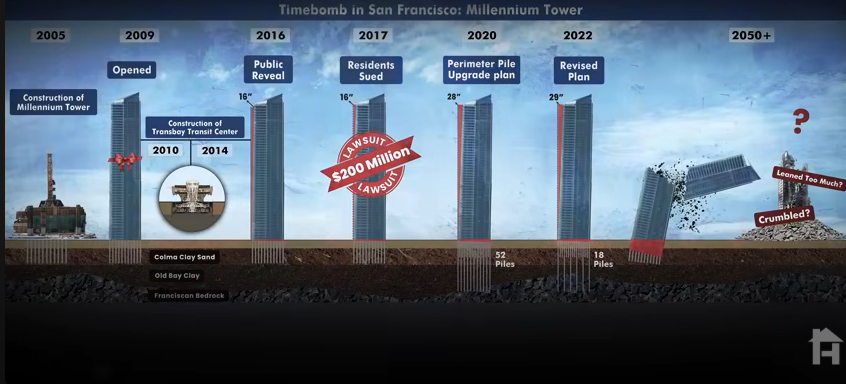
The Retrofit Revision: Steps to Secure the Tower
Every high-stakes project faces hurdles, but this “fix” actually accelerated the disaster. Vibrations from drilling through the Old Bay Clay caused the tower to sink even faster, forcing a total halt in August 2021 when sensors flagged critical shifts.
By 2023, a revised scheme finally turned the tide. Engineer Ronald O. Hamburger³ reported the operation was a success, exceeding projections and even recovering nearly an inch of tilt thr ough a precise jacking operation.
What makes this even more explosive is who was on the hook for the fix: a roughly $100 million project funded by a mix of developer cash, insurance settlements, and even money tied to public tax-supported transit funding.
That meant a portion of the bill ultimately came out of funds backed by Californian government and federal tax dollars. Making everyday taxpayers an unexpected investor in Millennium Tower’s chaotic repair saga.
A Partial Repair and Earthquake Fears
But behind the comforting statistics on tilt and sinking, a far more troubling reality was emerging. Not everyone believed the fix had made the building safer. In fact, some experts warned it may have done the opposite. Structural engineer David Williams bluntly stated that “it definitely has not improved the seismic capability of the tower.”
His concern was chilling. The retrofit left the tower anchored to bedrock on only two sides, creating a dangerously uneven foundation. In a major earthquake, Williams warned, the building could begin to rock violently, slamming down on one corner while lifting off another. Instead of stabilizing the tower, critics fear the latest fix may have turned it into a high-rise balancing act, waiting for the next big shake.
What an Earthquake Could Mean for Millennium Tower’s Future?
In 2021, the lead designer behind the so-called “fix” told NBC Bay Area⁴ that “the building could lean more than six feet and still safely withstand a massive earthquake.” Sounds reassuring, right? But not everyone was convinced. Geotechnical and foundation engineer Ben Turner, hired by the homeowners, raised serious red flags.
His report revealed a shocking oversight: He noted that while seismic loading is a critical part of Millennium Tower’s design, the model used to address the structural issues focused largely on non-seismic factors. In other words, the fix prioritized settlement and tilt but did not fully account for earthquake forces.
Public concern exploded, with fear and uncertainty. Many residents and observers continued to question whether Millennium Tower could truly withstand a major earthquake. While the retrofit plan was highly detailed, it did not clearly explain how much more the building might sink into the ground or lean further during strong seismic activity.
How Millennium Tower Has Held Up During Earthquakes?
San Francisco is a city on the edge, sleeping on a high-rise grave. It has already felt some of nature’s fiercest shakes, including the destructive 1989 Loma Prieta earthquake (M6.9) and the 2014 South Napa quake (M6.0). Millennium Tower stood through a few, but those were only warm-ups compared with the “Big One” scientists say is overdue.
Despite its well-known sinking and lean, expert reviews since 2017 have suggested that after extensive analysis and retrofit work, Millennium Tower may be able to withstand a major earthquake of up to magnitude 8.0.
Scientists predict there is about a 72 percent chance that a magnitude 6.7 or greater earthquake will strike the San Francisco Bay Area before 2043, according to U.S. Geological Survey studies. This highlights the region’s ongoing seismic risk and the likelihood of a major quake in the coming decades.
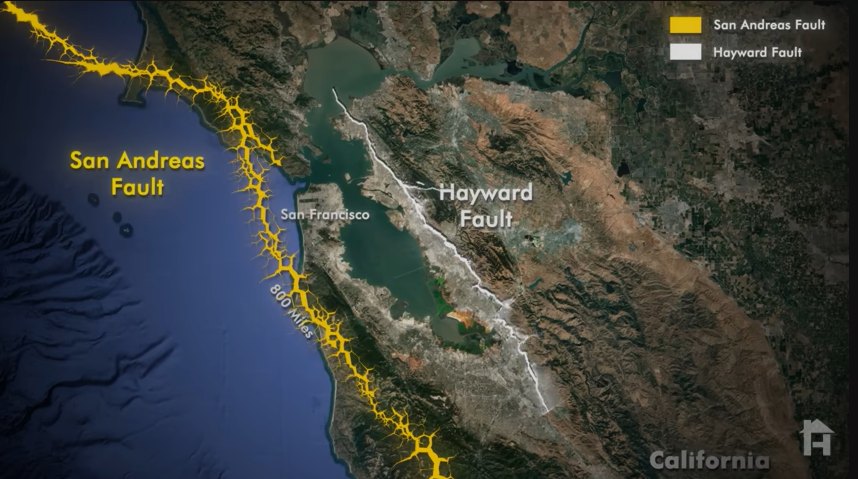
While the so-called ‘Big One,’ similar to the massive 1906 quake, could reach magnitude 8 or higher, the most likely scenarios involve magnitude 7 or stronger earthquakes on major faults such as the Hayward, Calaveras, or San Andreas.
At the same time, many engineers and seismic experts warn that these projections have limits because no model can predict every outcome, and an earthquake stronger than magnitude 8.0 could significantly increase the risk of severe structural damage or even collapse.
With the building already leaning and sinking, experts warn that this luxury high-rise could behave very differently under the violent ground motion expected from a major earthquake.
Situated in the middle of one of the nation’s most active fault systems, Millennium Tower, amid a big shake, may not just lean. It could become a ticking seismic time bomb that tests the very limits of urban engineering.
Millennium Tower Sits on the Edge of Two Shifting Plates 🌍

San Francisco has a massive earthquake problem and the Millennium Tower is right in the middle of the seismic zone. The two grinding tectonic plates that experts warn are ready to snap. The San Andreas and Hayward Faults have turned downtown San Francisco into the world’s most dangerous high-rise experiment.
Millennium Tower might not sit directly on a fault line, but that won’t matter when the ” Big One” finally hits. Every time the earth shifts, the building’s flawed foundation is pushed to the breaking point. We could be one major earthquake away from watching this billion dollar disaster become the most terrifying viral video in history.
Experts have long warned that a significant earthquake along the San Andreas Fault system is not a question of if but when. Based on decades of seismic data, scientists estimate a very high probability that a magnitude 6.7 or greater quake could strike the San Francisco Bay Area within the next few decades.
This kind of quake would bring intense shaking that could seriously damage buildings, infrastructure, and utilities throughout the region.
In a major “Big One” scenario, widespread structural failures are expected, especially among older buildings not built to the most modern standards. Critical systems like bridges, highways, water supply lines, gas lines and electrical grids could suffer extensive damage and outages that last for weeks or even months.
Aftershocks, some strong in their own right, could complicate rescue efforts and inflict additional damage on structures already weakened by the main quake.
Did Millennium Tower Affect San Francisco’s Housing Market?
For decades, San Francisco’s housing market looked unstoppable. Prices kept rising and demand stayed strong. From luxury penthouses to historic townhomes, homes for sale in San Francisco were seen as safe investments. Then came the Millennium Tower and everything changed.
The big headlines had cracked buyer confidence. Suddenly, glossy listings and skyline views were no longer enough. Trust had faded, and buyers moved away from the leaning tower.
The controversy began scrutinizing homes for sale in SoMa, paying attention to building safety and foundation reports before making a purchase.
Consulting engineer Robert Pyke⁵ an expert in Geotechnical and earthquake engineering, directly blamed the designer Treadwell & Rollo for Millennium Tower’s foundation problems. He pointed to the crushing time pressures during the 2008 market crash as a key factor, suggesting the building’s structural flaws were, in part, rushed into existence.
What’s Next for SF’s Millennium Tower?
When the Big One finally hits, Millennium Tower will face its toughest test yet. Its sunken foundation and tilted frame could turn the tower into a catastrophic spectacle. Every quake, every tremor, pushes the building closer to its breaking point.
For residents, investors, and city planners, the question isn’t if the next earthquake will come, but whether this towering gamble can withstand it?