Charlotte is at the center of the metro area and is the second-largest banking and financial hub in the nation. Over the past five years, nearly 115,000 residents moved to cities near Charlotte, accounting for 40% of the Charlotte metro’s growth.
Many homebuyers choose nearby cities like Concord for newer homes, more space, and lower living costs, despite rising home prices. Living near Charlotte means you are never far from catching a game at Bank of America Stadium or exploring Uptown’s nightlife.
Houzeo is America’s best home buying and selling platform.
For Home Sellers: List your home for a Flat Fee, and save 2.5% to 5.5% on the listing agent commission! That’s thousands of dollars extra in your pocket.
For Home Buyers: Houzeo has the most number of houses for sale in Charlotte. Start your dream home search now!
Yes! You can list your home for sale or search millions of homes on the Houzeo mobile app!
Download now on the Apple App Store or the Google Play Store.




Key Takeaways
- Concord is the best city near Charlotte, NC: It stands out for growth and convenience, strong retail expansion, motorsports attractions, and continued housing development.
- Each city caters to a different lifestyle: Areas like Huntersville and Fort Mill attract families, while places like Indian Trail and Concord appeal to young professionals.
- Gastonia is the cheapest city near Charlotte, NC: It offers a median home price of $281,950 with a commute of 45 minutes to Charlotte.
- Living near Charlotte has its trade-offs: More space, better schools, and lower property taxes are the big draws , but expect higher suburban home prices and heavy rush-hour traffic.
How We Ranked Cities Near Charlotte
To identify and compare cities near Charlotte, we built a clear and transparent methodology using reliable data sources and four key indicators of livability.
Data Sources
- Cost of Living: We analyzed everyday expenses across major categories—housing, groceries, utilities, transportation, healthcare, and miscellaneous goods—using the C2ER Cost of Living Index.
- Median Home Price: Housing market data was gathered from publicly available state and county housing reports, along with HUD datasets, to ensure accuracy and neutrality.
- Median Rent: Rental information was sourced from C2ER and regional housing studies, verified against state housing authority publications.
- Crime Rate: We used FBI Uniform Crime Reporting (UCR) statistics and North Carolina Department of Public Safety reports to evaluate safety levels across cities.
All data reflects the most recent updates available through 2026, ensuring readers receive current insights.
Scoring System
We created a balanced scoring framework to highlight the most relevant factors for residents:
- Cost of Living (30%)
- Median Home Price (30%)
- Median Rent (25%)
- Crime Rate (15%)
This scoring system helps us compare cities near Charlotte by balancing housing costs, everyday expenses, and safety. Each city’s score breakdown is available so readers can see exactly how rankings were determined.
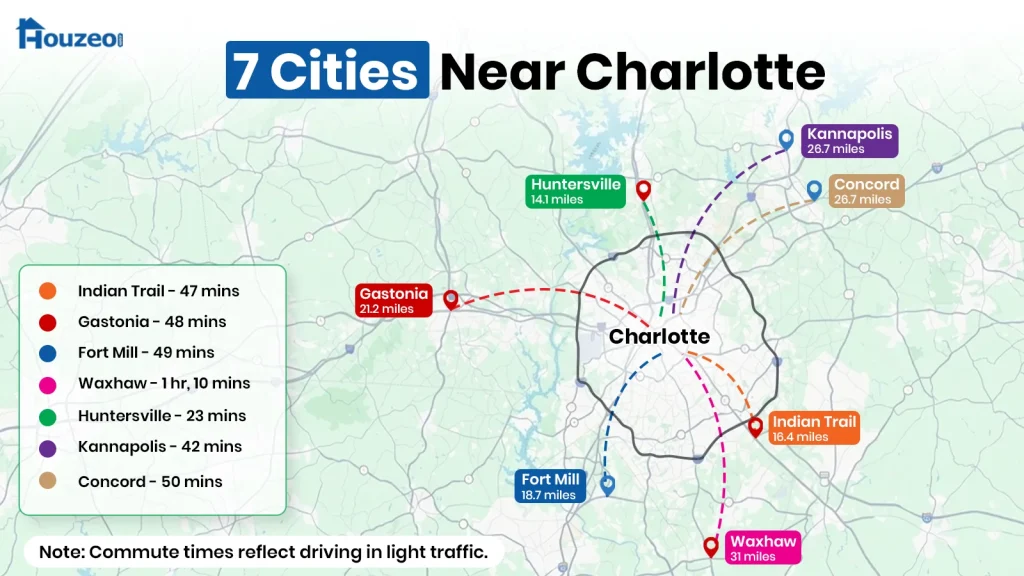
Map of the Cities Near Charlotte, NC
Here’s a quick look at where the major cities and towns around Charlotte, NC, are located. This map helps you understand commute direction and proximity.
Best Cities Close to Charlotte, NC
Some of the best cities near Charlotte, NC, combine affordability, space, and growth. While home prices may exceed Charlotte’s median, overall living costs are lower thanks to reduced taxes, fewer urban expenses, and cheaper utilities. Here are the top ones to consider.
Concord, NC

The city has established neighborhoods alongside attractions like Concord Mills and Charlotte Motor Speedway. While it’s about a 50-minute drive to Charlotte, you still have access to its jobs, dining, and entertainment. This means if you are looking for homes for sale in Concord, you are simply getting more space and value here.
- Demographic: Concord has a population of approximately 115,053 residents, with a median age of 36 years. This points to a young, working -age population. A median household income around $86,964 reflects a financially stable, upper-middle income base.
- Connectivity: Just 26.7 miles from Charlotte via I-85, Concord offers easy, direct access to employment centers, making daily commuting manageable.
- Job Market: Concord has a diverse economy with manufacturing, healthcare, and retail sectors. Major employers include Atrium Health Cabarrus and companies near Concord Mills.
- Recreation: Popular attractions include Charlotte Motor Speedway and Concord Mills mall. Frank Liske Park and Les Myers Park, along with trails such as the Hector H. Henry II Greenway, provide accessible green space for walking, biking, and everyday outdoor activity.
- Traffic Near Commercial Areas: You’ll run into heavy traffic near I-85 during rush hours, particularly around major retail zones.
- Limited Walkability: With an average walk score of 18, you’ll likely depend on a car for most daily needs, especially outside a few central areas.
- Seasonal Crowds: If you live near Charlotte Motor Speedway, be prepared for periodic spikes in traffic and noise, as major events can draw 80,000+ attendees.
Kannapolis, NC

Kannapolis blends historic character with ongoing development, but its biggest advantage is location. Sitting between Concord and Charlotte, you can comfortably access Charlotte’s jobs, dining and entertainment. With homes for sale in Kannapolis, you will find lower entry prices and the same regional access.
- Demographics: Kannapolis had a population of 62,299 residents, with a median age of 36.9 years. The median household income of $73,836 places it in a, middle-income range, which supports a comfortable but more budget-conscious lifestyle.
- Connectivity: The city is located 26.7 miles away from Charlotte and is connected through the I-85. This means you can realistically work in Charlotte or access its dining and entertainment without needing to live at Charlotte price points.
- Job Market: The economy has shifted from textiles to biotech and research, with the North Carolina Research Campus leading the way. Healthcare and retail also contribute to employment.
- Recreation: Downtown Kannapolis features a revitalized streetscape, Cannon Ballers stadium, and parks. Village Park offers family-friendly outdoor activities and seasonal events.
- Lower Median Income: Median household income is around $55K–$60K, lower than nearby suburbs like Concord or Huntersville. So you may rely more on commuting to Charlotte for higher income opportunities.
- Economic Transition: The shift from textiles to biotech is ongoing, with job growth still stabilizing. You may have a gradual career growth.
- Limited Walkability: Walk Scores are generally below 30. Daily errands, commuting, and entertainment will require you to drive rather than walk.
Gastonia, NC

Gastonia offers lower home prices while still keeping you just 48 mins away from Charlotte. The city has developed neighborhoods and redeveloped areas such as Gibson Mill. Outdoor recreation is centered around Crowders Mountain State Park, which is perfect for hikers looking for homes for sale in Gastonia.
- Demographics: Gastonia has a population of 85,528, with a median age of 36.5 years, pointing to a largely working age population. The median household income is $67,005, which is lower than Charlotte metro average.
- Connectivity: The city is located along the Interstate 85, providing a direct connection to Charlotte. It is 21.2 miles away with average commute time of 26-27 minutes. This works best for hybrid workers who are okay with longer commute.
- Job Market: Historically rooted in manufacturing and textiles, Gastonia now includes healthcare, logistics, and retail employment. Major employers include CaroMont Health and local manufacturing firms. Economic diversification has been gradual but steady.
- Recreation: Along with Crowders Mountain State Park, the downtown has newer projects like the FUSE District. There is a new stadium and mix-use corridors with breweries and housing.
- Car Dependent Commute: There are no major public transit system, so most you will have to rely on personal vehicles for daily travel.
- Ongoing Economic Transition: While sectors like healthcare generate over $1.49 billion in annual revenue locally, the city is still transitioning, with uneven redevelopment across neighborhoods.
- Older Housing Stock: The median year homes were built is around 1970, meaning many properties may require updates or higher maintenance.
Indian Trail, NC
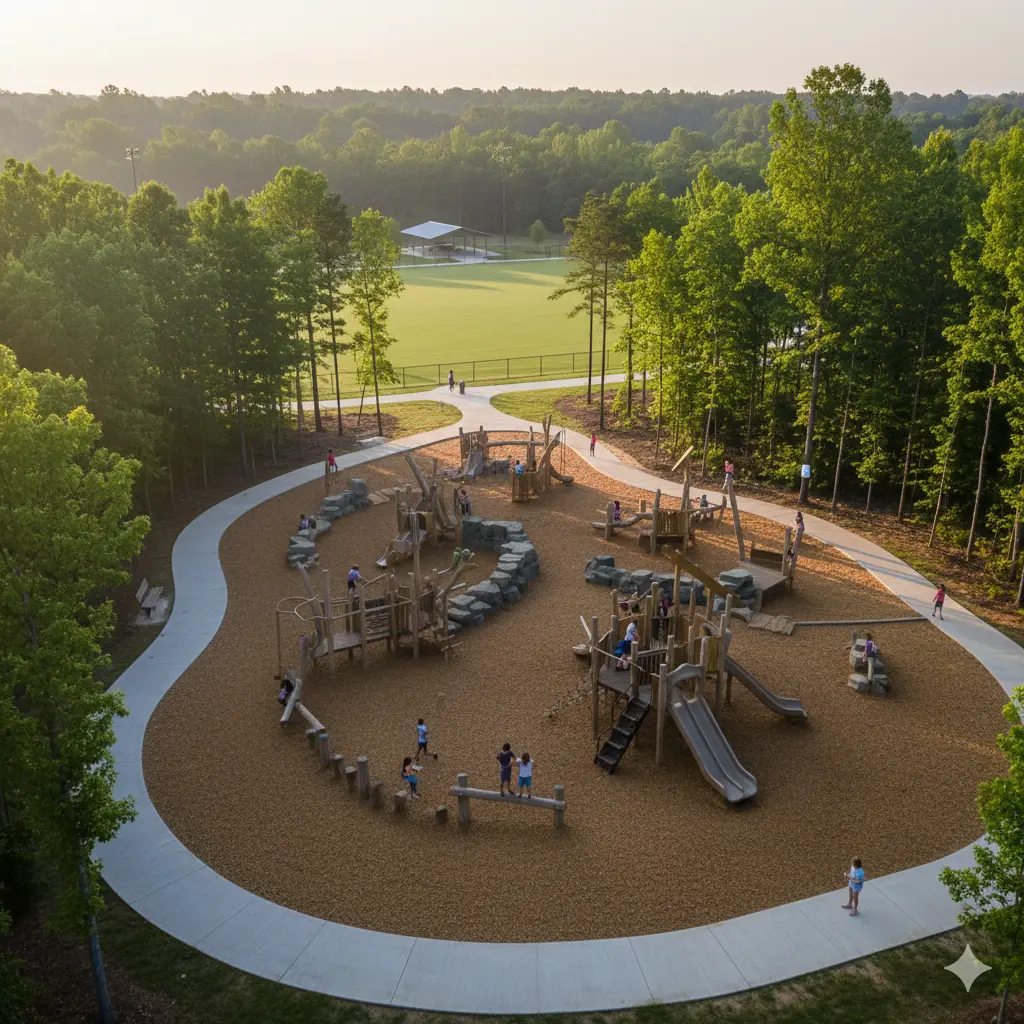
Indian Trail offers suburban calm with strong schools and family‑friendly parks like Crooked Creek Park and Chestnut Square Park. With Charlotte close by, homes for sale in Indian Trail give you space that city living can’t match.
- Demographics: Indian Trail has a population of 43,867 with a median age of about 36.2 years, giving it the feel of a mid‑sized suburban town with young families and professionals. A median household income of $108,483 points to a comfortable, upper‑middle‑class lifestyle.
- Connectivity: Located along U.S. Route 74, Indian Trail offers a direct link to Charlotte with average commute times of about 31 minutes. It’s at a perfect distance to enjoy Charlotte’s amenities and embrace the suburban calm.
- Job Market: Apart from the commuter-based employment, the local economy is driven by service and education. Jobs are concentrated in Union County Public Schools, retail hubs like Sun Valley Commons, and healthcare providers such as Novant Health.
- Recreation: Outdoor recreation is centered around Crooked Creek Park, a 76-acre park with sports fields, playgrounds, and walking trails. Additional options include Chestnut Square Park, which hosts community events and seasonal markets.
- Car Dependency: Indian Trail has a Walk Score of 3, meaning you would need a car for nearly all errands, limiting walkability.
- Traffic on US-74: Congestion is common along US-74, the town’s main corridor, so you’ll feel slowdowns during peak hours.
- Limited Transit Options: Public transportation is minimal, with most residents relying on personal vehicles for commuting.
Fort Mill, SC

Fort Mill gives you the best of both worlds: lower taxes and affordable living, while staying plugged into Charlotte’s jobs, nightlife, and attractions. This is great if you are looking for homes for sale in Fort Mill. Its location near the state border provides cost advantages while still remaining connected.
- Demographics: It has a population of 30,775 residents, with a median age of about 38.4 years. The median household income is around $121,823, which is 1.5 times the amount in South Carolina. You’re stepping into an affluent and comfortable community, surrounded by working age professionals and families.
- Connectivity: It is well connected via I-77, supporting easy commutes to Charlotte, which is 18.7 miles away. For daily commuters, it’s a manageable drive; for hybrid workers, it’s the perfect balance.
- Job Market: Fort Mill benefits from proximity to Charlotte, with employment in finance, healthcare, and corporate sectors. Locally, major employers like LPL Financial and Red Ventures anchor the economy, meaning you don’t have to leave town to find strong career opportunities.
- Recreation: The Anne Springs Close Greenway offers 2,100 acres of trails, lakes, and outdoor activities, perfect for hiking, biking, and family outings. The town also features parks and family-oriented recreational spaces.
- I-77 Traffic Delays: If you’re commuting towards Charlotte expect peak-hour traffic to delay your travel time by 20–30 minutes or more.
- Rapid Population Growth: Ongoing development has increased pressure on infrastructure and local roads.
- Competitive Housing Market: High demand and limited inventory mean you’ll face stiff competition when buying a home. Prices keep climbing, so acting quickly and decisively is key.
Waxhaw, NC

Waxhaw offers a small-town setting amid rapid growth, with its population increasing by over 12% since 2020. Its historic downtown, centered around the preserved rail district and Main Street is charming. Homes for sale in Waxhaw are appealing if you are looking for character, momentum, and tradition.
- Demographics: Waxhaw’s 22,275 residents give it a small‑town vibe, but with a median age of 36.2 you’ll be surrounded by young professionals and families. With median household income averaging $131,894, this is an affluent community.
- Connectivity: At 31 miles from Charlotte, Waxhaw keeps you close enough to the city for work, dining, and entertainment. The drive via NC‑16 and I‑485 takes 25–45 minutes, which works well for hybrid workers.
- Job Market: Employment is largely commuter-driven, with many residents working in Charlotte’s finance and healthcare sectors. Locally, small businesses and retail clusters in Downtown Waxhaw provide jobs.
- Recreation: It centers around Downtown Waxhaw, a preserved rail district with a walkable Main Street, seasonal events, and local shops. Outdoor options include Cane Creek Park, a 1,000+ acre park with trails, camping, and a lake, and Mineral Springs Greenway.
- Long Commute Times: If you’re driving into Charlotte, be ready for 30–60+ minutes on the road. That’s the time you’ll need to factor into your mornings and evenings.
- High Car Dependency: With limited public transit, you’ll rely almost entirely on your car for work, errands, and daily life.
- Rising Home Prices: Strong demand has pushed values higher, so affordability is tightening. If you’re looking to buy, you’ll need to act quickly.
Huntersville, NC

Huntersville offers suburban living with access to outdoor recreation at the Lake Norman. While slightly pricier than some nearby areas, it remains more affordable than Charlotte and stays closely connected. Homes for sale in Huntersville offer waterfront living with easy access to Charlotte’s jobs and entertainment.
- Demographics: Huntersville has a population of around 67,000, with a median household income of approximately $120,000. This points to an upper-middle, family-oriented suburb with a strong earning base. You’ll find well-maintained neighborhoods with higher-quality amenities.
- Connectivity: The town is located along Interstate 77, providing direct connectivity to Charlotte, with average commute times of about 27 minutes. This works well if you are a hybrid worker or are okay with daily commute.
- Job Market: Employment in Huntersville is supported by healthcare providers like Novant Health and Atrium Health, as well as the Bank of America and Wells Fargo. Locally, it is supported by motorsports employers like Joe Gibbs Racing.
- Recreation: Lake Norman is the main highlight, offering boating and waterfront activities. Parks like Jetton Park and Birkdale Village add shopping, dining, and outdoor leisure options.
- I-77 Congestion: I-77 is one of the busiest commuter corridors, with frequent delays during peak hours due to high traffic volumes.
- Higher Cost of Living: Median household income exceeds $110K, reflecting higher home prices and overall cost compared to nearby suburbs.
- Rapid Growth Pressure: Fast population growth has increased demand for roads, schools, and housing supply that you depend on.
Out of all the cheapest places to live in North Carolina, Thomasville (affordability score of 7.2) is the closest to Charlotte. It sits 70 miles northeast of Charlotte, about an hour by car. The cost of living is lower than Charlotte’s, which means lower expenses while staying within commuting distance.
Key Facts: Thomasville vs. Charlotte
- Median Home Price: $230,000
- Median Home Rent: $1,084
- Cost of Living Index: 6% ⬇️ than Charlotte
Local Highlights
- Historic Downtown: Visit the Big Duncan Phyfe Chair, browse antiques at P & G Antiques, or explore local art at the Sebastian Stephen Gallery.
- Recreation: Enjoy fishing and trails at Lake Thom-A-Lex Park, catch a HiToms baseball game at Finch Field, or relax at Optimist Park.
- Community Events: Don’t miss Everybody’s Day Festival (the oldest street festival in NC), the Thomasville Farmers Market, and the annual Holiday Parade & Tree Lighting downtown.
Some of the best places to visit near Charlotte include:
- Lake Norman: Popular for boating, waterfront dining, and weekend trips.
- U.S. National Whitewater Center: Known for rafting, ziplining, and trails.
- Charlotte Motor Speedway: Hosts the Coca-Cola 600, one of NASCAR’s longest and most demanding races in Concord.
- Crowders Mountain State Park: Famous for steep hikes and rocky peaks kike the King’s Pinnacle.
- Carowinds: Major amusement park with festivals and seasonal events.
These spots are all within a short drive, making them ideal for quick day trips.
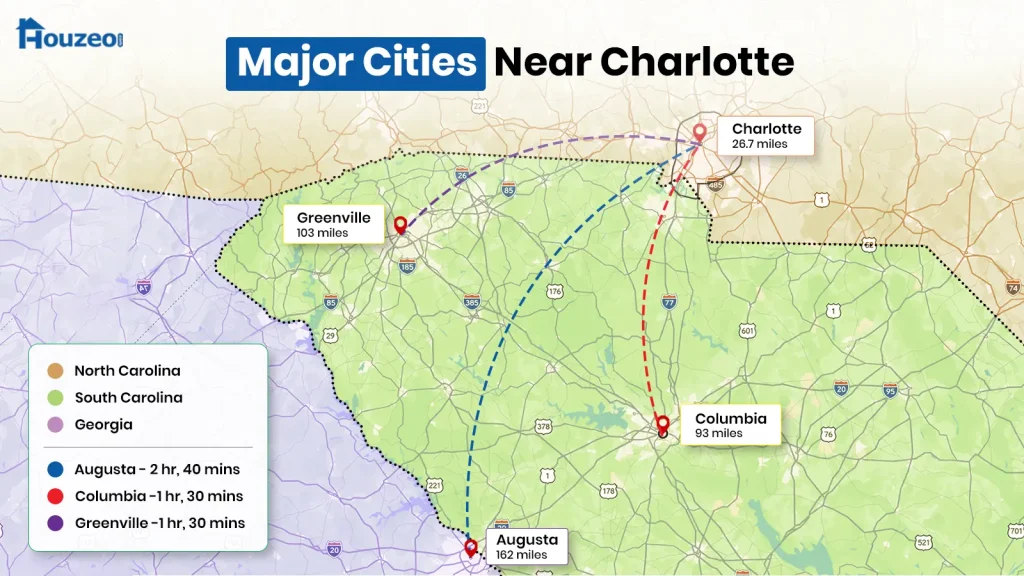
Major Cities Near Charlotte in Neighboring States
While most people focus on nearby suburbs, the Charlotte region also connects to several larger metro areas within driving distance. Let’s understand Charlotte’s regional reach and metro-to-metro comparison.
| Greenville, SC | Columbia, SC | Augusta, GA | |
|---|---|---|---|
| Distance From Charlotte | 103 miles/2 hours | 93 miles/1.5 hours | 162 miles/2.5 hours |
| Population | 72,935 | 146,655 | 201,6000 |
| Median Home Price | $480,000 | $262,000 | $222,000 |
| Median Household Income | $71,472 | $56,916 | $55,485 |
| Best For | Young professionals and outdoor enthusiasts | First-time home buyers | Military families and healthcare workers |
1. Greenville, SC
The plenty of homes for sale in Greenville reflect a city that balances affordability with opportunity. The city’s economy thrives with major employers in automotive, tech, and healthcare. You stay close to Charlotte for regional access while enjoying Greenville’s lower costs.
You will love strolling Main Street with its restaurants, shops, and galleries. Falls Park on the Reedy offers scenic trails and the Liberty Bridge. The Peace Center hosts concerts and shows, while festivals and art walks keep the city lively.
2. Columbia, SC
If you want tradition mixed with youthful energy, Columbia fits perfectly. As South Carolina’s capital, it blends government influence with steady growth and long‑term stability. So, if you’ve been frustrated with Charlotte’s prices, take a look at homes for sale in Columbia; it might surprise you.
The University of South Carolina fuels nightlife in Five Points, while Riverbanks Zoo and the Columbia Museum of Art provide family-friendly attractions. Festivals and college sports keep the calendar full all year.
3. Augusta, GA
Augusta is famous worldwide for the Masters Tournament and Fort Gordon’s presence. It combines military stability with steady growth, creating a city full of opportunity. Plus, if you search for homes for sale in Augusta and compare them to what the budget will get you in Charlotte, the difference is striking.
You can enjoy the Riverwalk along the Savannah River, the Phinizy Swamp Nature Park, and a growing downtown food scene. Art walks and live music add to the sense of a community on the rise.
Why Consider Cities Near Charlotte, NC?
Rather than leaving the Charlotte metro, many homebuyers are relocating to cities around Charlotte, NC, for more space, lower costs, and long-term value.
1. Better Housing
Rising demand is pushing up home prices in Charlotte, with prices increasing by around 40–45% over the past five years. Instead of settling for a smaller home in Charlotte, you can get a larger, newer home in towns near Charlotte.
2. More Space and Quieter Lifestyle
Many cities close to Charlotte, NC, have lower property taxes than those living within city limits. With rates around 1% in Charlotte compared to about 0.7% to 0.8% nearby, you can save $1,000 to $2,000 per year. This matters especially for first-time homebuyers and families upgrading to larger homes.
Charlotte’s cost of living is 1% below the national average, but many nearby cities are even more affordable, typically 4-10% lower than Charlotte. This gap can make a noticeable difference in your monthly expenses.
3. Lower Taxes and Cost of Living
Moving to cities around Charlotte is not just a financial shift, but a lifestyle one. Suburbs like Huntersville give you direct access to outdoor spots like Lake Norman for boating and waterfront properties. And importantly, you don’t lose access to Charlotte. You are still within commuting distance of major job hubs.

Pro-Tip When exploring suburbs near Charlotte, knowing how to buy a house in North Carolina can help you spot the best value and avoid surprises.
Pros and Cons of Living Near Charlotte
Living in cities around Charlotte offers more space, strong schools, and access to a growing job market. But it also comes with trade-offs like higher home prices and longer commutes. Here’s a quick look at what to expect.
| Factor | Pros | Cons |
|---|---|---|
| Housing | More space, newer homes, and planned communities. | Higher prices in popular suburbs like Fort Mill and Huntersville. |
| Cost of Living | Lower property taxes in many nearby areas, especially in South Carolina. | Higher home prices may offset some savings. |
| Commute | 20–40 minute access to Charlotte job centers via I-77, I-85, and I-485. | Heavy traffic during peak commute hours. |
| Lifestyle | Quiet suburbs, strong schools, and family-friendly neighborhoods. | Fewer nightlife and urban entertainment options. |
| Growth | Strong access to Charlotte’s expanding job and retail markets. | Rapid growth driving congestion and construction. |
Which City Near Charlotte, NC Is Right for You?
Concord is often ranked the best city near Charlotte thanks to its affordability and growth. It’s especially popular with young professionals and first‑time home buyers. If staying close matters more to you, Huntersville is the better fit, with about a 23-minute drive to Charlotte.
If you’re moving to North Carolina, these surrounding cities offer a range of options, from quiet suburbs with top-rated schools to more affordable areas with easy access to Charlotte’s job market.
Compare each city based on what matters most: home prices, schools, and commute, to find the right fit.