When people search for the hottest states in the US, they usually expect a simple list, but heat isn’t just about peak temperatures. It’s about how often high temperatures occur and how long they persist throughout the year.
States like Florida average 72.9°F annually, consistently ranking among the warmest in the country based on long-term temperature data. That ranking is driven less by extreme spikes and more by sustained warmth across most months of the year.
This guide breaks down the hottest states in the US along with humidity, city-level extremes, and year-round climate patterns, so you can understand not just where it’s hottest, but where it’s still practical to live.
Houzeo is America’s best home buying and selling platform.
For Home Sellers: List your home for a Flat Fee, and save 2.5% to 5.5% on the listing agent commission! That’s thousands of dollars extra in your pocket.
For Home Buyers: Houzeo has the largest number of homes for sale in the US. Start your dream home search now!
Yes! You can list your home for sale or search millions of homes on the Houzeo mobile app!
Download now on the Apple App Store or the Google Play Store.



How We Ranked the Hottest States in the US
The simplest answer is average annual temperature. It is a figure derived from long-term NOAA climate station data aggregated across thousands of weather stations nationwide.
This approach is more useful for relocation decisions than summer temperature alone. A state like Oklahoma ranks near the top in summer heat but drops out of the top 10 once winter cools it down.
One limitation worth flagging: statewide averages cover a lot of ground. Texas alone spans desert, subtropical, and semi-arid climates.
🔥Top 10 Hottest States in the US
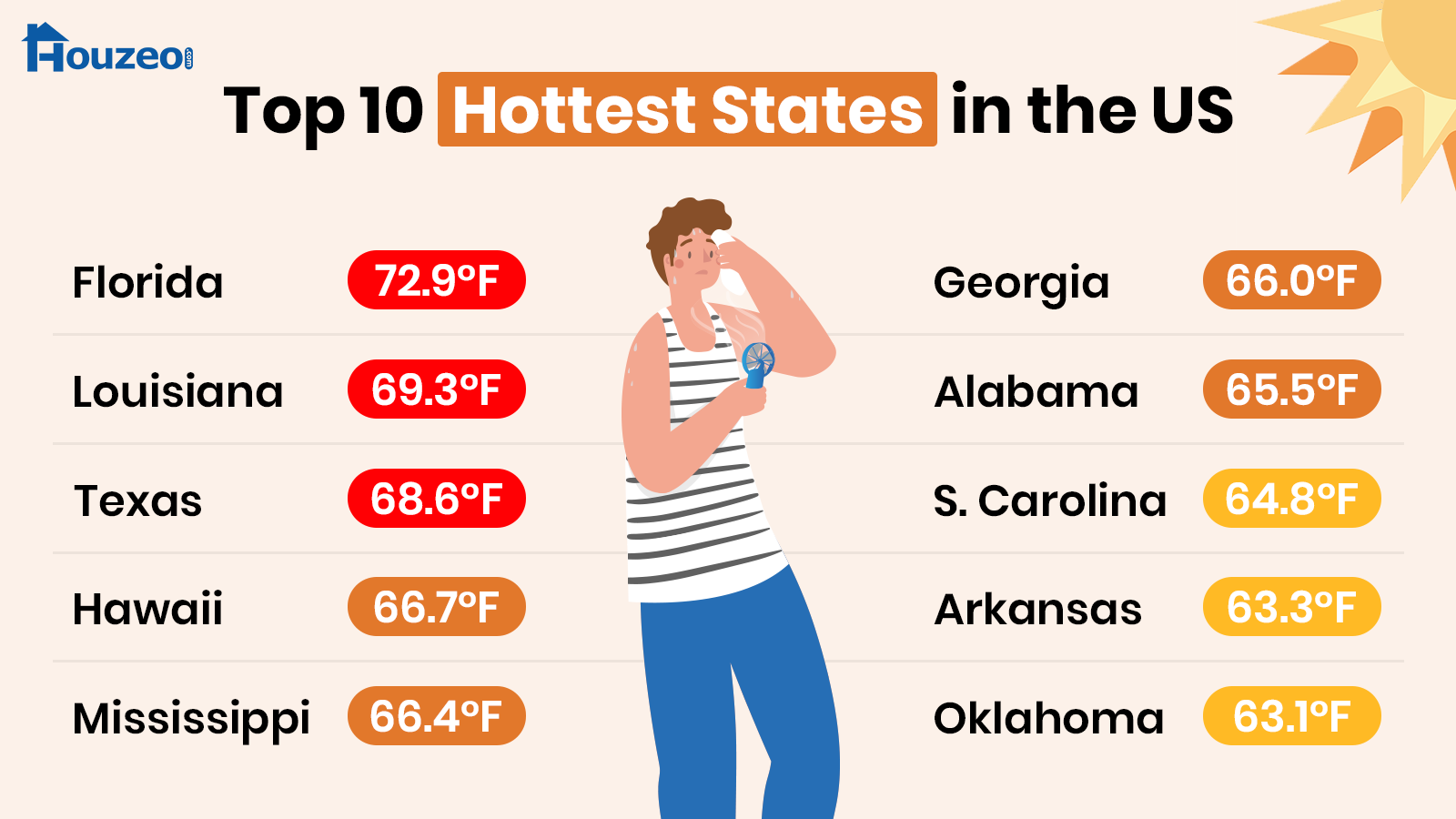
The rankings below reflect long-term NOAA climate station data, using 2024 as the most recent complete-year dataset available. All ten states in this top 10 hottest states in America list average above 62°F annually.
1. Florida
Florida has the highest average annual temperature among US states in published climate datasets, at 72.9°F. No other adjacent state comes close. The reason isn’t extreme peaks; Florida’s record high is only 109°F, which ranks 40th among all states.
July averages between 90°F and 92°F statewide, with the heat index pushing well above that in southern and coastal areas. Southern Florida: Miami, Naples, Key West, stays warm year-round.
2. Louisiana
Louisiana averages 69.3°F annually, with long, humid summers and mild winters. August highs range from 89°F to 94°F, and the state sees about 90 days above 90°F each year. During extreme heat events, humidity can push the heat index past 120°F.
Humidity keeps temperatures elevated after dark, different from dry-heat states where temperatures drop 30 to 40 degrees between afternoon and midnight. New Orleans is the hottest city in Louisiana, averaging 72.7°F annually in 2024.
3. Texas
Texas averaged 68.6°F in 2024, but that statewide figure masks strong regional variation. It also recorded the highest average summer temperature in the country at 81.3°F. This was driven by flat terrain across the Gulf Coast and Chihuahuan Desert that allows heat to build with little topographic resistance.
That depends entirely on where you are. Eastern Texas: Houston, Beaumont, is humid subtropical, where heat index values regularly exceed 100°F.
4. Hawaii
Summer peaks average around 77°F in coastal areas. February, the coldest month, still averages 72°F in those same zones. The average annual temperature in Hawaii is around 66.7°F.
Ocean trade winds keep conditions from feeling oppressive even during warm months. Humidity exists but behaves differently than on the Gulf Coast. There’s consistent airflow, and temperatures don’t stay elevated overnight the way they do in Louisiana or Mississippi.
5. Mississippi
Mississippi averages 66.5°F annually, placing it among the top 5 hottest states in America. Summers are hot and humid, arriving early and lasting well into fall. The state is situated firmly in the humid subtropical zone, where the combination of heat and moisture defines daily life from May through October.
Jackson was the hottest city in the state in 2024, averaging 68.3°F. This was more than 3 degrees warmer than Jackson’s 1964 average, a striking marker of long-term warming.
6. Georgia
Georgia records an average annual temperature of 66.0°F. The southern region runs hotter, with summer temperatures reaching 90°F to 100°F. The Blue Ridge foothills in the north stay noticeably cooler and pull the statewide average down compared to pure Gulf states.
Atlanta is at a higher elevation than most southeastern cities, which moderates its temperatures relative to coastal Savannah or Brunswick. Georgia gets genuine seasonal change; real winters exist in the north. This separates the Peace State from Florida and Louisiana on this list.
7. Alabama
On average, Alabama’s mercury rises to 65.5°F annually. The Gulf of Mexico drives the climate: hot, humid summers, mild winters, and consistent moisture throughout the warm season. Mobile in the south stays warmest and most humid year-round.
Summer heat builds gradually from June into August, often accompanied by afternoon thunderstorms that add moisture without offering much cooling relief. The absence of a strong cool season is what keeps Alabama’s annual average so elevated.
8. South Carolina
The average recorded temperature in 2024 for South Carolina was 64.8°F. The Lowcountry: Charleston, Hilton Head, Myrtle Beach, is the warmest and most humid, driven by Atlantic coastal conditions.
The Upstate near the Appalachians runs cooler, especially in winter. Overnight temperatures along the coast don’t drop much from late June through September.
9. Arkansas
Each year, Arkansas experiences an average temperature of 63.3°F. Gulf of Mexico air masses push warm, humid air northward through most of the year. The state sees all four seasons; winters are real, with ice storms common at least once a year, but summers are long and hot.
Flat plains in the east allow weather systems to roll through without much obstruction, which can intensify both heat waves and severe weather.
10. Oklahoma
Oklahoma averages 63.1°F annually and is the most seasonally variable state on this list. It wouldn’t appear in the top 10 hottest states in the US at all if ranked by any season other than summer. Winters are genuinely cool. The western Panhandle gets cold. However, summers in Oklahoma City and Tulsa are intense.
🌆 Hottest Cities in the US
State averages smooth over a lot. Cities run hotter than surrounding regions because of urban density, concrete, and limited greenery. These are the cities that stand out most for extreme summer peaks, relentless heat indexes, or both.
| City | Avg. Annual Temp | Why It Feels Hot |
|---|---|---|
| Miami, FL | ~78°F | Overnight temps rarely fall below 80°F in summer; persistent humidity keeps heat index elevated May–Oct |
| Phoenix, AZ | 75.6°F | Similar to desert peaks in Phoenix, the annual average is lowered by cooler winter temperatures |
| Houston, TX | 71.1°F | Around 100–110 days above 100°F annually; the annual average lowered by mild winters despite extreme summer heat |
| New Orleans, LA | ~72°F | Gulf humidity drives heat index far above thermometer readings; heat advisories common Jun–Sep |
| Las Vegas, NV | 70.1°F | Similar to desert peaks in Phoenix, the annual average is lowered by cooler winter temperatures |
💧Most Humid States in America
Temperature tells you how hot it gets. Humidity determines how that heat actually feels. When the air is highly humid, sweat doesn’t evaporate efficiently, which limits the body’s ability to cool itself. That’s why 92°F in New Orleans can feel worse than 105°F in Scottsdale.
The most humid states in America are located along the Gulf Coast and across the Southeast, where warm ocean air keeps moisture elevated well beyond summer months.
1. Florida
The Sunshine State consistently records some of the highest dew point and relative humidity levels in the US. This is driven by its low latitude, warm surrounding waters, and subtropical to tropical climate.
That persistent moisture prevents meaningful overnight and winter cooling, which is a key reason Florida has the highest average annual temperature among US states in published climate datasets.

Fun Fact Florida receives more lightning strikes than any other US state. The same heat and humidity that keep it warm year-round trigger thousands of storms daily. This phenomenon has earned Florida the nickname “Lightning Capital of the World.”
2. Louisiana
The Pelican State’s Gulf of Mexico exposure keeps humidity consistently elevated across a long warm season. Humid air masses settle low across the state’s flat geography and stay.
During extreme heat events, the heat index has been recorded exceeding 120°F, conditions that make Louisiana summers among the most physically demanding in the country.
Fun Fact Louisiana sees more days with a heat index above 100°F than almost any other state. It’s not the hottest on a thermometer. Gulf humidity just makes it feel that way for far longer than most states.
3. Mississippi
The Magnolia State follows the same Gulf-driven pattern. High humidity through a long warm season makes the state feel hotter than raw temperatures suggest. Minimal elevation means humid air doesn’t get displaced by geography the way it does in states with significant mountain ranges.
Fun Fact The Gulf of Mexico pushes warm, moist air northward straight through Mississippi for most of the year. That’s why the state feels so consistently humid, even far from the coast.
4. Alabama
The Yellowhammer State’s humidity is most intense in its southern and coastal regions, particularly around Mobile Bay. Central Alabama also sees consistently high summer humidity, with moist Gulf air influencing much of the state.
The Appalachian foothills in the north offer drier conditions, but they cover a small portion of the state’s overall geography.
Fun Fact Alabama gets drenched. The state receives more rainfall than almost any other in the Southeast, all fed by the same Gulf moisture system that makes its summers so relentlessly hot and humid.
🌅 What States Are Warm All Year Round?
Being on the hottest-states list doesn’t mean a state stays warm across every month. Oklahoma gets cold winters. Arkansas sees ice storms. Sustained year-round warmth is a separate question from peak summer heat. So which states will keep your electricity bill high year-round?
1. Florida is the clearest answer. Southern Florida places like Miami and Naples rarely drop below 65°F even in January. It’s the only US state where warm weather is the rule across all 12 months, not just most of them.
2. Hawaii is the most climatically stable US state. It has never recorded a temperature below freezing, and coastal areas stay within a narrow warm range year-round. Trade winds prevent both desert-level heat and mainland-style winter drops.
3. South Texas, which includes McAllen, Brownsville, and Laredo, stays genuinely warm all year with mild winters and consistently high temperatures. North and central Texas see real winter cold, so the state can’t be generalized as warm statewide.
4. Louisiana and coastal Mississippi stay warm-dominant through most of the year, but January in Shreveport can dip into the 40s°F. Warm most of the time, not constantly warm.
☀️ What State Has the Best Weather Year-Round?
Best weather is more subjective than hottest; it depends on what you’re trying to avoid. However, some states hold up well across multiple climate measures: temperature range, humidity, seasonal balance, and outdoor livability.
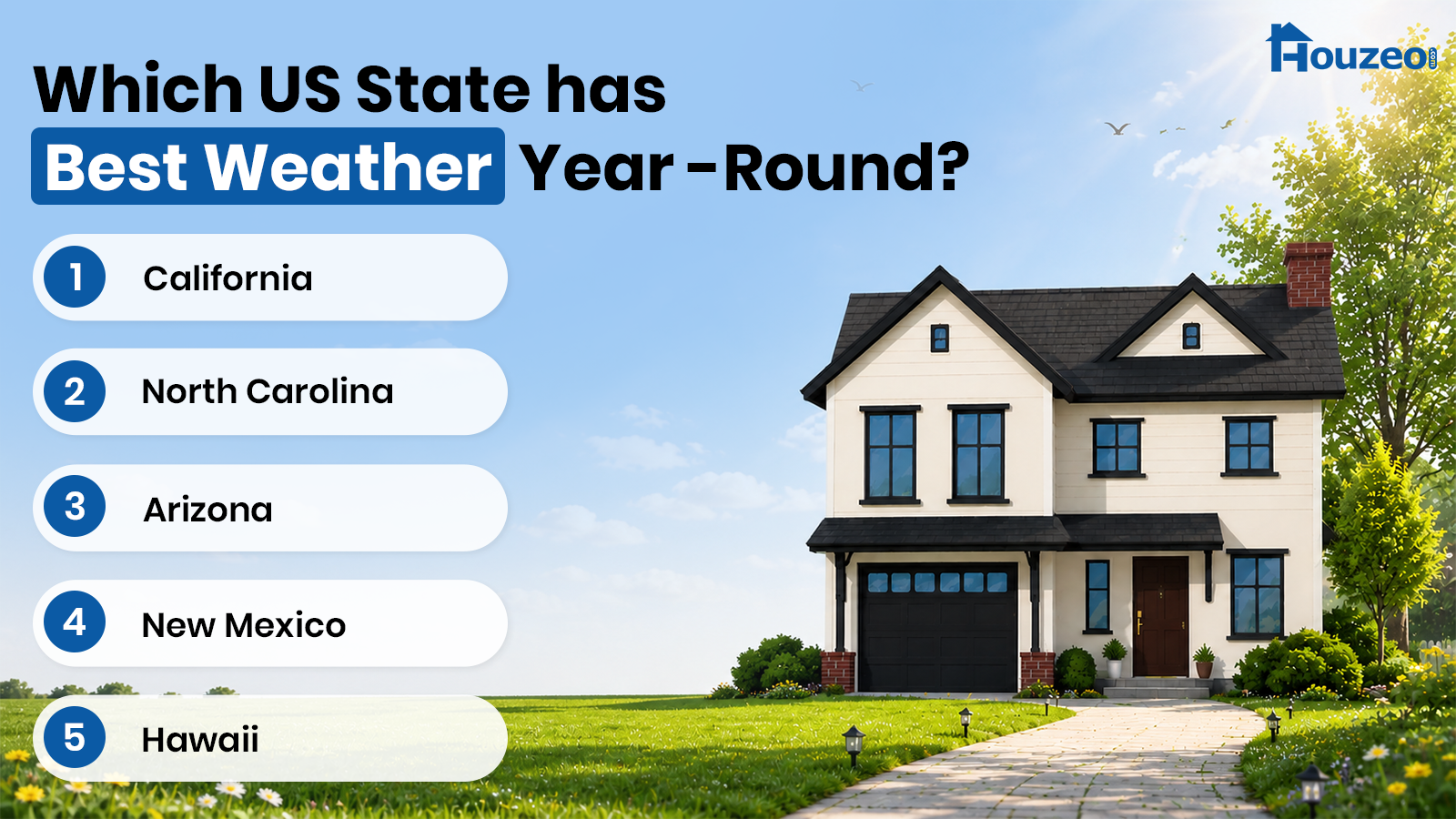
1. California
Cities like San Diego and Santa Barbara are often cited for having among the most balanced climates in the country. The Pacific Ocean stabilizes temperatures: summers stay warm without extreme heat, winters are mild without being cold, and humidity stays low.
Low humidity means sweat evaporates efficiently, which makes the same temperature feel more comfortable than in Gulf states.
👉You can browse homes for sale in California to compare coastal and inland markets; the price difference between them is significant.
2. North Carolina
North Carolina offers a practical middle ground for buyers who want warmth without committing to Gulf Coast humidity. Summers are warm but generally manageable across most of the state.
Winters are mild compared to most of the country. The mountains in the west run cooler; the coast runs warmer and more humid; the Piedmont sits comfortably between both. Among all the cities, Raleigh is considered one of the best places to live in the US.
👉Discover over 72,000 homes for sale in NC waiting to be your new home.
3. Arizona
Arizona’s best-weather case rests on elevation. Much of the state sits well above sea level, and at higher elevations, summers are mild, winters are sunny and dry, and humidity stays low year-round. The low desert, Phoenix, and the surrounding valley are the exception, not the rule.
Buyers who look beyond it find a state with genuinely comfortable year-round conditions, particularly in the central highlands, where temperatures stay moderate across all four seasons.
👉Explore homes for sale in Arizona to compare desert and highland markets.
4. New Mexico
New Mexico is one of the most underrated best-weather states in the country. Albuquerque enjoys 310 days of sunshine combined with a mild, dry climate, four distinct seasons, and very low humidity, with an average relative humidity of just 44 percent.
Summers at elevation are warm but not extreme. Albuquerque sits above 5,000 feet, which keeps afternoon temperatures comfortable even in July. Winters are cool and sunny rather than cold and grey.
👉Look through homes for sale in New Mexico to find out what the market looks like across the state.
5. Hawaii
The Island state is hard to beat by climate metrics alone: year-round warmth, ocean-regulated humidity, and minimal seasonal extremes. A great place to live who don’t like seasonal changes.
However, the practical barrier for most buyers is the housing cost. Furthermore, the general cost of living run is 60% higher than in mainland states.
Fun Fact Hawaii is the only US state that never records freezing temperatures at sea level, and never gets above 100°F either. It sits in a climate window that almost no other place on Earth maintains year-round.
Finding Your Climate Fit
Heat means something different in every state on this list. Florida’s warmth is persistent and humid. Arizona’s is dry and elevation-dependent. Mississippi builds slowly and never really lets go.
The right fit depends on what trade-offs you’re willing to make, and cost is often the biggest one. Some of the warmest states are also among the most affordable. If budget matters as much as climate, our guide to the cheapest places to live in the US is a good next step.
» Houzeo Reviews: Read what customers have to say about Houzeo, America’s best home buying website.