If you’re buying your first home, you’ve probably asked, “What is a townhouse?” Many buyers compare townhouses with condos and single-family homes because they offer a middle ground. This is especially true in competitive markets where detached homes may feel out of reach.
But before deciding if a townhouse is right for you, it’s important to understand how townhouse ownership works. You should also consider the costs involved and how it compares to other types of homes.
Houzeo is America’s best home buying and selling platform.
For Home Sellers: List your home for a Flat Fee, and save 2.5% to 5.5% on the listing agent commission! That’s thousands of dollars extra in your pocket.
For Home Buyers: Houzeo has the most number of houses for sale in US. Start your dream home search now!
Yes! You can list your home for sale or search millions of homes on the Houzeo mobile app!
Download now on the Apple App Store or the Google Play Store.




Key Takeaways
- A townhouse is a multi-floor home that typically shares walls but offers private ownership and entrance.
- It often sits between a condo and a single-family home in terms of cost, space, and responsibility.
- Most townhouses include HOA fees that may cover shared amenities and some maintenance.
- Townhouses are generally more affordable than detached homes but come with less privacy and some restrictions.
- They can be a strong option for first-time buyers or those wanting more space without full home upkeep.
- Whether a townhouse is right for you depends on your budget, lifestyle, and long-term ownership goals.
What Is a Townhouse?
A townhouse is a multi-floor home that shares one or two walls with neighboring properties but has its own private entrance. Unlike condos, townhouse owners typically own both the interior and exterior of the property, along with the land beneath it.
Many communities offer HOA-maintained amenities like landscaped common areas, guest parking, playgrounds, and recreational facilities. A townhouse can offer more space and privacy than a condo while remaining more affordable than a detached home.
Yes, townhouses are usually individually owned properties. Unlike apartments, which are typically rented, townhouse owners generally hold full ownership of the structure and the land it sits on.
However, some responsibilities, such as exterior maintenance or shared amenities, may be managed by a homeowners’ association (HOA).
A townhouse is generally defined by three key features: shared walls with neighboring homes, individual ownership of the dwelling, and a private entrance. Most townhouses are part of a row-style development and may be governed by an HOA.
Townhouse vs. Other Types
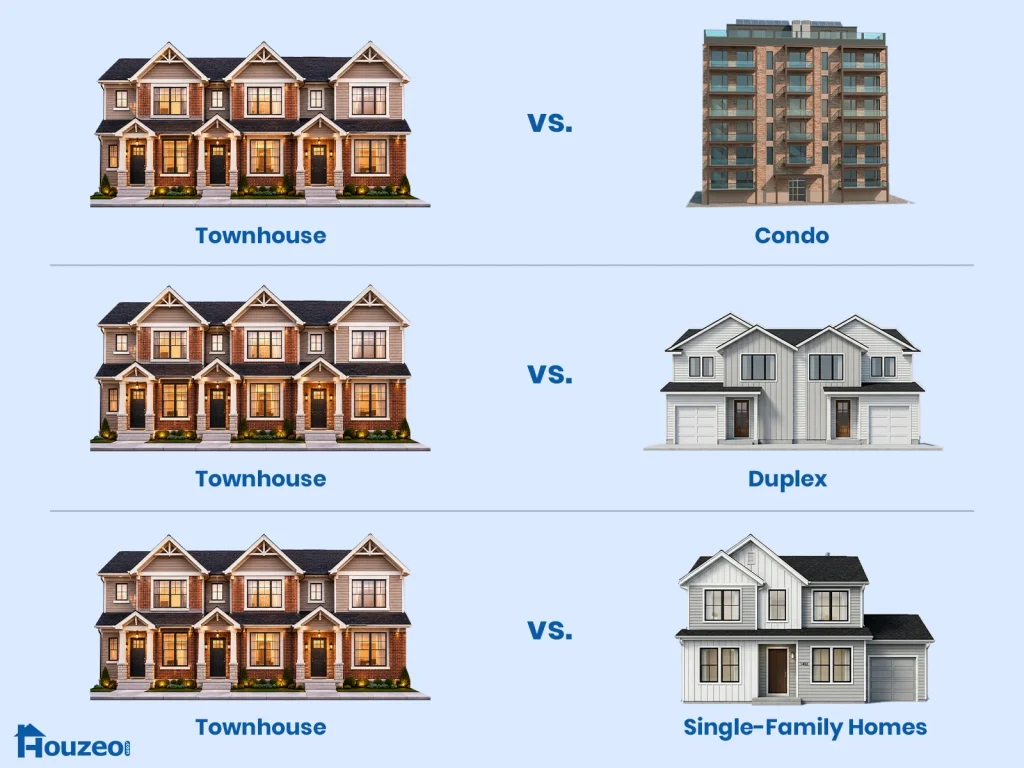
Understanding how townhouses compare to other housing types can help you figure out what fits your budget, lifestyle, and long-term goals. Let’s see how they stack up against condos, duplexes, and single-family homes.
Townhouse vs. Condo
The biggest difference between a townhouse and a condo is ownership and responsibility.
With a condo, you typically own only the interior space, while the building structure and common areas are managed by an HOA. This means less maintenance for you, but also less control over the property.
By contrast, a townhouse usually offers greater ownership. That also means you’re more responsible for maintenance compared to a condo.
In simple terms, a condo means less responsibility and less ownership control, while a townhouse means more ownership and more responsibility.
Townhouse vs. Duplex
A duplex is a single building divided into two separate living units, either side-by-side or stacked vertically. It’s often owned entirely by one person or entity, who may live in one unit and rent out the other.
A townhouse, on the other hand, is one unit in a row of similar homes, each owned separately. You share one or two walls with neighbors, but you don’t typically share ownership of the entire structure.
Another key difference is flexibility: duplex owners often have more control over rental decisions, while townhouse communities may have HOA rules that restrict renting.
In a nutshell, a duplex is a 2-unit property, often with single ownership, while a townhouse is an individual ownership within a row of homes.
Townhouse vs. Single-Family Home
Single-family homes are completely detached properties, meaning no shared walls and full control over the land and structure. This gives homeowners maximum privacy, space, and freedom, but also the highest cost and full responsibility for maintenance.
Simply put, the difference between a townhouse and a house is that single-family homes offer full privacy but full responsibility and a higher cost. At the same time, a townhouse is a shared structure with moderate responsibility and a lower cost.
How Much Does a Townhouse Cost?
Townhouse prices can vary widely depending on location, size, age, amenities, and local housing demand. In many markets, townhouses are more affordable than single-family homes, making them popular with first-time buyers seeking more space at a lower cost.
However, the purchase price is only part of the total cost. Buyers should also factor in ongoing expenses such as HOA fees, property taxes, insurance, utilities, and maintenance costs.
Building a townhouse typically costs $150–$300+ per square foot for construction, with total project costs often landing in the hundreds of thousands of dollars per unit once land, permits, site work, and design fees are included. Costs can be much higher in expensive urban markets and lower in some smaller cities and rural areas..
What Affects the Cost of a Townhouse?
Several factors can influence how much you’ll pay for a townhouse:
- Location: Townhouses in major cities or high-demand suburbs usually cost more than those in smaller towns or less competitive markets.
- Size and layout: Larger homes with extra bedrooms, garages, or outdoor space generally come with higher prices.
- Community amenities: Properties with pools, gyms, clubhouses, gated access, or maintained landscaping may have higher HOA fees.
- Age and condition: Newer or recently renovated townhouses often cost more upfront but may require fewer repairs initially.
- Local market conditions: Housing inventory, interest rates, and buyer demand can all affect the final pricing.

Pro Tip! When buying a townhouse, even small changes in mortgage rates can significantly impact your monthly payment. Use a mortgage calculator to estimate your costs and plan your budget.
Average Ongoing Costs to Expect
In addition to your mortgage payment, you, as a townhouse owner, may have to pay ongoing costs. Such as:
- HOA fees: Monthly or annual fees for maintaining shared community areas and amenities.
- Property taxes: Local taxes based on your home’s assessed value and location.
- Homeowners insurance: Coverage that helps protect your townhouse and belongings from damage or loss.
- Utilities: Regular expenses such as electricity, water, gas, internet, and trash services.
- Exterior or interior maintenance: Repair and upkeep costs not covered by the HOA agreement.
Some townhouse communities include services like landscaping, snow removal, or exterior repairs in HOA fees, while others leave more responsibilities to the homeowner. That’s why it’s important to compare communities carefully and choose one that fits your budget best.
HOAs usually maintain shared spaces like roads, sidewalks, landscaping, and community amenities such as parks or pools. In some cases, they also cover exterior maintenance like roofing or painting. Exact responsibilities depend on the HOA agreement.
Pros and Cons of Buying a Townhouse
Like any type of property, townhouses come with both advantages and compromises. Some buyers prefer them for their practical layout and manageable upkeep, while others may find HOA restrictions or shared walls limiting over time.
The right choice often depends on your budget, lifestyle, maintenance preferences, and how much privacy or flexibility you want from a home. Let’s take a closer look at the pros and cons to consider before buying a townhouse:
| Pros of Buying a Townhouse | Cons of Buying a Townhouse |
|---|
| More affordable than many single-family homes: Townhouses are often priced lower than detached homes in the same area. This makes them attractive to first-time buyers. | Resale value may vary by location: Appreciation depends heavily on local demand, HOA reputation, and nearby housing competition. |
| More space than most condos: Many townhouses offer multiple floors, extra bedrooms, garages, or small outdoor areas. | Less freedom to customize: Exterior changes may require HOA approval depending on community guidelines. |
| Lower maintenance than detached homes: Some communities handle landscaping, exterior upkeep, or snow removal through the HOA. | HOA fees and rules: Many townhouse communities require monthly HOA payments and may have restrictions on renovations, parking, or rentals. |
| Good middle-ground option: Townhouses balance affordability, ownership, and space between condos and detached homes. | Shared walls with neighbors: Less privacy compared to a detached home, and noise can sometimes travel between units. |
Who Should Buy a Townhouse?
A townhouse can work well for some buyers and feel restrictive for others. The key is understanding how its mix of shared-community living, ownership responsibilities, and pricing aligns with your lifestyle and long-term plans.
If you want a balance between affordability and space, a townhouse may offer a practical path into homeownership. But if you prioritize maximum privacy or complete property control, another housing type may be a better fit.
When a Townhouse Makes Sense
A townhouse may be a good fit for you if you:
- Want more space without the price of a detached home: Townhouses often provide multiple bedrooms, garages, or extra living space at a lower cost than many single-family homes.
- Prefer some maintenance support: Many townhouse communities handle services like landscaping or exterior upkeep through the HOA, reducing day-to-day responsibilities.
- Are a first-time homebuyer: Townhouses can offer a more affordable entry point into homeownership while still providing a traditional residential feel.
- Want to live in urban or suburban areas: Townhouses are commonly built in locations where land is limited and detached homes are more expensive.
- Value community amenities: Some developments include shared spaces like parks, pools, walking paths, or clubhouses.
Pro Tip! Once you know your budget and HOA rules, start checking townhomes for sale near me to compare your options.
When a Townhouse May Not Be Ideal
A townhouse may not be the best fit for you if you:
- Want maximum privacy: Shared walls and closer spacing between homes can be a drawback for buyers who prefer more separation from neighbors.
- Dislike HOA rules or fees: Some communities have strict guidelines around parking, exterior design, pets, or rentals, along with recurring HOA costs.
- Need a large yard or outdoor space: Townhouses typically have smaller lots compared to detached homes.
- Prefer full control over the property: Renovations or exterior changes may require HOA approval, depending on the community.
- Need extensive parking or storage: Some townhouse developments may have limited guest parking, driveway space, or storage areas.
Is a Townhouse Right for You?
Choosing a townhouse depends on your priorities. It offers a balance of affordability, space, and lower maintenance than single-family homes, though shared walls, HOA rules, and limited outdoor space may not suit every lifestyle.
If you want more independence than a condo without the upkeep of a detached home, a townhouse can be a good fit. Before buying a house, review maintenance responsibilities, community rules, and resale potential to find what best fits your budget and lifestyle.