Ready to buy land?
Federal land‑value data from the U.S. Department of Agriculture shows farm real estate at an average of $4,350 per acre. Non-farm and developed land typically ranges from $10,000 to over $100,000 per acre, based on location, zone, and market conditions.
Whether you plan to build a home, start a farm, or invest, buying land requires careful planning. Understanding the land buying process can save money and prevent delays.


Houzeo is America’s best home buying and selling platform.
For Home Sellers: List your home for a Flat Fee, and save 2.5% to 5.5% on the listing agent commission! That’s thousands of dollars extra in your pocket.
For Home Buyers: Houzeo has the most number of houses for sale in US. Start your dream home search now!
Yes! You can list your home for sale or search millions of homes on the Houzeo mobile app!
Download now on the Apple App Store or the Google Play Store.
Key Takeaways
- Get Pre‑Approved for Land Financing: Raw land often requires larger down payments and higher interest rates. A pre-approval helps you stand out and stay within the budget.
- Save with Local Programs: Some states offer grants or low‑rate financing for farm, conservation, or rural land projects if you qualify.
- Review Due Diligence Carefully: Always verify the title, zoning, utilities, access, and survey details before buying.
- Think Ahead on Development: Confirm road access, infrastructure, soil, and future zoning so you don’t buy a parcel that’s hard or expensive to build on.
- Protect Your Investment: Get proper coverage and look into agricultural, conservation, or homestead exemptions that can cut your annual land‑holding costs.
What to Know Before Buying Land
Land purchases carry a different risk profile than home purchases. Before you search listings or talk to a lender, get clear on what type of land you need and the development costs associated with the type of land you want.
1. Types of Land You Can Buy
Land does not come in one category. The type of land you purchase determines everything that follows, from financing options to the legal uses and its development potential.
- Residential Land: It is zoned for residential use, such as homes or subdivisions. It is often near existing utility infrastructure and is the easiest type to finance. Buyers who plan to build a primary residence usually start here.
- Agricultural Land: It is designated for farming, ranching, or timber operations. It sometimes carries water rights, irrigation infrastructure, or special grazing easements. Specialty lenders and USDA programs serve this segment specifically.
- Commercial Land: It is zoned for business use, such as retail, offices, industrial, or mixed-use development. It carries a higher price per acre and more regulations than residential parcels.
- Raw or Unimproved Land: It has no utilities, no paved roads, and no developed infrastructure. Per-acre prices are often lower, but loans are harder to secure, and development costs can exceed the land’s value.
2. Zoning Laws and Restrictions
Zoning determines what activities are legally permitted on a parcel. In real estate terms, a “parcel” of land refers to a specific piece of property that is legally defined by boundaries, acreage, and zoning. Each land type has its own rules on structures, setbacks, height limits, and permitted uses.
Before any offer, check the parcel’s zoning designation through the county assessor’s or planning department’s website. Also, you need to confirm:
- Whether your intended use is permitted as-of-right or only through a conditional use permit or variance.
- Whether deed restrictions or HOA rules impose limits beyond the zoning code.
- Whether any conservation easements permanently restrict development.
Zoning variances are possible but slow, expensive, and far from guaranteed. Call the county planning department and request a pre-application call to gauge the feasibility.
3. Utilities and Access
A parcel without water, power, or road access is not worthless, but the cost to establish those connections changes the financial picture entirely. Key things to confirm before you make an offer:
- Legal Road Access: Check for legal road access before buying land. A landlocked parcel has no guaranteed access to a public road, making it difficult to develop, finance, or resell.
- Water Source: Check municipal water availability, whether a well permit is obtainable, and if the parcel has documented water rights.
- Sewer or Septic: Determine whether the lot can support a septic system based on soil type and minimum lot size requirements. In many areas, a septic system can cost $5,000–$20,000 or more, depending on the land conditions.
- Power and Internet: Get a written estimate from the local utility company on the cost and timeline to extend service.
Check HOA restrictions, minimum build-size rules, timelines for utility connections, and future development plans around the property before you purchase land to build a house.

Pro Tip A vacant parcel generates no rental income but still accrues property taxes, loan interest, and insurance from the date of purchase. Buyers who hold land for years before developing it pay those costs the entire time.
How Do I Buy Land: A Step‑by‑Step Guide
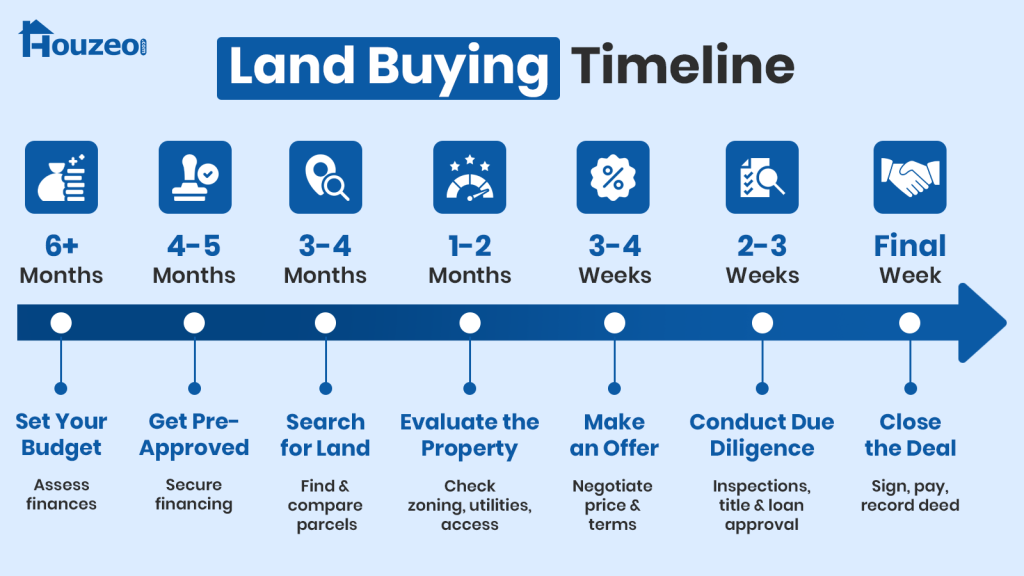
Buying land follows a structured process that starts with planning and ends with legal registration. Unlike an existing home purchase, a land purchase requires you to verify the title, zoning, soil, utilities, and access before you commit.
Once you understand the overall flow, each phase of the land buying procedure can be broken down into clear, manageable steps.
1. Set Your Budget
Land financing is more restrictive than a home mortgage, and the total cost of a purchase runs well beyond the listing price. Know your numbers before you make an offer to be in a stronger position at every step.
Understand Your Financial Position
Financing land is typically more expensive and restrictive than a home. Most lenders consider raw or vacant land a higher-risk investment.
Buyers often face down payment requirements of 20% to 50%, interest rates that are 1 to 3 percentage points higher than conventional mortgage rates, and shorter loan terms, generally 10 to 20 years.
Before you browse the listings, know your total available liquid capital, your monthly debt obligations, and your credit score. A good credit score (usually above 680) will expand your lender options significantly for land-specific financing.
Loan Options for Land
Several land loan options are available depending on the land category and your financial situation.
| Loan Type | Best For | Typical Down Payment |
|---|---|---|
| Raw Land Loan | Undeveloped parcels, no utilities | 30% to 50% |
| Improved Land Loan | Parcels with road access and hookups | 20% to 30% |
| USDA FSA Loan | Agricultural buyers meeting program criteria | Varies by program |
| Seller Financing | Rural parcels, flexible qualification | Negotiable |
| Home Equity / HELOC | Buyers with existing property equity | Varies |
One option to understand before you commit to a traditional loan is a land contract. Under this, the seller retains legal title until the buyer completes all payments. This makes qualification easier, but ownership does not transfer until the final payment is made.
Where to buy land for cheap? Some states, such as Texas, California, Iowa, and Nebraska, offer grants or low-rate loans for rural land projects that support farm and agricultural land buyers.
Costs to Consider
Purchase price is only part of the total spend. Budget for the following before you close:
- Land Survey: $500 to $2,500, depending on acreage and terrain.
- Title Insurance: Roughly 0.5% to 1% of the purchase price. Who pays closing costs varies by state, so check your local conventions before assuming the seller covers this.
- Appraisal Fee: Typically $300 to $600 for residential parcels, potentially more for large rural tracts. Land appraisals are less standardized than home appraisals, so costs can vary significantly by location.
- Soil and Environmental Testing: $1,000 to $5,000 for percolation tests, Phase I environmental assessments, or soil borings.
- Utility Connection Fees: Highly variable; get written estimates from local providers before you finalize a purchase price.
- Permit Fees: County-level fees for grading, clearing, or construction permits vary widely by jurisdiction.
- Property Taxes: Begin accruing from the date of purchase, regardless of development status. They vary widely by state and county. For example, rural land in Texas averages around $1.67 per $100 of assessed value.
- Closing Costs: Typically 2% to 5% of the purchase price, which covers title, records, and lender fees.
2. Find Land for Sale
Land listings are more fragmented than home listings. Fewer parcels appear on the MLS, agent specialization matters more, and some of the best deals never get listed at all. You should know where and how to search.
How to Find Land to Buy
Houzeo aggregates land listings and gives buyers access to MLS-listed parcels with full transparency on pricing, seller history, and comparable sales. It’s a popular search too; land made up 8.8% of property-type selections, according to the 2026 Home Buyer Report.
County tax assessor and GIS portals let you identify parcels by owner, acreage, and tax status, useful to find owners who may be motivated to sell even if not publicly listed.
Work With Real Estate Agents or Platforms
Not every real estate agent is equipped to handle land transactions. Land purchases involve issues of mineral rights, easements, water rights, and soil testing, which most residential agents rarely encounter.
Look for agents who specifically advertise land or farm and ranch experience. They should hold the Accredited Land Consultant (ALC) designation from the Realtors Land Institute. Also, they must have a track record of closed land deals in your target area.
Find Land Near Me
| Region | Land For Sale Near Me |
|---|---|
| West | Arizona | California | Montana | Washington State |
| South | Alabama | Arkansas | Florida | Georgia | Kentucky | Louisiana | North Carolina | Oklahoma | South Carolina | Tennessee | Texas |
| Northeast | New York | Pennsylvania |
| Midwest | Indiana | Kansas | Michigan | Minnesota | Missouri | North Carolina | Ohio | Wisconsin |
3. Evaluate the Land
A parcel that looks right on a map can have zoning issues, utility gaps, or environmental problems that make it unbuildable. Thorough evaluation before an offer is what separates informed buyers from expensive mistakes.
Zoning and Land Use Restrictions
Don’t rely solely on the listing description. Ask these questions specifically before you make the purchase:
- What is the current zoning designation?
- What uses are permitted by right vs. conditional use permit?
- Are there overlay districts (flood, historic, conservation) that apply?
- What is the minimum lot size for your intended use?
Also, review any deed restrictions and CC&Rs, which run with the land regardless of future ownership.
CC&Rs (Covenants, Conditions, and Restrictions) are rules that control how you can use a property. They may limit home size, building style, fencing, livestock, RV parking, or commercial use. Always review CC&Rs before buying land to make sure your plans for the property are allowed.
Utilities and Infrastructure Availability
Call each utility provider that serves the area directly, not the listing agent. Get written estimates of connection costs and timelines.
If the parcel will rely on a well, a hydrogeological report on groundwater availability is a worthwhile pre-offer investment in drought-prone markets.
Location, Access, and Road Connectivity
Verify that legal access is documented in the chain of title before any offer. A gravel road that crosses a neighbor’s land without a recorded easement can be closed anytime. Also consider proximity to emergency services, as it affects insurance rates and permit eligibility.
Quick Tip Prioritize land with access to emergency services, major highways, schools, and local amenities. These factors can reduce development costs, improve resale value, and increase long-term buyer appeal.
Environmental and Soil Conditions
- Phase I Environmental Site Assessment: Commission site assessment for any parcel with prior commercial or industrial use. Even agricultural land can carry contamination from pesticide storage tanks, underground fuel containers, or illegal dumpgrounds.
- Percolation Test: For residential development, a percolation test determines whether the soil can support a septic system. A failed test adds cost and changes design scope, but does not automatically kill a deal.
- Verify Flood Risk: Flood zone status is available at the FEMA Flood Map Service Center. Parcels inside a Special Flood Hazard Area face development restrictions and require flood insurance.
Future Development Potential
Before you finalize a purchase, assess the property’s future development potential and review these key indicators:
- Pending rezonings or comprehensive plan amendments in the county.
- Planned infrastructure investments: road extensions, utility expansions, broadband rollouts.
- Population growth trends using U.S. Census Bureau data.
- Comparable sales from the prior 12 to 24 months to understand price direction in that market.
4. Make an Offer
Once you have evaluated the land, the offer stage is where price, terms, and legal protections get established. If you get these right, due diligence becomes smoother.
Determine Market Value
To estimate land value independently, review recent comparable sales through county tax records or a licensed appraiser. Use price per acre as the main benchmark.
Adjust based on road access, utility availability, topography, flood risk, and zoning restrictions. Do not rely solely on national automated valuation tools, as vacant land data is often inaccurate or outdated.
Negotiate Price and Terms
Land sellers are often more flexible than home sellers, especially for rural parcels with extended time on the market. Strengthen your position with cash offers or pre-approved financing to show credibility.
Flexible closing timelines may appeal to sellers managing tax obligations, and an agreement to handle minor property maintenance during escrow can also improve negotiations.
Understanding how earnest money works matters here. Land sellers often require a larger deposit than the typical 1% to 3% on a home purchase to account for the longer due diligence period and higher deal-fall-through risk.
Include Contingencies
Hire a real estate attorney to draft or review the purchase agreement to protect your interests. Common contingencies include:
- Financing contingency to exit if your loan falls through.
- Due diligence contingency to get 30 to 60 days for inspections, surveys, and permit research.
- Zoning contingency to exit if the parcel cannot legally serve your intended use.
- Survey contingency if boundary issues, encroachments, or access problems surface.
- Environmental contingency if testing reveals contamination.
5. Conduct Due Diligence: What To Look For When Buying Land?
This is the stage where everything you couldn’t verify from a listing gets confirmed or contradicted. Due diligence on land takes longer than on a home and costs more upfront, but it is the only way to know what you actually purchase.
Pro Tip Use the USDA Web Soil Survey and Google Earth satellite imagery together to study a parcel’s topography, drainage patterns, and vegetation before the visit. These tools are free and often reveal deal-breaking conditions within minutes.
Land Survey and Boundaries
A boundary survey is essential. It establishes the exact legal boundaries of the parcel, identifies encroachments, and is typically required by lenders. An ALTA/NSPS survey is the most comprehensive type and includes easements, encroachments, and utility locations.
Title Search and Ownership Verification
A title company or real estate attorney should verify ownership and review the property’s legal history to uncover potential issues.
- Confirm the seller legally owns the land and has the right to sell it.
- Check for unpaid liens, mortgages, or judgments tied to the property.
- Review easements, rights-of-way, and deed restrictions that may limit land use.
Purchase the owner’s title insurance, which can protect you from hidden title defects discovered after closing.
Check Liens and Legal Issues
Review county and title records for unpaid property taxes, contractor liens, pending lawsuits, or state and federal tax claims that could affect ownership or delay closing. Ask for a tax and lien status report during due diligence.
6. Close the Deal
Once due diligence is complete and both parties are satisfied, the final phase covers financing, legal documents, and the transfer of ownership.
Finalize Financing
Your lender will complete underwriting and order a land appraisal before loan approval. Be prepared for a larger earnest money deposit and additional financial documentation, such as personal financial statements or proof of reserves.
Review Legal Documents
Carefully review all closing documents, such as the purchase agreement, deed, title commitment, and closing disclosure. Make sure the terms match your agreement and that there are no unexpected restrictions or costs.
- Deed Type: A general warranty deed provides the highest buyer protection. A quitclaim deed provides none.
- Title Commitment Exceptions: These can include easements or restrictions that affect how you can use the land.
- Prorations: Property taxes and prepaid assessments should be correctly prorated to the closing date.
Closing Process and Ownership Transfer
At closing, you’ll sign the deed and all financing documents, pay closing costs and the remaining down payment, and the title company will record the deed with the county. Once recorded, you’re the legal owner.
Request certified copies of the recorded deed and keep them with your estate planning documents. Update your homeowner’s or landowner’s insurance policy immediately.
Why Buying Land Is Different From Buying a House?
Buying a house follows a more standardized process. Buying land requires extra research and careful review. Before you begin, understand a few key differences.
| Feature | Buying a House | Buying Land |
|---|---|---|
| Financing | Lower interest rates and longer mortgage terms. | Higher interest rates, larger down payments, and shorter loan terms, including 10-year mortgages. |
| Property Condition | Home inspector reviews visible issues. | Buyer must order soil, perc, environmental, and survey tests. |
| Utilities | Utilities are usually already connected. | Utilities may need installation or verification. |
| Appraisal | Home appraisal is based on many recent home sales. | Often based on fewer comparable land sales. |
| Development Readiness | Move-in ready after closing. | May require zoning, permits, and site preparation. |
| Risk Level | More standardized process. | Requires deeper research and due diligence. |
Pros and Cons of Buying Land
Land purchase offers flexibility and long-term potential, but it also comes with unique costs, risks, and development challenges buyers should understand upfront.
✅Pros of Buying Land
- Long-term appreciation potential, particularly in areas with population growth or planned infrastructure.
- Land can be held, developed, leased for farming or renewable energy, or subdivided depending on zoning.
- Lower entry cost than improved real estate in many rural and suburban markets.
- Agricultural use designations in most states reduce annual property taxes substantially.
- A tangible, finite asset with no depreciation and minimal maintenance costs if held as raw land.
⚠️Cons of Buying Land
- Harder to finance than a home, with higher rates and stricter qualification requirements.
- No income stream unless leased; carrying costs run from the date of purchase.
- Rural land can take months or years to sell at full market value.
- Zoning, environmental, or utility problems can render a parcel undevelopable.
- Appraisal uncertainty makes the independent valuation of rural tracts difficult.
Should You Make a Land Purchase?
Buying land is a long‑term decision that favors prepared buyers. While a home purchase focuses largely on what’s visible, land investment demands deeper research into hidden factors such as soil quality, water access, utility options, title clarity, and local regulations.
For buyers ready to start their search, land for sale listings offer access to parcels across the country with transparent pricing, property details, and verified seller information. This makes it easier to compare options and move forward with confidence.
» Houzeo Reviews: Read what customers have to say about Houzeo, America’s best home buying website.