Ready to buy a home in the Constitution State?
With a year-round warm climate and a zero state income tax, Connecticut offers a desirable lifestyle with financial benefits. Your dream home could be a classic single-family house in Enfield or a condo in Stafford.
Whether you’re a first-time homebuyer or new to Connecticut housing market, this guide will teach you everything you need to know. We’ve broken down the entire home-buying process into 13 actionable steps.
Houzeo is America’s best home buying and selling platform.
For Home Sellers: List your home for a Flat Fee, and save 2.5% to 5.5% on the listing agent commission! That’s thousands of dollars extra in your pocket.
For Home Buyers: Houzeo has the most number of houses for sale in Connecticut. Start your dream home search now!
Yes! You can list your home for sale or search millions of homes on the Houzeo mobile app!
Download now on the Apple App Store or the Google Play Store.




Key Takeaways:
- Get Pre-Approved ASAP: In a seller’s market like Connecticut, a pre-approval letter helps you stand out.
- Save Thousands with Assistance Programs: Programs like the CHFA First-Time Homebuyer Program offer low-interest loans and down payment assistance for eligible buyers. Be sure to research statewide and local assistance programs before applying.
- Don’t Skip Connecticut-Specific Inspections: A 4-Point Inspection is often required for homeowner’s insurance. A standard home inspection and radon test are strongly recommended.
- Ask for Credits, Not Repairs: If the inspection has issues, ask the seller for credit at closing. This allows you to hire your own contractors and prevent closing delays.
- Protect Your Investment and Your Wallet: Remember to get flood insurance, as standard policies don’t cover it. Don’t forget to file for the Homestead Exemption to save up to $250,000 on your home’s taxable value.
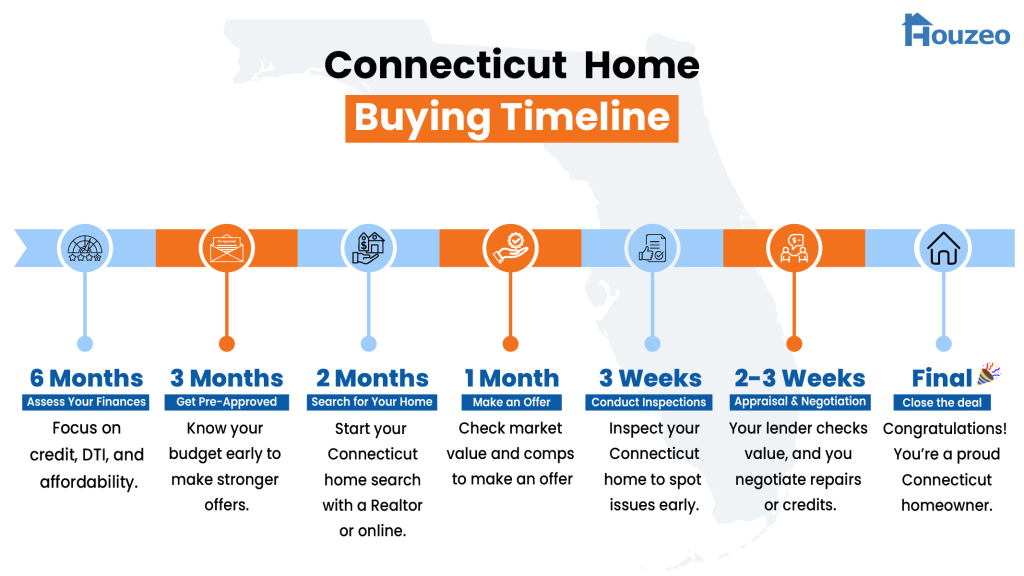
How to Buy a Home for the First Time in Connecticut: 13 Steps!
This step-by-step guide walks first-time home buyers in Connecticut through everything, from assessing finances and budgeting for a down payment to choosing the right mortgage. These 13 steps make the Connecticut real estate process clear, simple, and manageable.
Step 1: Assess Your Finances
As a first-time home buyer in Connecticut, the two factors that should matter the most to you are your credit score and Debt-to-Income (DTI) ratio. Additionally, you must also consider how much you can afford for a down payment, a monthly mortgage, taxes, and insurance.
What Is Your Credit Score?
A credit score is a three-digit number that indicates your creditworthiness to lenders. The minimum credit score to buy a house in Connecticut depends on the type of mortgage you get.
Minimum and Ideal Credit Scores by Loan Type
| Loan Type | Minimum Score | Ideal Score |
|---|---|---|
| FHA | 500 (10% down) | 580+ (3.5% down) |
| Conventional | 620 | 740+ for best rates |
| VA | No minimum(lenders typically prefer 620) | 640 |
| USDA | No minimum | 640 |
Portfolio mortgage loans are easy to qualify for. Here, the credit score needed to buy a house starts at around 580. VA loans are available only to veterans and active-duty service members, and require a score of 620. FHA loans also accept scores as low as 580. They are good for buyers with lower credit scores looking for houses in Connecticut.
When purchasing property in Connecticut, you can check your credit score using several reliable methods. Most of them are free and will not harm your score:
- Annual Credit Reports: Federal law entitles you to one free credit report every 12 months from each of the three major credit bureaus: Equifax, Experian, and TransUnion. These can be accessed through the official, government-authorized website, AnnualCreditReport.com.
- Credit Monitoring Services: Many banks, credit card issuers, and financial service apps provide complimentary and regular access to the FICO score. This is a convenient way to track your credit health over time.
Knowing how to repair your credit score is important to get better mortgage rates. If you’re a first time home buyer in Connecticut, here’s what you need to do:
- Pay down credit card balances and make all payments on time.
- Avoid opening multiple new accounts quickly.
- Consider becoming an authorized user on a family member’s account with a good history.
- Monitor your score regularly to track progress.
How to Calculate Your Monthly Mortgage Payment in Connecticut?
As a first time home buyer in Connecticut, knowing your average mortgage payment helps you plan your budget. Your total payment includes 4 key components, often called PITI:
- Principal and Interest: This is a major chunk of your payment, covering the amount you borrowed (principal) and the cost of borrowing (interest). It’s determined by your loan amount, interest rate, and loan term.
- Taxes: Connecticut property taxes are based on your home’s assessed value. The lender holds these funds in an escrow account and pays the tax on your behalf.
- Insurance: Lenders require you to have homeowners’ insurance to protect the property. The annual premium is usually divided by 12 and added to your monthly payment, also managed through the escrow account.
Apart from PITI, your monthly payment may also include Private Mortgage Insurance if your down payment is less than 20%, and HOA fees.
What Is a Debt-to-Income (DTI) Ratio?
Your debt-to-income ratio shows how much of your monthly income goes toward debt payments, including mortgage, car loans, credit cards, and student loans. To calculate it, add all monthly debts and divide the total by your gross pre-tax monthly income.
A high DTI can prevent you from qualifying for a mortgage, as it shows that you struggle to manage your debt. For the best mortgage rates and a higher likelihood of mortgage approval in Connecticut, aim for a DTI ratio of 36% or lower.
💡 You can still qualify for a loan in Connecticut despite a high DTI if you have compensating factors like a strong credit history, significant cash reserves or savings, stable long-term employment, larger down payment, etc.
Recommended DTI Ratios by Loan Type
| Loan Type | Recommended DTI Ratio | With Compensating Factors |
|---|---|---|
| Conventional | 36% back-end | 45-50% |
| FHA | 43% back-end | Up to 50% |
| VA | 41% | Can exceed 50% with the residual income test |
| USDA | 41% back-end | 44% with strong credit |
To improve your DTI ratio for a mortgage, you can either reduce your monthly debts or increase your verifiable income.
- Pay Down Debt: Use a tax refund or bonus to clear smaller loans, or consolidate multiple debts into a single loan with a lower monthly payment.
- Increase Verifiable Income: Ask for a raise, take on part-time work, or start a side business. Include all consistent income sources on your application, such as bonuses or commissions, but remember that lenders require a two-year history for secondary income.
- Adjust Your Housing Budget: A larger down payment reduces your loan amount and your monthly mortgage payment. You can also consider a lower home purchase price to keep your future housing costs down.
Step 2: Budget for Your Down Payment and Closing Costs
You should set aside money for the down payment and closing costs. Connecticut’s first time home buyer programs help make homeownership accessible and affordable.
How Much Down Payment Does a Connecticut First Time Home Buyer Need?
Typically, the down payment on a house for a first time home buyer in Connecticut usually ranges from 3% to 20% of the property’s price. However, it can vary based on the loan type. FHA loans require just 3.5% down, while some conventional loans allow a 3% down payment.
To help with these upfront costs, there are many state and local down payment assistance programs in Connecticut. They provide grants or loans to cover these expenses.
👉 First-Time Home Buyer Programs in Connecticut: Find out which is the #1 downpayment assistance program in the Constitution State.
How to Estimate Closing Costs in Connecticut?
Closing costs are fees and expenses paid at closing beyond your down payment. Typically, buyer closing costs in Connecticut usually range from 2% to 5% of the home’s price. So, for a $461,800 home, buyers might pay $9,236 to $23,090.
These fees cover lender charges, appraisals, inspections, title insurance, taxes, agent commissions, and recording fees when buying a property in Connecticut.


Step 3: Get Pre-Approved for a Mortgage
Secure your financing early by getting pre-approved for a mortgage as a first time homebuyer in Connecticut. This step helps you understand your budget and strengthens your offer when buying a home in Connecticut.
How to Get Pre-approved as a First Time Home Buyer in Connecticut?
You need to follow these steps to get pre-approved when buying a house in Connecticut:
- Gather Financial Documents: Provide proof of income (recent pay stubs and W-2s), tax returns (last two years), asset statements, debt information, and a government-issued ID. Connecticut lenders may also ask for two forms of ID and a certified cashier’s check for closing costs.
- Choose a Lender and Apply: Compare lenders in Connecticut and submit a mortgage application to get the best rates and terms.
- Receive Pre-Approval Letter: The lender verifies your info and issues a letter stating your approved loan amount, usually valid for 60–90 days.
A mortgage preapproval turns you from a casual house hunter to a serious buyer in Connecticut, as it:
- Strengthens Your Offer: 86% of the sellers prefer buyers with a pre-approved mortgage. For the strongest position, ask for a fully underwritten pre-approval, where the lender has already verified all your documents.
- Defines Your Budget: It clarifies exactly how much you can afford, allowing you to focus your home search on a realistic price range.
- Speeds Up Closing: With much of the financial vetting already completed, the mortgage process is streamlined once your offer on a home is accepted.
Yes, you can get pre-approved and even buy a home with bad credit in Connecticut. However, your loan options may be limited. You can also expect higher interest rates with poor credit.
Step 4: Choose the Right Mortgage
As a first time homebuyer in Connecticut, assess your finances and select a loan that fits your budget and qualifies you for available programs.
| Feature | Conventional | FHA | VA | USDA |
|---|---|---|---|---|
| Min Credit Score | 620 | 580 (500 w/10% down) | No minimum | 640 |
| Min Down Payment | 5% to 20% | 3.5% | 0% | 0% |
| Max DTI | 45% to 50% | 43% to 50% | 41%+ | 41% to 44% |
| Mortgage Insurance | PMI if <20% | Always | None | Always |
| Loan Limits | $766,550+ | $498,257 to $766,550 | $766,550+ | Varies |
| Property Eligibility Criteria | Few | Must meet FHA standards | Must meet VA standards | Rural/suburban areas only |
Step 5: Decide Where to Buy a Home in Connecticut
Deciding where to buy is one of the most important steps for a first time homebuyer in Connecticut. Consider factors like local housing markets, popular neighborhoods, cost of living, and amenities to help you find the best places to live in Connecticut.
Why Now Is the Time to Buy in Connecticut
The Connecticut housing market currently favours sellers, giving you fewer choices and faster-moving listings which means acting smart and fast is key:
- Housing Supply is Low: Connecticut has a 2-month housing supply, indicating a tight market.
- Prices Have Stabilized or Rising: The median home price has remained at $450,000.
- Sellers are Negotiating: 24.5% of homes in Connecticut have seen price drops, signaling slight seller flexibility.
- Homes are on the Market Longer: Properties are taking an average of 41 days to sell, which prompts you to make quicker decisions.
These trends show that now is the best time to buy a house in Connecticut. According to Mauricio Umansky, founder of The Agency, the current market provides “great opportunities for buyers to be aggressive and write strong offers.”
Popular Areas for Different Buyer Types
With the market now in your favor, you can be more selective about where you buy. Use this advantage to find a neighborhood that matches your priorities, whether it’s schools, commute, or lifestyle.
- Best Areas for Families: Towns such as West Hartford (near Hartford), Glastonbury, Simsbury, and Fairfield County suburbs (such as Darien, New Canaan) offer highly rated schools, community amenities, and family-friendly parks. Explore homes for sale in West Hartford. Typical home prices often range from $400,000 to $800,000+, depending on the town.
- Best Areas for Retirees: Coastal and shoreline towns like Mystic, Old Saybrook, and Groton offer relaxed living, a water-access lifestyle, and smaller, manageable homes. Check out homes for sale in Mystic. Prices here range from $300,000 to $500,000 for many single-family home options.
- Best Areas for Young Adults: Metro areas such as Stamford, Hartford, New Haven, and towns within commuting distance of NYC or Boston provide strong job markets, transit access, and vibrant social life. Browse homes for sale in Stamford. Condos and smaller homes in these areas can start around $250,000 to $400,000.
Consider the Cost of Living When Choosing a Location
When looking for the best place to buy a house in Connecticut, consider the overall cost of living, as lower home prices can be offset by higher taxes or insurance.
- High-Cost Areas: Fairfield County (Stamford, Greenwich, Darien) is about 20-25% above the national average.
- Moderate-Cost Areas: Hartford region suburbs and central Connecticut (e.g., West Hartford, Avon) are near the state average and run 10-15% above the national average.
- Low-Cost Areas: Inland or more rural counties (northwest CT, parts of Litchfield County) may be 5-10% above the national average, still higher than national but lower relative to CT’s highest zones.
Step 6: Start House Hunting in Connecticut
Once you’re pre-approved and know where you want to live, the next step is finding the right house. As a first-time home buyer in Connecticut, you have two options:
- Work with a Realtor.
- Search for homes online.
An experienced agent can give you valuable local insights and expert guidance on neighborhood trends. However, you’ll have to negotiate the buyer agent commission with the seller, which may raise the home sale price.
If you prefer to take the lead, a high-tech platform like Houzeo gives you complete control. You can browse through more than 1100 luxury homes in Connecticut, set alerts, and save your search. You can even schedule showings and submit offers on your own.

Don’t Just Browse. Buy.
Your entire home purchase, managed in one place.
Download the Houzeo Mobile AppStep 7: Schedule and Attend Home Showings
After you narrow down your list of potential homes, schedule and attend showings to see each property in person. For a first-time home buyer in Connecticut, visiting homes firsthand helps you evaluate condition, layout, and neighborhood, ensuring you make an informed choice.
During the showing, ask specific questions like:
- How long has the home been on the market?
- Why is the owner selling?
- What is the age of the roof, HVAC system, and water heater?
- Are there any HOA fees or pending special assessments?
- Is the property located in a flood zone or area prone to severe winter storm damage?
When buying a house in Connecticut for the first time, check the property carefully during the open house. Look for roof sagging, foundation cracks, water stains, uneven floors, or sticking doors, which may indicate serious issues.
As a first time home buyer in Connecticut, there are three main aspects you need to focus on when shortlisting homes:
- Insurance Risks: Verify the home’s flood zone using FEMA’s maps. Get a 4-point inspection and a wind mitigation report to assess insurability and identify features, like an old roof or the lack of impact windows, that could drive up insurance costs.
- Commute and Lifestyle: Test your commute during rush hour. Visit the neighborhood at different times to check for noise from traffic, airports, or nightlife. Ensure convenient access to key amenities like schools, groceries, and parks.
- Connecticut Home Loans/Assistance Program Eligibility: If you’re applying for a loan or first time buyer program in Connecticut, ensure that the house complies with its property requirements, or you may risk losing the assistance.
Step 8: Make an Offer
When crafting an offer, make a competitive bid but stay within your budget. As a first-time home buyer in Connecticut, consider factors like the home’s market value, recent comparable sales, and any repairs needed. This increases your chances of getting a fair deal.
Step 1: Analyze Recent Sales
Your agent will pull up real estate comps that are similar to the one you want. Focus on the final sale price, not the list price. Home prices in many Connecticut metro areas have seen growth, so your offer should reflect this trend.
Step 2: Adjust for the Home’s Condition
Factor in the age and condition of the roof and HVAC. If a comparable home sold for $450,000 but had a new roof, and your target home needs a $20,000 replacement, adjust your offer to account for that expense.
Step 3: Factor in Today’s Market
Connecticut’s market is leaning toward sellers in many metro zones. If the home is well priced and in good condition, you may need to offer at or slightly above asking. If it’s been on the market for a longer period or has condition issues, you may negotiate a few percent below the asking price.
What is an Earnest Money Deposit in Connecticut?
An earnest money deposit is a “good-faith” payment that shows you are a serious buyer. This money is held in escrow and applied towards your down payment at closing.
In Connecticut, the standard deposit is 1% to 3% of the purchase price. On a $450,000 home, this would be between $4,500 and $13,500. In highly competitive markets like Hartford and New Haven corridors, sellers may expect a deposit closer to 10%.
Once your offer is accepted, you typically have 3 business days to submit the deposit to an escrow agent, such as a title company or real estate attorney.
Yes, you can get your earnest money deposit back in Connecticut, but only if you back out of the sale for the following reasons:
- The inspection reveals major issues, and you exercise the inspection contingency.
- The appraisal comes in low, and you exercise the appraisal contingency.
- You’re unable to secure the required financing, and exit during the financing contingency period
- Title issues are discovered.
Many Connecticut first time home buyers forfeit their earnest money because:
- They back out after the contingency periods expire without a valid reason.
- They violate contract terms.
- The seller meets all contract obligations, but the buyer still refuses to close.
Step 9: Conduct Home Inspections
First-time home buyers in Connecticut should schedule home inspections to uncover any issues before buying a house. You typically get the inspection report within 24 to 48 hours.
Which Connecticut Home Inspections Should You Schedule?
A standard home inspection in Connecticut isn’t enough. The state’s unique climate and weather risks require a few specialized inspections:
- General Home Inspection ($400–$650): A licensed inspector will examine everything from the roof to the foundation. They pay special attention to storm damage, proper drainage, and the age of the AC unit.
- 4-Point Inspection ($150–$250): Insurance companies require a 4-point inspection for homes over 30 years old. It focuses on the four most critical systems: the roof, HVAC, electrical, and plumbing. An old roof or an outdated electrical panel can result in the insurance coverage being denied.
- Wind Mitigation Inspection ($75–$150): This inspection documents hurricane-resistant features like impact windows, hurricane straps, and a hip-shaped roof. These features can qualify you for insurance discounts of up to 45%.
- WDO / Termite Inspection ($75–$100): A termite inspection is mandatory for government-backed loans like FHA and VA, and is highly recommended for all others.
Consider Other Specialized Inspections
Based on the property, a Connecticut first time house buyer may want to conduct additional tests. For older homes, a sewer scope can detect cracks or tree roots in the main sewer line, saving you from a $15,000 repair down the road. If you see large cracks or uneven floors, a $700 foundation inspection is worth the investment.
For rural properties, a septic inspection is essential. If the home has a pool, a separate pool inspection will check the pump, filter, and structure for costly defects.
Radon Test: Radon is a common invisible radioactive gas in Connecticut that can pose health risks. A radon test during the inspection is strongly advised to ensure safety.
Underground Oil Tank Check: The Presence of underground oil tanks can complicate property transfer. A test should be conducted to detect any tanks.
It’s not recommended. Even if you plan to buy cheap homes in Connecticut, skipping a home inspection can lead to unexpected repair costs.
Step 10: Complete the Home Appraisal
After the inspection, your lender will typically order a home appraisal, which professionally values the property to ensure it matches your offer.
Why Do Lenders Need Appraisals?
A home appraisal in Connecticut confirms the property’s market value. Appraisers typically focus on the following parameters:
- Flood Zone and Elevation: A home in a high-risk flood zone (like Zone AE or VE) will likely be valued lower than a similar inland property due to higher insurance premiums.
- Insurance and Mitigation Features: The age of the roof, the presence of hurricane shutters, and impact-resistant windows directly affect a home’s insurability and, therefore, its market value.
- Condo/HOA Health: Appraisers closely examine a condo association’s financial health. They look for anything that may reduce the unit’s value, like the association’s reserve funds or any pending special assessments.
A standard appraisal in Connecticut costs between $350 and $650 and typically takes 7 to 14 days to complete. For luxury or waterfront properties, the cost and timeline can be higher.
If the appraisal comes in lower than your offer price, you have an appraisal gap. In such a situation, you can either:
- Renegotiate the Price: Ask the seller to lower the price to the appraised value. In the current market, many sellers are willing to negotiate.
- Cover the Gap: If the seller won’t budge, you can choose to pay the difference in cash.
- Dispute the Appraisal: If you believe the appraiser made a factual error or used poor comparable sales, you can file for a Reconsideration of Value.
- Walk Away: If you cannot reach an agreement, your appraisal contingency allows you to cancel the contract and get your earnest money back.
Step 11: Negotiate Repairs and Credits
As a first time home buyer in Connecticut, use your home inspection results to negotiate repairs and request credits from the seller. This step can help reduce unexpected costs and ensure your new house is move-in ready.
How to Use Your Inspection Report to Negotiate Repairs?
Your negotiation strategy should center on issues that impact the home’s safety, structural integrity, and insurability. Minor cosmetic flaws are not worth fighting over and can make you seem unreasonable. It’s easy to make this mistake as a first home buyer in Connecticut.
Focus your request on these critical areas:
- Safety Hazards: This includes outdated and dangerous electrical panels, faulty wiring, or missing safety features like GFCI outlets near water.
- Structural Problems: Any issues with the foundation, load-bearing walls, or the roof structure.
- System Failures: A failing HVAC system, major plumbing leaks, or an old roof.
Get 2 to 3 written estimates from licensed contractors for any major repairs. A repair request that includes professional quotes shows you are serious and have done your homework.
Should You Ask for Repair Credit?
While you can ask the seller to perform the repairs themselves, it’s better to ask for credit instead. Credit gives you the funds to hire your own contractors and ensures the work is done to your standards, not just the cheapest way possible. It also allows the sale to proceed on schedule, without any delays.
How to Negotiate Seller Concessions
Seller concessions are a powerful tool for reducing your out-of-pocket closing costs when buying real estate in Connecticut. Here, the seller pays for some of your expenses, such as the appraisal, title insurance, or property taxes.
Your ability to negotiate concessions depends on your loan type. Each loan program sets a maximum limit on how much a seller can contribute:
| Loan Type | Minimum Down Payment | Maximum Seller Concession |
|---|---|---|
| Conventional | Less than 10% | 3% of the purchase price |
| Conventional | 10% or more | 6% of the purchase price |
| FHA Loan | Any amount | 6% of the purchase price |
| VA Loan | Any amount | 4% of the purchase price |
| USDA Loan | Any amount | 6% of the purchase price |
Step 12: Review Your Closing Costs
After negotiating repairs and credit as a first time home buyer in Connecticut, review all closing costs carefully. Check title fees, escrow, insurance, and taxes so you can finalize your budget and confidently buy your house.
Understanding Closing Costs in Connecticut
- Connecticut-Specific Taxes ($1,500–$3,000+): Connecticut charges a state conveyance tax of 0.75% on homes under $800,000, and a municipal conveyance tax (typically 0.25% to 0.5%) depending on the city. Together, these can add around $2,500–$3,000 to a $400,000 home.
- Title Fees ($1,800+): These fees cover the title search, settlement services, and title insurance policies for both you and your lender. In Connecticut, buyers are responsible for paying the owner’s title insurance, though it varies by negotiation.
- Third-Party Fees ($1,000 to $1,800): This category includes the appraisal fee, credit report fee, and flood certification fee. It also covers any inspections you ordered, like the general, 4-point, and WDO inspections. Since Connecticut is an attorney-closing state, your lawyer’s fee (typically $800–$1,200) will appear here.
- Prepaid and Escrow Costs ($3,000 to $6,000): You will pay for your first year of homeowners’ insurance upfront. You will also fund your escrow account with several months of property tax and insurance payments to cover future bills.Flood insurance isn’t mandatory for all homes, but if your property is near the Connecticut River or coastal zones, it may be required by your lender.
Step 13: Close on Your New Home
Closing day is the moment you officially become the owner of your new Connecticut home. Its success depends on a careful final walk-through, a smooth funding process, and making sure all legal documents are properly signed and recorded.
Complete Your Final Walk-Through
Within 24 hours of closing, you will do one last walk-through of the property. This is not a formal inspection, but rather your final chance to see if you want this home. Use this checklist:
- Verify Repairs: Bring your inspection report and repair addendum. Confirm that all negotiated repairs have been completed to a professional standard.
- Test Everything: Run the air conditioning and test all appliances. Make sure every system is functioning as it should.
- Check for Included Items: Ensure all items that were supposed to be included in the sale, like appliances, window treatments, and light fixtures, are still in place.
- Look for Signs of Additional Damage: Make sure no new damage has occurred since your last visit. If you see any issues, notify your agent and the title company immediately before you sign any documents.
Sign the Documents
While there are numerous documents to sign, the most important ones are:
- The Closing Disclosure: You will sign the final version of this document, which outlines all your loan terms and costs.
- The Promissory Note: This is your legal promise to repay the loan. The promissory note outlines the loan amount, interest rate, repayment schedule, and maturity date.
- The Mortgage: This document secures the property as collateral for your loan.
Once you have signed everything, you will provide your “cash to close” amount via a cashier’s check or wire transfer. After your lender sends their funds to the title company, the deal is officially funded.
Get Your Keys and Celebrate
Once the deal is funded, the title company will record the new deed with the county, officially transferring ownership to you. After they pay the seller and other parties, you will finally get the keys to your new home.
Congratulations, you are officially a Connecticut homeowner! 🎉
🚩 What are the Red Flags to Look for When Buying a House in Connecticut?
A new home is a huge financial investment. To ensure that you don’t sink your money into a dud, look out for these red flags:
1. Bargain-Priced Homes
An asking price that’s significantly lower than comparable homes in the area seems like a dream come true. But that’s just until the roof collapses or faulty electrical systems burn the house down.
An extremely low price could mean the property is uninsurable, or is located in a high-risk flood zone with steep insurance costs. So before you put in an offer, check the home’s sale history and other permits from the local county’s office. Also, get insurance quotes to understand your total expense better.
2. Neighborhood Sell-Out
During the open house, if you notice too many “For Sale” signs on a single street or in a small community, it should ring alarm bells. It could be due to skyrocketing HOA fees, declining school quality, or a recent increase in crime rates. It could also point to a future nuisance, like a commercial development planned nearby.
Talk to potential neighbors to get their opinion on the area. You can also check community social media pages or online forums like Nextdoor for discussions about local issues.
3. Excessive Use of Air Fresheners
A few scented candles create a welcoming atmosphere, but if a home smells like a lavender bubble burst in it, then there’s something fishy. It may be covering up a musty smell that highlights the presence of mold and plumbing issues.
Pay close attention to the smell in the closets, bathrooms, and around the air conditioning unit. Open kitchen and bathroom cabinets and smell the area under the sink. If you detect a musty odor, ask for a separate mold inspection along with the standard home inspection.
4. Sloping or Uneven Floors
Floors that are noticeably slanted or feel bouncy can indicate foundation problems. In Connecticut, older homes may face foundation deterioration due to pyrrhotite-rich concrete (especially homes built between 1983–2015) that expands when exposed to water and oxygen. Minor settling may be acceptable in older homes, but significant slopes signal a major structural issue.
Bring a marble or a golf ball with you to showings and place it on the floor in different rooms to see if it rolls. Also, look for other signs of foundation issues, like large zigzag cracks in the drywall, especially above door frames.
5. Condensation in Windows
Fog between the panes of double-glazed windows means the seal has failed and insulating gas has escaped. In Connecticut’s cold winters and humid transitions, this can lead to high energy bills and moisture issues around the windows.
Inspect all windows (especially those facing south or southwest) for failed seals or moisture buildup, and get a replacement cost estimate if needed.
What Should You Do After Closing?
Welcome home! Now it’s time to handle a few must-dos to protect your investment:
- File for Homestead Exemption: If the house is your primary residence, apply for the Connecticut homestead exemption that protects the equity in your primary residence from certain creditors and in bankruptcy proceedings. Up to $250,000 of equity in your primary residence is exempt
- Set Up Utilities: Connect your water, electricity, internet, and trash/recycling. In Connecticut, you also need to consider wind/hail damage risk, flood insurance if in a high-risk zone, and ensure your roof condition is acceptable for your insurer.
- Get Insurance: Homeowners insurance is required if you’re financing, and flood insurance may be needed in FEMA zones. Rates are higher in coastal areas like Key West and Naples due to hurricane risk.
- Home Maintenance Plan: In Connecticut’s climate, you should schedule HVAC tune-ups twice a year, ensure the roof is cleared of snow/ice buildup, keep gutters clean, and consider upgrading windows and doors for better insulation and energy efficiency.
How to Buy a House in Connecticut Without a Realtor?
Research neighborhoods and browse listings on trusted sites like Houzeo. Then, schedule showings directly with sellers or their agents. You can also hire a real estate attorney to review contracts and handle legal details.
Next, get pre-approved for a mortgage, make an offer, schedule inspections, and negotiate repairs. With the necessary due diligence, you can buy a house without a Realtor.
Which First Time Home Buyer Programs in Connecticut Can You Apply For?
Various programs make homeownership accessible for a first time home buyer in Connecticut. They assist with down payments through grants or low-interest, deferred-payment loans. Applicants must meet the income and credit score criteria and complete a homebuyer education course to avail of these programs.
| Program Name | Eligibility | Grants/Assistance | Key Benefit |
|---|---|---|---|
| CHFA Homebuyer Mortgage Program | First-time buyers or buyers in targeted areas with income and purchase limits | 30-year fixed-rate mortgage with below-market rates | Can be combined with Down Payment Assistance Program |
| CHFA Down Payment Assistance Program (DAP) | Buyers approved for CHFA first mortgage | Low-interest second mortgage loan up to $15,000 | Helps cover down payment and closing costs |
| Time to Own Program | First-time homebuyers purchasing in High or Very High Opportunity Areas | 0% interest loan up to $50,000, forgiven 10% annually over 10 years | No monthly payments, loan fully forgiven if held 10 years |
| CT Forever Home Program | First-time buyers with income limits in Connecticut | Up to $28,000 down payment assistance at 1% interest | 10-year affordability requirement, supports affordable homeownership |
| City-Specific Programs (e.g., Fairfield, Hamden) | Varies by city, typically income-eligible first-time buyers | Grants up to $40,000+ (Hamden offers up to $5,000 grant) | Local support for down payment and closing costs |
| Mortgage Credit Certificate Program | First-time buyers living and purchasing in CT | Tax credit up to $2,000 on mortgage interest | Reduces federal tax liability for qualified buyers |
1. CHFA Homebuyer Mortgage Program
- Eligible Buyers: First-time buyers or buyers in targeted areas who meet income and purchase price limits.
- Credit Score: Typically minimum 640, subject to lender criteria.
- Assistance: Offers affordable 30-year fixed-rate mortgage loans.
This is the primary mortgage program offered by the Connecticut Housing Finance Authority (CHFA). It helps first-time buyers access affordable 30-year fixed mortgages across Connecticut. To qualify, you must meet CHFA’s income and sales price limits, complete the homebuyer education course, and purchase an owner-occupied primary residence.
2. CHFA Down Payment Assistance Program (DAP)
- Eligible Buyers: Buyers approved for a CHFA first mortgage.
- Credit Score: Must meet CHFA mortgage credit standards.
- Assistance: Provides a low-interest second mortgage loan up to $15,000 to assist with down payment and closing costs.
The CHFA DAP loan is designed for buyers who can make mortgage payments but lack sufficient funds for upfront costs. It can be paired with the CHFA first mortgage to increase home-buying access.This repayable loan lowers upfront costs and helps buyers enter the market more easily.
3. Time to Own Program
- Eligible Buyers: First-time buyers purchasing homes in designated High or Very High Opportunity Areas.
- Credit Score: Must meet CHFA standards and loan underwriting guidelines.
- Assistance: Offers a 0% interest deferred loan up to $50,000 with no monthly payments.
The Time to Own program is a forgivable down payment assistance program for homebuyers, specifically targeting residents of Connecticut who have a CHFA first mortgage. It helps buyers who may struggle with upfront costs. The forgivable loan significantly reduces the barrier of down payment and closing costs.
4. CT Forever Home Program
- Eligible Buyers: Income-qualified first-time homebuyers in Connecticut.
- Credit Score: Subject to lender requirements.
- Assistance: Up to $28,000 at 1% interest for down payment assistance.
The CT Forever Home Program is a down payment assistance (DPA) program for eligible first-time homebuyers in Connecticut, providing up to $28,000 at a 1% interest rate. This program is offered through the Housing Development Fund (HDF).
Buyers commit to owning and occupying the home for at least ten years. It’s designed to promote affordable, sustainable homeownership.
5. City-Specific Programs (Fairfield, Hamden, etc.)
- Eligible Buyers: Varies by city, generally income-eligible first-time buyers.
- Credit Score: Varies
- Assistance: Grants and loans for down payment and closing costs, some up to $40,000.
Many Connecticut cities have additional programs tailored to local needs to increase buyer affordability
6. Mortgage Credit Certificate Program
- Eligible Buyers: First-time buyers purchasing a home in Connecticut.
- Credit Score: Varies by lender.
- Assistance: Federal tax credit of up to $2,000 annually based on mortgage interest paid.
A Mortgage Credit Certificate (MCC) program helps first-time homebuyers save money by providing a federal income tax credit for a portion of their mortgage interest each year. This credit reduces tax liability dollar-for-dollar and can increase a buyer’s purchasing power, reducing the buyer’s annual tax liability, improving affordability over time.
What Should You Know Before Buying a House in Connecticut?
Before you buy a home in the Constitution State, you must understand the factors that can impact your budget and lifestyle.
What are Some Additional Costs When Buying Houses in Connecticut?
Apart from the purchase price, you must account for several other expenses, like property taxes and potential HOA fees. However, the most critical consideration for any Connecticut homebuyer is insurance.
- Why Homeowners Insurance is Crucial: Connecticut faces unique insurance risks from winter storms, coastal flooding, and wind damage. This makes homeowners’ insurance a vital part of protecting your property and finances.
- High Insurance Costs: The average cost of homeowners’ insurance in Connecticut is around $1,651 per year, close to the national average. However, premiums can rise significantly in coastal towns like Fairfield or New Haven due to storm exposure or flooding.
- Choosing the Right Policy: When selecting a policy, ensure it provides adequate hurricane and flood coverage. You could lower your premium by choosing a home with wind mitigation features like impact windows or a newer roof.
Do You Need Separate Flood Insurance in Connecticut?
Yes, you do. Standard homeowners’ insurance does not cover flood damage, so a separate policy is necessary for protection. FEMA maps determine your property’s flood risk:
| Flood Zone | Risk Level | Insurance Recommendation |
|---|---|---|
| A, AE, V, VE | High-Risk | Mandatory for most mortgages. These areas have at least a 1% chance of flooding annually. |
| B, C, X | Low-to-Moderate | Highly Recommended. Roughly 25% of all flood claims happen in these “lower-risk” areas. |
When is Flood Insurance Required?
Whether you need flood insurance typically depends on your property’s location, your mortgage lender, and your homeowners’ insurance provider. However, there are two main situations where flood insurance is mandatory in Connecticut:
- Federally-Backed Mortgages in High-Risk Zones: You have a federally-backed mortgage, and your home lies in a FEMA-designated high-risk flood zone.
- Your lender or insurer requires it due to the property’s location, elevation, or flood history.
Why First-Time Homebuyers Should Explore Connecticut Now?
Connecticut offers a unique blend of historic charm, strong job markets, and quality schools, making it an appealing destination for first-time homebuyers. The state’s housing market has stabilized, offering buyers more negotiating room in 2025.
From Hartford’s affordability to Stamford’s corporate hub and New Haven’s vibrant culture, there’s a Connecticut community for every lifestyle and budget. With numerous down payment assistance programs through CHFA and local initiatives, homeownership is more accessible than ever.
» Houzeo Reviews: Read what customers have to say about Houzeo, Connecticut’s best home buying website.