17% of FSBO sellers struggle with pricing, while 10% are stuck on paperwork. But the biggest roadblock for FSBO sellers isn’t pricing or paperwork; it’s invisibility.
Homes on the MLS sell for 17.5% more than those not on the MLS. But FSBO listings aren’t on the MLS. Without MLS exposure, a successful sale is almost impossible. No wonder FSBO listings dropped to an all-time low of just 5% in 2025.
Houzeo, New York’s #1 FSBO website, solves all three issues without the 3% commission. With the Gold plan, you get maximum MLS exposure, pricing assistance, and contract review, all 100% online.
Houzeo is America’s best home buying and selling platform.
For Home Sellers: List your home for a Flat Fee, and save 2.5% to 5.5% on the listing agent commission! That’s thousands of dollars extra in your pocket.
For Home Buyers: Houzeo has the most number of houses for sale in New York. Start your dream home search now!
Yes! You can list your home for sale or search millions of homes on the Houzeo mobile app!
Download now on the Apple App Store or the Google Play Store.
Key Takeaways
- Price Smart: Set your price using building-specific comps and factors like the roof’s age, energy efficiency grade, flood risk, and insurance costs.
- Fix Deal Killers First: Tackle issues like moisture, rot, termites, and ensure compliance with NY State fire and gas safety laws to avoid issues later.
- Prep and Present Well: Master seasonal curb appeal by keeping entryways ice-free. Make rooms clutter-free to make a strong first impression. Also, ensure that the required alarms and natural gas detectors are in place.
- Market Widely: Combine an MLS listing with professional photos, a clear description, yard signs, open houses, and virtual tours to reach more buyers.
- Negotiate and Close Confidently: Evaluate offers based on price and contingencies. Work with a title company and an attorney, so your paperwork, deed transfer, and payout go smoothly.
Points to Remember Before Selling a House in New York
| Median Home Price in New York | $601,500 (Dec 2025) |
| Average Days on the Market | 47 (Dec 2025) |
| Homes for Sale | 42,397 Homes (Dec 2025) |
| Required Disclosures in New York | Radon gas, mold, lead, flood history, roof leaks, electrical defects, HOA information, code violations, coastal erosion, etc. |
| Required Essential Documents in New York | Bargain and Sale Deed, Purchase Contract with Attorney Riders, Closing Disclosure, Mortgage Payoff Statement, Title Report, TP-584 and RP-5217 Tax Forms, Mandatory Property Condition Disclosure Statement (PCDS), HOA Documents, Property Tax Receipts, Certificate of Occupancy, Seller’s Affidavit of Title, etc. |
Yes, you can sell a house without a Realtor. However, it would mean you would take control of the entire sale. By managing the transaction independently, you avoid the traditional 3% listing agent commission.
By taking this route, you are responsible for pricing, marketing, conducting showings, and negotiating terms directly with buyers or their agents. Because New York is an “attorney state,” you will work with a real estate attorney to draft the contract and handle the legal transfer of funds and the deed, rather than a title and escrow company.
What Does Selling a House By Owner in New York Mean?
Selling a house by owner in New York means you manage the entire sale without a real estate agent. This approach, known as For Sale By Owner (FSBO), eliminates the listing agent’s fee.
But it comes with trade-offs: less exposure and more work. When you sell FSBO, your home won’t be on the MLS. It will be invisible to the 88% of buyers who use an agent to find their dream homes. You’ll also have to handle marketing, negotiations, and contracts all by yourself.

Pro Tip: Love your pets, but buyers don’t need to see the evidence. Hide the chew toys, swap out the scratched-up rug, and make sure pet hair isn’t taking over every surface.
How to Sell a House Without a Realtor in New York?
In New York, the process of selling a house without a Realtor is divided into two main phases:
- Listing Prep: You must price your home accurately, complete crucial repairs, and handle all required New York disclosures.
- Marketing & Negotiations: After listing, your attention should be on execution. Market your property, manage showings, negotiate offers, and sell your home successfully.
New York’s housing market follows a seasonal pattern. Families rush in to settle between March and June. Any house that isn’t sold before August, sits till the next Spring. To successfully sell your home by owner in this dynamic environment, follow these 8 steps:
1: Price Your Home Competitively
2: Check Maintenance and Make Repairs
3: Fill the Disclosure Forms
4: Make Your Home Market-Ready
5: Increase Your Property’s Visibility
6: Manage Property Tours
7: Review, Compare, and Negotiate Offers
8: Finalize the Sale
To sell your home fast without a Realtor in New York, you must price your property competitively to attract buyers quickly and avoid the “stale listing” trap.
Prepare your home with repairs, a deep clean, and high-quality photos to make a strong first impression online. List your property on the MLS through a Flat Fee MLS service like Houzeo and respond immediately to inquiries.
Step 1: Price Your Home Competitively
Pricing your home correctly is the single most important decision you’ll make as an FSBO seller. In New York, the median days on market is 41, up 1 day from last year, and 15.5% of homes have seen price drops—an increase of 1.9 points—giving buyers more power.
Your goal is to set a price that attracts them without leaving money on the table. A CMA report is your shortcut to accurate pricing, and you can get it for free with Houzeo’s Gold plan!
Compare Your Home to Recent Sales
The best way to start is with real estate comps, i.e., recently sold homes in your immediate area that are similar to yours. Don’t just look at list prices; focus on final sale prices. Here’s how you can compare your home:
- Get Your Facts in Order: Identify your property type, heated living area, bed/bath count, lot size, and school zone.
- Find Similar Properties: Look for homes that have sold within the last 6 months in a 0.25 to 1.0-mile radius. Only expand this radius if local inventory is extremely low.
- Account for Key Features: Adjust the value of your comps based on factors like multi-seasonal outdoor living areas, thermal windows and insulation, roof age and ice-damming prevention, and heating and electrification.
Understand Your Local Market
To price your home effectively, you must analyze your specific metro area and neighborhood. Here’s a snapshot of the New York housing market:
| Location | Median Sale Price | Year-on-Year Change | Days on Market | Market Tempo |
|---|---|---|---|---|
| York | $787,500 | +4.3% | 55 | Very competitive. |
| Ithaca | $352,500 | -1.3% | 56 | Somewhat competitive. |
| Hudson | $250,000 | -13.8% | 61 | Somewhat competitive. |
| The Hamptons | $1,625,000 | +25.5% | 85 | Not very competitive. |
Your pricing strategy must reflect the trends in your specific housing market:
- In ‘very competitive’ markets like York, price at or just above your CMA high end to capitalize on strong demand and bidding wars.
- In “somewhat competitive” cities like Ithaca, you can price near the middle of your CMA range to capture early buyer traffic.
- In “not very competitive” areas like Hudson and The Hamptons, list slightly below your CMA midpoint to generate buyer activity.
Pro Tip: If homes in your area are selling for 3% to 5% below list price, set your price accordingly. Have a plan to lower it within the first two to three weeks if buyer interest is low.
👉 Tired of Reading? Watch how to sell your home by owner now
Step 2: Check Maintenance and Make Repairs
If you’re selling a home by owner, a pre-listing home inspection helps you catch issues early and keeps your sale on track. The goal is to identify and fix issues that could stop a buyer from getting an insurance policy or a loan.
| Repair | Average Cost | Average Resale Value | Costs Recouped |
|---|---|---|---|
| Garage Door Replacement | $4,501 | $15,152 | 337% |
| Entry Door Replacement – Steel | $2,684 | $5,900 | 220% |
| Manufactured Stone Veneer | $13,251 | $26,598 | 201% |
| Siding Replacement – Fiber Cement | $25,666 | $25,475 | 99% |
| Minor Kitchen Remodel – Midrange | $31,212 | $33,456 | 107% |
| Backup Power Generator | $15,652 | $13,675 | 87% |
What Issues Should You Fix Before You Sell Your Home in New York?
- Water, Moisture, and Mold: New York law mandates you to disclose any knowledge of basement seepage, roof leaks, or indoor mold. Hence, to avoid deal-killing “red flags,” you should fix active leaks and have any mold over 10 square feet professionally remediated by a NY-licensed mold assessor. Not to mention, “painting over” stains is considered active concealment and can lead to post-sale lawsuits.
- Septic and Well Systems: Many New York counties require mandatory inspections at the time of property transfer. You should get your septic tank pumped and the system “dye-tested” by a certified inspector before listing. A failed report could prevent a buyer from securing a mortgage.
- Condo-Specific Issues: New York lenders are strictly enforcing “Critical Repair” guidelines. Hence, you should fix outdated Federal Pacific electrical panels or evidence of facade crumbling. Failing to do so can make your unit unfinanceable for most buyers.
Step 3: Fill the Disclosure Forms
In New York, there is a mandatory, all-in-one New York seller disclosure form known as the Property Condition Disclosure Statement (PCDS). Under Real Property Law Article 14 Section 462, sellers of 1-4 family homes are legally mandated to provide the 56-question document to the buyer before the contract is signed. It covers structural, mechanical, and environmental issues.
Additionally, federal and New York disclosure laws require you to provide buyers with several specific notices. If you fail to provide these disclosures, it does not give the buyers an automatic right to cancel, but may lead to significant legal liability for damages after the sale.
- Agricultural District Notice: If the property is located within an agricultural district, the seller is required to send a specific notice to the buyer regarding the noise, dust, and odors associated with farming activities.
- Radon Testing: Sellers must deliver a certificate proving the property has been tested for radon. Any attempt to waive the buyer’s right to a radon assessment is now legally null and void.
- Lead-Based Paint Disclosure: For homes built before 1978, federal and state laws require the “Lead Warning Statement.” Sellers must disclose any known lead reports.
- Condominium & Cooperative Resales: While exempt from the PCDS, sellers must provide the building’s Offering Plan, Financial Statements, and Board Minutes to the buyer’s attorney for review during the pre-contract due diligence period.
- Flood History Disclosure: If your property has been subject to flood problems, water damage, or is in a flood-prone area, sellers are required to disclose flood history and flood insurance claims filed on the property during their ownership.
New York law explicitly states that a seller does not have to disclose certain “stigmatizing” events. You don’t have to disclose deaths on the property, neighborhood crime statistics, or previous occupants’ HIV/AIDS status.
While you are not required to report paranormal activity, if the home is publicly promoted as haunted, you are legally “estopped” from staying silent about it.
Step 4: Make Your Home Market-Ready
A well-staged home can help buyers see its full potential. In fact, 83% of buyers’ agents say home staging influences buyers’ decisions, so make your home pop before you list it.
Here’s what you can do to make your home market-ready:
- Declutter and Depersonalize: Clear out personal items and unnecessary furniture. A clean and neutral space helps buyers picture themselves living there.
- Improve Curb Appeal: New York’s four-season climate means buyers are looking for a “turnkey” exterior that can withstand the elements. Power-wash the siding and walkways to remove winter road salt and northern-exposure mildew. Ensure front steps are free of freeze-thaw cracks, setting a tone of meticulous maintenance.
- Highlight Outdoor Living Spaces: In New York’s competitive market, a functional outdoor area acts as a vital extension of your home’s square footage. Highlight the versatility of your patio or deck by staging “seasonal stretch” features like a fire pit, seating with weather-resistant textiles, and layered ambient lighting.
- Opt for a Professional Home Stager: Bring in home staging companies to give your place a polished look. They place your furniture and decor strategically to create a more spacious appeal. This can boost your value by up to 10%.
Pro Tip: Love your pets, but buyers don’t need to see the evidence. Hide the chew toys, swap out the scratched-up rug, and make sure pet hair isn’t taking over every surface.
When staging your home, you should:
- Install Required Alarms: New York Executive Law § 378 and the State Fire Code requires smoke alarms in every bedroom and outside sleeping areas, and carbon monoxide alarms if the home has a fuel-burning appliance, attached garage, or fireplace.
- Secure Your Pool: Your pool area must comply with New York State Residential Code (Section R326). All pools with a water depth over 24 inches must be enclosed by a fence at least 4 feet high with self-closing, self-latching gates to prevent child drownings.
- Get a Flood Elevation Certificate: If your home is in a Special Flood Hazard Area (SFHA), you must have a FEMA Elevation Certificate. Buyers need this document to secure a mortgage and obtain flood insurance.
Step 5: Increase Your Property’s Visibility
Selling a house in New York without proper marketing is like trying to sell an Upstate retreat without mentioning the mountain views. In a competitive market, you’ve got to showcase what makes your property stand out, or it’ll just get lost in the crowd:
- List on Your Local MLS: Get your property on the MLS for extra exposure. It will also be syndicated to major sites like Zillow, Trulia, Realtor.com, etc. You can list your home on the MLS in New York to attract more local agents and buyers searching for that perfect home.
- Hire a Pro Photographer: Listings with professional photos sell 50% faster on the MLS as they elevate the appeal of your property. 85% of buyers say that high-quality photos entice them as they browse properties online.
- Craft a Compelling Description: Highlight what makes your home unique, whether it’s turkney interior updates, a commuter-friendly location near the train station, or a private outdoor retreat staged for multi-season use. Focus on the sophisticated New York lifestyle and paint a picture of how buyers will enjoy living in your home.
Put a “For Sale” Yard Sign: Buyers are always looking for homes in the best places to live in New York. Whether you’re in Plattsburgh or New York City, a well-placed yard sign can grab attention. Houzeo’s Gold plan gives you a customizable sign with a QR code. Just one scan will send buyers directly to your listing!
Step 6: Manage Property Tours
Listing your home on the MLS gets attention, but showings and open houses seal the deal. Buyers can’t picture life in the Empire State without seeing the modern updates or feeling the year-round comfort of the home. Here’s how to highlight your home’s best features:
- Host Open Houses: Almost 50% of all buyers attend open houses. Plan them on prime Spring weekends to highlight turkney interiors, energy efficiency, or cozy seasonal living.
- Set up a Showings Calendar: Many buyers browsing homes for sale in New York prefer to schedule private showings online. Simplify this process with an online booking system like Houzeo Showings. Offer flexible times and virtual tours or live video showings for out-of-state buyers.
After a showing, reach out to the buyer within 24 to 48 hours. You can answer questions, gauge interest, and remind them about upcoming offer deadlines. You can also ask buyers for their honest opinions and make repairs or adjust the pricing as needed.
Yes! A virtual tour can help attract attention from out-of-state buyers who may not be able to attend your open house. In fact, 95% buyers show greater interest in listings with a virtual tour. You can have:
- Live Video Tours: Use Zoom, FaceTime, or other video platforms to conduct live home tours and answer questions in real-time.
- Recorded Walkthroughs: Post high-quality walkthrough videos or 3D virtual tours on listings and social media. This way, prospective buyers can view your home at their convenience. Matterport and Zillow 3D Home.
Step 7: Review, Compare, and Negotiate Offers
New York’s competitive real estate market means buyers may come with different types of offers. Since you are selling a home without a Realtor, you must keep these questions in mind during negotiations:
- Are cash offers worth it? Ensure the buyer is legitimate and verify their proof of funds. It’s also important to assess whether the offer reflects the fair market value of the property to avoid underselling.
- Can the buyer finance the purchase? Verify the buyer’s pre-approval status with their lender. Also, ensure the buyer’s loan type, whether it’s a VA or FHA loan, aligns with the conditions of the sale. Confirm the buyer’s ability to deposit the earnest money, typically 1-3% of the sale price in Upstate NY and 10% in Downstate NY.
- How will contingencies impact the sale? In New York, properties in flood-prone areas may include additional contingencies, like foundation inspections or elevation certificates. Assess how they affect your sale timeline and negotiate to streamline the process. Typically, offers with fewer or waived contingencies are stronger.
- Who will cover closing costs? Sellers usually cover their own closing costs in New York, like escrow fees, NYS Transfer Tax, Attorney Fees, NYC Transfer Tax (if applicable), etc. However, buyers may negotiate for them to contribute more. You must calculate your final proceeds and negotiate accordingly.
When reviewing an offer, ensure that you focus on inspection periods, appraisal requirements, financing contingencies, and timelines that could affect closing. Ambiguous or long deadlines are red flags that increase the risk of the deal falling through.
Additionally, check the earnest money deposit amount. Larger deposits signal committed buyers who are less likely to back out.


Step 8: Finalize the Sale
You now need professional legal help for this crucial step:
1. Select Your Closing Agent
In New York, a title company, closing attorney, or licensed escrow agent typically handles the closing. Most FSBO sellers opt for a title company to manage the paperwork, handle funds, and file documents with the relevant government agencies.
Pro Tip: For added legal protection, especially in complex sales, consider using a title company that is also attorney-owned.
2. Get All Documents Required for Selling Your Home By Owner in New York
Gather all necessary paperwork for selling a house by owner ahead of time to prevent delays. You will need:
- Fully Executed Contract of Sale.
- Property Condition Disclosure Statement
- A valid photo ID (Driver’s License or Passport) for everyone on the title.
- Deed & Title Information
- Mortgage Payoff Letter
- NYS Transfer Forms, such as TP-584 and RP-5217.
- Certificate of Occupancy
- Final Utility and Tax Bills
- Keys and access codes for the property.
- Most recent property tax bill and required tax documents, like an IRS Form 1099-S.
- Lead-Based Paint Disclosure
- Smoke and Carbon Monoxide Detector Affidavit
- FIRPTA Affidavit
At the closing table, you will need to sign the following key documents:
- The Grant Deed to transfer ownership.
- The Closing Disclosure.
- Affidavit of Title.
- A Bill of Sale for any personal property included in the sale.
- HOA Resale Package (CC&Rs, financials, estoppel letter) if applicable, confirming all dues are paid.
- NYS Tax Forms (TP-584/RP-5217)
🖊️ Remember to double-check all names, figures, and terms for accuracy before signing. It is customary to sign legal documents with a blue ink pen.
You can find the most critical legal documents required to sell a house by owner in New York available for free directly on the New York Department of State (DOS) website. While some third-party sites charge for “premium” templates, the State of New York provides mandatory disclosures at no cost to ensure consumer protection and statutory compliance.
3. Transfer Possession and Hand Over the Keys
At closing, you will hand over all keys, remotes, and access codes to the new owner. The title company will record the new deed with the county clerk. It will then disburse the funds, pay off any liens, and provide you with your net proceeds via wire transfer or a check.
Congratulations, you’ve sold your home by owner and saved thousands in commissions 🎉!
📌 Free FSBO Checklist for Selling Your New York Home
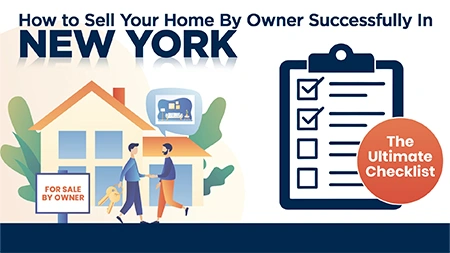
Keep the Commission, Take the Checklist
Smart sellers use checklists. Savvy sellers use ours.
Download Your FSBO ChecklistHow Much Do You Save By Selling Your House By Owner?
Over $15,795!
When you sell your house with a Realtor, you may have to pay as much as $18,045 on a median home of $601,500, in agent commissions.
However, with Houzeo, you can list your home for just $249—that’s less than a day at a theme park. You can save around $15,795 on the listing agent fee and use it to take the ultimate Hamptons Summer retreat or a private super-yacht charter tour.
👉 Ready to Sell Your Home By Owner in New York? List on the MLS Now!
What Are the Legal Requirements for Selling Your New York Home By Owner?
When selling your home by owner, disclose all known issues and use state-approved contracts that meet legal standards. A pre-listing inspection and real estate attorney can help ensure transparency, proper documentation, and a smooth closing with a valid deed transfer.
- Complete Required Seller Disclosures: New York law mandates sellers to disclose any known issues affecting the property. This includes past repairs, environmental hazards, structural problems, and lien information.
- Use State-Specific Contracts: Use New York-specific real estate contracts, such as those provided by the New York Realtors Association. The forms should comply with state law and outline essential terms and contingencies.
- Engage a Real Estate Attorney: While not mandatory, a New York real estate attorney can help you review contracts, prepare closing documents, and ensure legal compliance throughout the selling process.
- Understand Deed Requirements: New York recognizes several deed types, including statutory warranty deeds and special warranty deeds, which transfer ownership. Deeds must be properly signed, notarized, and include a legal property description to be valid.
To sell your house without a Realtor while meeting legal requirements, disclose all known property issues using the mandatory Property Condition Disclosure Statement and New York-specific real estate contracts. Hire a licensed attorney to draft the contract and oversee the transaction to ensure compliance and a valid deed transfer at closing.
What Are Some Pros and Cons of Selling a Home Without a Realtor?
The benefits of selling your home yourself include keeping the agent’s commission and controlling the whole process: pricing, showings, and negotiation. You move on your schedule, not an agent’s.
But you’re responsible for all marketing and legal work, and if you don’t use a trusted service for exposure, you risk attracting scammers or facing hidden fees.
✅ Pros
- Save Thousands: You typically have to pay 2.5% to 3% to a listing agent. If you sell your home yourself, you get to keep a larger portion of the sale price.
- Sell Faster: You can list your house yourself whenever you are ready, no need to search for a Realtor or wait for their availability. You market and sell on your own schedule.
- Retain Control: You have complete control to price, market, and negotiate the sale. You can work at your own pace and decide what offers to accept based on your needs.
❌ Cons
- Limited Assistance: To sell a home by owner, you need to conduct showings, negotiate with buyers, and handle the legalities yourself. The time and effort required can often overwhelm first-time sellers.
- Potential Hidden Costs: If you list with a low-cost FSBO service, you may incur high hidden fees at closing.
- Increased Risk of Scams: Platforms like Craigslist and Facebook Marketplace attract fraudsters and scammers, which may bring unnecessary risks.
What Are Some Common Mistakes to Avoid While Selling a House By Owner in New York?
When you sell your home by owner, ensure that you don’t:
- Forget the MLS: If you try selling your home without the MLS, it’s like fishing in a lake without a rod. To get more visibility on 100+ major platforms like Zillow, Trulia, and Realtor.com, you must opt for a Flat Fee MLS listing in New York with Houzeo.
- Misprice Your Home: You need to know your property’s true value. Price it too high and buyers won’t bite. Price it low and you leave money on the table. Use a home worth calculator and a CMA report to find the right price.
- Ignore Marketing: A home on sale without strong marketing is like a deli without a neon sign – boring! In New York’s fiercely competitive market, high-quality photos and a well-written description are essential. You can add a free yard sign to reach drive-by traffic.
- Neglect Seller Disclosures: Skip any of the legal forms or the New York seller disclosure form, and you’ll be in a pickle soon. Ensure you complete all required disclosures and hire a New York real estate attorney to help with the process.
- Fail to Negotiate Smartly: When a buyer makes a low offer, don’t fold. Hold firm on your price and terms. Buyers will test you—respond with the confidence of a New York Knicks player in crunch time.
Effective negotiations start by understanding a buyer’s financial posture. Always verify a recent pre-approval letter or “Proof of Funds” before accepting an offer to ensure the buyer can actually close the deal. By focusing on non-price terms, you can maintain leverage and ensure a smooth transfer through the escrow process.
How to Sell a House By Owner in Neighboring States
Are There Any Alternatives to Selling Your Home By Owner in New York?
If selling your home on your own is too daunting, here are some alternatives you can consider:
- Flat Fee MLS Services: You pay a fixed fee to list your home on the MLS and gain increased exposure. You stay in control of the sale and avoid high commissions.
- Discount Real Estate Agents: They offer services such as contract review at a lower fee than traditional agents. Discount brokers in New York charge between 0.5% and 2.5% as commission.
- Full Service Agents: They provide various services from listing to closing, but charge a hefty 5% to 6% commission.
- Cash Buyers: You can sell your house fast for cash in New York to cash buyers and iBuyers looking for homes to flip and sell for a profit.
Should I Sell My House By Owner in New York?
Yes, selling your house by owner in New York is a smart move if you want to save on commissions. The key is to choose the best FSBO website in New York that lists your home on the MLS and gets you in front of serious buyers.
» Houzeo Reviews: Find out what customers have to say about Houzeo – New York’s best home-selling website.