Thinking of buying a home?
To buy your first home in the U.S., start by assessing your finances and getting pre-approved. Then choose a mortgage, find a home, make an offer, complete the inspection, finalize your financing, and close on the property. This guide breaks the process down into 13 actionable steps.
With diverse housing markets and first-time buyer programs in every state, the U.S. offers a lifestyle and budget to fit almost any buyer. Your dream home could be a charming single-family house in Austin or a chic downtown condo in Chicago.



Key Takeaways
- Get Pre-Approved ASAP: The U.S. is currently leaning toward a buyer’s market in many areas, a pre-approval letter helps you stand out.
- Save Thousands with Assistance Programs: Many US states offer down payment assistance programs, such as CalHFA in California, TDHCA in Texas and, Florida Assist in Florida
- Don’t Skip Home Inspections: A home inspection is essential before you buy, and reports like roof or wind mitigation assessments can even lower your insurance costs by up to 45%
- Ask for Credits, Not Repairs: If the inspection has issues, ask the seller for credit at closing. This allows you to hire your own contractors and prevent closing delays.
- Protect Your Investment and Your Wallet: Get the right insurance coverage for your home, and check your state’s homestead exemption or property tax relief options to lower your annual costs.
Houzeo is America’s best home buying and selling platform.
For Home Sellers: List your home for a Flat Fee, and save 2.5% to 5.5% on the listing agent commission! That’s thousands of dollars extra in your pocket.
For Home Buyers: Houzeo has the most number of houses for sale in US. Start your dream home search now!
Yes! You can list your home for sale or search millions of homes on the Houzeo mobile app!
Download now on the Apple App Store or the Google Play Store.
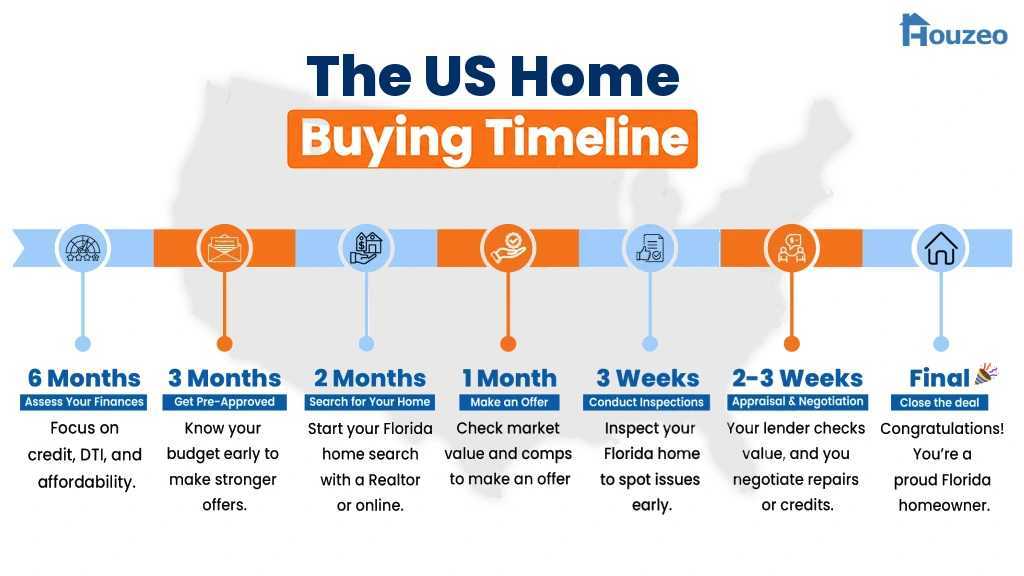
How to Buy a Home for the First Time: 13 Steps!
This step-by-step guide walks first time home buyers through everything, from assessing finances and budgeting for a down payment to choosing the right mortgage. These 13 steps to buy a house make the real estate process clear, simple, and manageable.
Step 1: Assess Your Finances
Before you start looking for a home, you’ll need to make sure you meet the basic requirements most lenders look at. These include your credit score, debt, savings for a down payment and closing costs, and proof of steady income.
As a first time home buyer, the two factors that should matter the most to you are your credit score and Debt-to-Income (DTI) ratio. Additionally, you must also consider how much you can afford for a down payment, a monthly mortgage, taxes, and insurance.
What credit score is needed to buy a house?
A credit score is a three-digit number that indicates your creditworthiness to lenders. The minimum credit score to buy a house depends on the type of mortgage you get.
| Loan Type | Minimum Score | Ideal Score |
|---|---|---|
| FHA | 500 (10% down) | 580+ (3.5% down) |
| Conventional | 620 | 740+ |
| VA | No minimum | 620 |
| USDA | No minimum | 640 |
Minimum and Ideal Credit Scores by Loan Type
Portfolio mortgage loans are easy to qualify for. Here, the credit score needed to buy a house starts at around 580. VA loans are available only to veterans and active-duty service members, and require a score of 620. FHA loans also accept scores as low as 580. They are good for buyers with lower credit scores looking for houses.
When purchasing property, you can check your credit score using several reliable methods. Most of them are free and will not harm your score:
- Annual Credit Reports: Federal law entitles you to one free credit report every 12 months from each of the three major credit bureaus: Equifax, Experian, and TransUnion. These can be accessed through the official, government-authorized website, AnnualCreditReport.com.
- Credit Monitoring Services: Many banks, credit card issuers, and financial service apps provide complimentary and regular access to the FICOscore. This is a convenient way to track your credit health over time.
Knowing how to repair your credit score is important to get better mortgage rates. If you’re a first time home buyer, here’s what you need to do:
- Pay down credit card balances and make all payments on time.
- Avoid opening multiple new accounts quickly.
- Consider becoming an authorized user on a family member’s account with a good history.
- Monitor your score regularly to track progress.
How to Calculate Your Monthly Mortgage Payment?
As a first time home buyer, knowing your average mortgage payment helps you plan your budget. Your total payment includes 4 key components, often called PITI:
- Principal and Interest: This is a major chunk of your payment, covering the amount you borrowed (principal) and the cost of borrowing (interest). It’s determined by your loan amount, interest rate, and loan term.
- Taxes: Property taxes are based on your home’s assessed value and can very state to state. for example, New Jersey’s is over 2.2% of home value, while Delaware’s is just 0.56%. The lender holds these funds in an escrow account and pays the tax on your behalf.
- Insurance: Lenders require you to have homeowners’ insurance to protect the property. The annual premium is usually divided by 12 and added to your monthly payment, also managed through the escrow account.
Apart from PITI, your monthly payment may also include Private Mortgage Insurance if your down payment is less than 20%, and HOA fees.
What Is a Debt-to-Income (DTI) Ratio?
Your debt-to-income ratio shows how much of your monthly income goes toward debt payments, including mortgage, car loans, credit cards, and student loans. To calculate it, add all monthly debts and divide the total by your gross pre-tax monthly income.
A high DTI can prevent you from qualifying for a mortgage, as it shows that you struggle to manage your debt. For the best mortgage rates and a higher likelihood of mortgage approval, aim for a DTI ratio of 36% or lower.
High-cost states like California, New York, and Hawaii often have buyers with higher DTIs, which may require stronger credit scores or larger down payments to qualify. In more affordable states such as Ohio, Indiana, and Texas, buyers typically have more flexibility because home prices are lower.
💡 You can still qualify for a loan in many states despite a high DTI if you have compensating factors like a strong credit history, significant cash reserves or savings, stable long-term employment, etc.
Recommended DTI Ratios by Loan Type
| Loan Type | Recommended DTI Ratio | With Compensating Factors |
|---|---|---|
| Conventional | 36% back-end | 45-50% |
| FHA | 43% back-end | Up to 50% |
| VA | 41% | Can exceed 50% with the residual income test |
| USDA | 41% back-end | 44% with strong credit |
To improve your DTI ratio for a mortgage, you can either reduce your monthly debts or increase your verifiable income.
- Pay Down Debt: Use a tax refund or bonus to clear smaller loans, or consolidate multiple debts into a single loan with a lower monthly payment.
- Increase Verifiable Income: Ask for a raise, take on part-time work, or start a side business. Include all consistent income sources on your application, such as bonuses or commissions, but remember that lenders require a two-year history for secondary income.
- Adjust Your Housing Budget: A larger down payment reduces your loan amount and your monthly mortgage payment. You can also consider a lower home purchase price to keep your future housing costs down.
Step 2: Budget for Your Down Payment and Closing Costs
You should set aside money for the down payment and closing costs. First- time home buyer programs help make homeownership accessible and affordable.
Low-income individuals can access assistance through federal government-backed loans and programs.
Agencies such as the U.S. Department of Housing, Fannie Mae, and Freddie Mac offer programs that have reduced down payments, lower interest rates, or grants to cover closing costs.
How Much Down Payment Does First Time Home Buyer Need?
Typically, the down payment on a house for a first-time home buyer usually ranges from 3% to 20% of the property’s price. However, it can vary based on the loan type. FHA loans require just 3.5% down, while some conventional loans allow a 3% down payment.
To help with these upfront costs, there are many state and local down payment assistance programs. They provide grants or loans to cover these expenses.
👉 First Time Home Buyer Programs Find out which is the #1 downpayment assistance program in the U.S.
How to Estimate Closing Costs?
Closing costs are fees and expenses paid at closing beyond your down payment. Typically, buyer closing costs usually range from 2% to 5% of the home’s price. So, for a $440,387 home, buyers might pay $8,086 to $20,215.
These fees cover lender charges, appraisals, inspections, title insurance, taxes, agent commissions, and recording fees when buying a property.


Step 3: Get Pre-Approved for a Mortgage
Secure your financing early by getting pre-approved for a mortgage as a first time homebuyer. This step helps you understand your budget and strengthens your offer when buying a house.
How to Get Pre-approved as a First Time Home Buyer?
You need to follow these steps to get pre-approved when buying a house:
- Gather Financial Documents: Provide proof of income (recent pay stubs and W-2s), tax returns (last two years), asset statements, debt information, and a government-issued ID.
- Choose a Lender and Apply: Compare lenders and submit a mortgage application to get the best rates and terms.
- Receive Pre-Approval Letter: The lender verifies your info and issues a letter stating your approved loan amount, usually valid for 30–90 days.
State-Specific Home Buying Documents
- Attorney Opinion Letter: Needed at closing in some states (e.g., Georgia, South Carolina).
- Specialized Property Disclosures: Like seismic risk (California), radon gas (Minnesota/Illinois), or extensive environmental forms.
- Well/Septic Reports: Legally required in rural areas of states such as Maine and Texas.
- Homestead Exemption Application: Needed in Florida, Texas, and a few others for property tax reductions.
- Unique Tax Forms: States like New York require additional transfer or mansion tax documentation.
A mortgage preapproval turns you from a casual house hunter to a serious buyer, as it:
- Strengthens Your Offer: 86% of sellers prefer buyers with a pre-approved mortgage. For the strongest position, ask for a fully underwritten pre-approval, where the lender has already verified all your documents.
- Defines Your Budget: It clarifies exactly how much you can afford, allowing you to focus your home search on a realistic price range.
- Speeds Up Closing: With much of the financial vetting already completed, the mortgage process is streamlined once your offer on a home is accepted.
Yes, you can get pre-approved and even buy a home with bad credit. However, your loan options may be limited. You can also expect higher interest rates with poor credit.
Step 4: Choose the Right Mortgage
As a first time homebuyer, assess your finances and select a loan that fits your budget and qualifies you for available programs.
| Feature | Conventional | FHA | VA | USDA |
|---|---|---|---|---|
| Min Credit Score | 620 | 580 (500 w/10% down) | No minimum | 640 |
| Min Down Payment | 5% to 20% | 3.5% | 0% | 0% |
| Max DTI | 45% to 50% | 43% to 50% | 41%+ | 41% to 44% |
| Mortgage Insurance | PMI if <20% | Always | None | Always |
| Loan Limits | $766,550+ | $498,257 to $766,550 | $766,550+ | Varies |
| Property Eligibility Criteria | Few | Must meet FHA standards | Must meet VA standards | Rural/s |
After getting mortgage pre-approval and knowing your budget, choose a property type that fits your finances. Many first-time home buyers start with a condo or a small single-family home because they are generally more affordable.
Best Mortgage Lenders for First-Time Buyers in the U.S.
Comparing lenders side by side helps you find the best combination of rate, minimum down payment, and first-time buyer perks. Mortgage rates change daily, so use Houzeo’s mortgage calculator for today’s APR. The table below focuses on qualification requirements and features, which stay more stable.
| Lender | Min. Credit Score | Min. Down Payment | Key Features |
|---|---|---|---|
| Rocket Mortgage | 620 (conventional); 580 (FHA/VA) | 1% (conventional, ONE+ program); 3.5% (FHA); 0% (VA) | RentRewards applies 10% of the last 12 months of rent toward closing costs, up to $5,000; fully online application and closing |
| Chase | 620 (conventional, FHA, VA) | 3% (conventional); 3.5% (FHA); 0% (VA) | Homebuyer grants of $2,500 or $5,000 in eligible areas; wide range of loan types |
| PNC Bank | 620 | 3% (conventional and PNC Community Loan); 3.5% (FHA); 0% (VA/USDA) | PNC Community Loan allows 3% down with no PMI; grants available for eligible borrowers |
| Navy Federal Credit Union | Not publicly disclosed | 0% (VA, Military Choice, Homebuyers Choice); 5% (conventional) | No PMI on VA, Military Choice, and Homebuyers Choice loans; membership required (open to military/veteran families) |
| Bank of America | Not publicly disclosed | 3% (Affordable Loan Solution) | Lender credit up to $7,500 for closing costs; down payment grant of up to $10,000 or 3% of the price, whichever is less, in select markets |
Step 5: Decide Where to Buy a Home
Deciding where to buy is one of the most important steps for a first time homebuyer. Consider factors like local housing markets, popular neighborhoods, cost of living, and amenities to help you find the best places to live in.
As a first-time homebuyer, you have access to a variety of mortgage programs and down payment assistance options that can make purchasing a house more affordable.
The best homes for first-time buyers are usually priced within local assistance limits, meet lender standards, and sit in neighborhoods with stable values and affordable insurance.
Why Now Is the Time to Buy a House
The U.S. housing market is a balanced market and shows equilibrium between buyers and sellers. You now have more negotiating power and a wider selection of properties to choose from:
- Housing Supply Is High: The U.S. currently has about 3.44 months of housing supply, which inclines towards a balanced market.
- Prices Have Stabilized: The median existing-home price nationwide is around $438,964.
- Sellers Are Negotiating: Roughly 19.38% of the homes nationwide have seen price reductions, showing that sellers are becoming more flexible as inventory rises.
- Homes Are on the Market Longer: Across the U.S., homes are spending an average of 51 days on the market, giving buyers more time to explore options and make informed decisions.
These trends show that now is the best time to buy a house. According to Mauricio Umansky, founder of The Agency, the current market provides “great opportunities for buyers to be aggressive and write strong offers.”
Popular Areas for Different Buyer Types:
The U.S. housing market is becoming more balanced, giving buyers more options through higher inventory, stable prices, and a slower pace of sales. This gives you more time to compare homes and neighborhoods before making an offer.
- Austin: A strong tech job market and softer prices with more room to negotiate make homes for sale in Austin a top pick for young professionals.
- Dallas-Fort Worth: One of the largest inventories in the country and a wide choice of suburbs make homes in Dallas a strong pick for growing families.
- Pittsburgh: One of the most affordable major metros, with homes for sale in Pittsburgh priced well below the national median. Prices are rising, so first-time buyers on a budget should move early.
- Chicago: A walkable, big-city lifestyle draws buyers to homes for sale in Chicago. It is a busy market with rising prices, so expect more competition.
Consider the Cost of Living When Choosing a Location
When looking for the best place to buy a house, consider the overall cost of living, as lower home prices can be offset by higher taxes or insurance.
- High-Cost Areas: San Francisco, New York, and Honolulu are 15–25% above the average.
- Moderate-Cost Areas: Dallas, Charlotte, and Phoenix are near or slightly below the average.
- Low-Cost Areas: Pittsburgh, Omaha, and Knoxville are 5–15% below the national average.
Step 6: Start House Hunting
Before house hunting, get mortgage pre-approval and choose your preferred area. This helps you focus on homes within your budget. From here, the next step is finding the right house. As a first-time home buyer in the U.S., you have two options:
- Work with a Realtor.
- Search for homes online.
An experienced agent can give you valuable local insights and expert guidance on neighborhood trends. However, you’ll have to negotiate the buyer agent commission with the seller, which may raise the home sale price.
If you prefer to take the lead, a high-tech platform like Houzeo is what you need. Whether you’re looking for beachfront mansions, high‑rise penthouses, spacious big homes, or luxury homes in the U.S, Houzeo has you covered. You can browse through thousands of listings, set alerts, and save your search. You can even schedule showings and submit offers, all by yourself.

Don’t Just Browse. Buy.
Your entire home purchase, managed in one place.
Download the Houzeo Mobile AppBuying With an Agent vs. Buying FSBO: Cost Comparison
U.S. Buyers can work with a licensed real estate agent or buy For Sale By Owner (FSBO) directly from a seller listing on a platform like Houzeo. Each path has a different cost and effort trade-off.
| Factors | Buying With an Agent | Buying FSBO |
|---|---|---|
| Typical Cost to a Buyer | Set by a signed agreement (2–3%) before touring; sellers often cover it as a concession, but it’s not guaranteed. | No agent fee on either side; sellers may price lower |
| Guidance & Paperwork | Agent handles negotiation, disclosures, and contract paperwork. In some states, a real estate attorney also handles the closing. | Buyer manages paperwork and negotiation directly with the seller, and can hire a real estate attorney to review contracts |
| Negotiating Power | Agent brings comps and local market knowledge to the table, and negotiates offers and counteroffers on your behalf. | Buyer negotiates directly with the seller, which can mean more flexibility but less built-in expertise. |
| Best For | First-time home buyer who wants hands-on guidance through inspections, financing, and closing | Buyers comfortable managing their own search. |
Step 7: Schedule and Attend Home Showings
Once you’ve identified homes that match your budget, preferred location, and needs, schedule and attend showings to see each property in person. For a first-time home buyer in the U.S., visiting homes firsthand helps you evaluate condition, layout, and neighborhood, ensuring you make an informed choice.
During the showing, ask key questions such as:
- How long has the home been on the market?
- Why is the owner selling?
- What is the age of the roof, HVAC system, and water heater?
- Are there any HOA fees or special assessments?
- Have there been any major repairs or renovations?
When touring a home, check for signs of structural or maintenance issues like roof sagging, foundation cracks, water stains, uneven floors, or sticking doors. These may indicate costly repairs down the line.
Advice for first time homebuyers, there are three main aspects you need to focus on when shortlisting homes:
- Insurance Risks: Verify the home’s flood zone using FEMA’s maps. Get a 4-point inspection and a wind mitigation report to assess insurability and identify features, like an old roof or the lack of impact windows, that could drive up insurance costs.
- Commute and Lifestyle: Test your commute during rush hour. Visit the neighborhood at different times to check for noise from traffic, airports, or nightlife. Ensure convenient access to key amenities like schools, groceries, and parks.
- Home Loans/Assistance Program Eligibility: If you’re applying for a loan or first time buyer program, ensure that the house complies with its property requirements, or you may risk losing the assistance.
Step 8: Make an Offer
When crafting an offer, make a competitive bid but stay within your budget. As a first time home buyer, consider factors like the home’s market value, recent comparable sales, and any repairs needed. This increases your chances of getting a fair deal.
Analyze Recent Sales
Your agent will pull up real estate comps that are similar to the one you want. Focus on the final sale price, not the list price. Home prices in many metro areas have seen modest declines, so your offer should reflect this trend.
Adjust for the Home’s Condition
Factor in the age and condition of the roof and HVAC. If a comparable home sold for $439,701 but had a new roof, and your target home needs a $24,000 replacement, adjust your offer to account for that expense.
Account for Current Market Conditions
With more homes for sale, you have leverage. Even home builders are lowering their prices by almost 6% to attract buyers. So, for a home that is priced fairly, offer 3% to 5% less. If it is overpriced, you can justify an even lower offer, citing both the comps and market trends.
What is an Earnest Money Deposit?
An earnest money deposit is a “good-faith” payment that shows you are a serious buyer. This money is held in escrow and applied towards your down payment at closing.
Across the U.S., buyers usually put down 1%–3% as an earnest money deposit. For a $439,701 home, that’s about $4,000–$12,000. In hot markets like Miami, Los Angeles, or New York, sellers may ask for up to 10% to show you’re serious.
Once your offer is accepted, you typically have 3 business days to submit the deposit to an escrow agent, such as a title company or real estate attorney.
Yes, you can get your earnest money deposit back, but only if you back out of the sale for the following reasons:
- The inspection reveals major issues, and you exercise the inspection contingency.
- The appraisal comes in low, and you exercise the appraisal contingency.
- You’re unable to secure the required financing, and exit during the financing contingency period
- Title issues are discovered.
Many buyers looking to buy a home for the first time forfeit their earnest money because:
- They back out after the contingency periods expire without a valid reason.
- They violate contract terms.
- The seller meets all contract obligations, but the buyer still refuses to close.
Step 9: Conduct Home Inspections
First time home buyers should schedule home inspections to uncover any issues before buying a house. You typically get the inspection report within 24 to 48 hours.
Which Home Inspections Should You Schedule?
A standard home inspection isn’t enough. The state’s unique climate and weather risks require a few specialized inspections:
- General Home Inspection ($300–$500): A licensed inspector will examine everything from the roof to the foundation. They pay special attention to storm damage, proper drainage, and the age of the AC unit.
- 4-Point Inspection ($150–$250): Insurance companies require a 4-point inspection for homes over 30 years old. It focuses on the four most critical systems: the roof, HVAC, electrical, and plumbing. An old roof or an outdated electrical panel can result in the insurance coverage being denied.
- Wind Mitigation Inspection ($75–$150): This inspection documents hurricane-resistant features like impact windows, hurricane straps, and a hip-shaped roof. These features can qualify you for insurance discounts of up to 45%.
- WDO / Termite Inspection ($75–$100): A termite inspection is mandatory for government-backed loans like FHA and VA, and is highly recommended for warm places, damp climate is a breeding ground for termites and other pests that can cause severe structural damage.
Consider Other Specialized Inspections
Based on the property, following the first time home buyers guide the buyers may want to conduct additional tests. For older homes, a sewer scope can detect cracks or tree roots in the main sewer line, saving you from a $15,000 repair down the road. If you see large cracks or uneven floors, a $700 foundation inspection is worth the investment.
For rural properties, a septic inspection is essential. If the home has a pool, a separate pool inspection will check the pump, filter, and structure for costly defects.
It’s not recommended. Even if you plan to buy cheap homes, skipping a home inspection can lead to unexpected repair costs.
Step 10: Complete the Home Appraisal
After the home inspection is complete, your lender usually orders an appraisal to confirm that the home’s market value supports the purchase price.
Why Do Lenders Need Appraisals?
A home appraisal confirms the property’s market value. Appraisers typically focus on the following parameters:
- Flood Zone and Elevation: A home in a high-risk flood zone (like Zone AE or VE) will likely be valued lower than a similar inland property due to higher insurance premiums.
- Insurance and Mitigation Features: The age of the roof, the presence of hurricane shutters, and impact-resistant windows directly affect a home’s insurability and, therefore, its market value.
- Condo/HOA Health: Appraisers closely examine a condo association’s financial health. They look for anything that may reduce the unit’s value, like the association’s reserve funds or any pending special assessments.
A standard home appraisal in the U.S. typically costs between $300 and $500 and takes about 7 to 14 days to complete. However, luxury, large, or waterfront properties may require a higher fee and take longer due to their complexity.
If the appraisal comes in lower than your offer price, you have an appraisal gap. In such a situation, you can either:
- Renegotiate the Price: Ask the seller to lower the price to the appraised value. In the current market, many sellers are willing to negotiate.
- Cover the Gap: If the seller won’t budge, you can choose to pay the difference in cash.
- Dispute the Appraisal: If you believe the appraiser made a factual error or used poor comparable sales, you can file for a Reconsideration of Value.
- Walk Away: If you cannot reach an agreement, your appraisal contingency allows you to cancel the contract and get your earnest money back.
Step 11: Negotiate Repairs and Credits
As a first-time home buyer in the U.S., use the inspection report to negotiate repairs or request seller credits for issues with the roof, plumbing, HVAC, or electrical system. This can help reduce unexpected costs and make your new home move-in ready.
How to Use Your Inspection Report to Negotiate Repairs?
Your negotiation strategy should center on issues that impact the home’s safety, structural integrity, and insurability. Minor cosmetic flaws are not worth fighting over and can make you seem unreasonable. It’s easy to make this mistake as a first home buyer.
- Safety Hazards: This includes outdated or unsafe electrical panels, faulty wiring, or missing safety features such as GFCI outlets near sinks, bathrooms, or outdoor areas, as required by US electrical codes.
- Structural Problems: Issues with the foundation, load-bearing walls, framing, or roof structure that can affect the home’s stability or safety.
- System Failures: Problems like a malfunctioning HVAC system, major plumbing leaks, or an aging roof nearing the end of its lifespan, which are common red flags in US home inspections.
Get 2 to 3 written estimates from licensed contractors for any major repairs. A repair request that includes professional quotes shows you are serious and have done your homework.
Should You Ask for Repair Credit?
While you can ask the seller to perform the repairs themselves, it’s better to ask for credit instead. Credit gives you the funds to hire your own contractors and ensures the work is done to your standards, not just the cheapest way possible. It also allows the sale to proceed on schedule, without any delays.
How to Negotiate Seller Concessions
Seller concessions are a powerful tool for reducing your out-of-pocket closing costs when buying real estate. Here, the seller pays for some of your expenses, such as the appraisal, title insurance, or property taxes.
Your ability to negotiate concessions depends on your loan type. Each loan program sets a maximum limit on how much a seller can contribute:
| Loan Type | Minimum Down Payment | Maximum Seller Concession |
|---|---|---|
| Conventional | Less than 10% | 3% of the purchase price |
| Conventional | 10% or more | 6% of the purchase price |
| FHA Loan | Any amount | 6% of the purchase price |
| VA Loan | Any amount | 4% of the purchase price |
| USDA Loan | Any amount | 6% of the purchase price |
Step 12: Review Your Closing Costs
Once repair negotiations are complete, review your final closing costs, including title fees, escrow charges, property taxes, homeowners insurance, and lender fees. This helps you finalize your budget and prepare for closing.
Understanding Closing Costs
- Taxes and Government Fees ($1,000–$2,000): Your closing costs will include local and state recording fees, transfer taxes, and possibly mortgage taxes. These costs vary widely by state and municipality. For example, some states charge a transfer tax based on the home’s sale price, while others do not.
- Title Fees ($1,500–$2,500): These fees cover the title search, settlement services, and title insurance policies for both you and your lender. The owner’s title insurance protects against ownership disputes or undiscovered liens. The buyer and seller typically negotiate who pays the owner’s policy, depending on local customs.
- Third-Party Fees ($1,000–$1,500): This category includes the appraisal fee, credit report fee, and flood certification (if required). It also covers any inspections you order, such as general home, pest, or roof inspections.
- Prepaid and Escrow Costs ($3,000–$6,000): You’ll usually prepay your first year of homeowners insurance and fund your escrow account with several months of property tax and insurance payments to cover upcoming bills.
Step 13: Close on Your New Home
Closing day is the moment you officially become the owner of your new home. Its success depends on a careful final walk-through, a smooth funding process, and making sure all legal documents are properly signed and recorded.
Complete Your Final Walk-Through
Within 24 hours of closing, you will do one last walk-through of the property. This is not a formal inspection, but rather your final chance to see if you want this home. Use this checklist:
- Verify Repairs: Bring your inspection report and signed repair agreement to the final walk-through. Confirm that the seller completed all agreed-upon repairs before closing.
- Test Everything: Run the air conditioning and test all appliances. Make sure every system is functioning as it should.
- Check for Included Items: Ensure all items that were supposed to be included in the sale, like appliances, window treatments, and light fixtures, are still in place.
- Look for Signs of Additional Damage: Make sure no new damage has occurred since your last visit. If you see any issues, notify your agent and the title company immediately before you sign any documents.
Sign the Documents
While there are numerous documents to sign, the most important ones are:
- The Closing Disclosure: You will sign the final version of this document, which outlines all your loan terms and costs.
- The Promissory Note: This is your legal promise to repay the loan. The promissory note outlines the loan amount, interest rate, repayment schedule, and maturity date.
- The Mortgage: This document secures the property as collateral for your loan.
Once you have signed everything, you will provide your “cash to close” amount via a cashier’s check or wire transfer. After your lender sends their funds to the title company, the deal is officially funded.
Get Your Keys and Celebrate
Once the deal is funded, the title company will record the new deed with the county, officially transferring ownership to you. After they pay the seller and other parties, you will finally get the keys to your new home.
Congratulations, you are officially a homeowner! 🎉
When you buy a house in the U.S., property taxes work in three stages:
- Taxes are prorated at closing: The seller pays for the portion of the year they owned the home, and you take over from the closing day forward.
- Your lender will collect taxes through escrow: If you have a mortgage, part of your monthly payment goes into an escrow account to pay future tax bills.
- You’ll receive your first tax bill later in the year: In the U.S., property taxes are set and collected at the local level, so billing schedules differ
🚩 What are the Red Flags to Look for When Buying a House?
A new home is a huge financial investment. To ensure that you don’t sink your money into a dud, look out for these red flags:
1. Bargain-Priced Homes
An asking price that’s significantly lower than comparable homes in the area seems like a dream come true. But that’s just until the roof collapses or faulty electrical systems burn the house down.
An extremely low price could mean the property is uninsurable or is located in a high-risk flood zone with steep insurance costs. So before you put in an offer, check the home’s sale history and other permits from the local county’s office. Also, get insurance quotes to understand your total expense better.
2. Neighborhood Sell-Out
During the open house, if you notice too many “For Sale” signs on a single street or in a small community, it should ring alarm bells. It could be due to skyrocketing HOA fees, declining school quality, or a recent increase in crime rates. It could also point to a future nuisance, like a commercial development planned nearby.
Talk to potential neighbors to get their opinion on the area. You can also check community social media pages or online forums like Nextdoor for discussions about local issues.
3. Foundation Cracks
Foundations cracks can be devastating for the health of any home. They’re a major indications that you should not buy that house. You can find these cracks on a home’s exterior inside the home’s basement, or underneath its floors. These cracks mainly serve as the hideaway for vermin or mold. If left unchecked, they can cause a home to lean or tilt.
4. Sloping or Uneven Floors
Sloping or uneven floors are a common red flag in US homes. They often show that something is wrong under the surface. The cause could be foundation settling, water damage, rotting wood, or shifting soil.
You may also notice doors that don’t close right or cracks in walls—these often come with floor problems. Repairs can be costly, so if you see floors that tilt, dip, or feel soft, get a professional inspection before making an offer. These repairs are extremely expensive, so always check for them before finalizing the deal.
5. Condensation in Windows
Foggy windows usually mean a loose seal. In worse cases, several windows may have the same issue. Not only does this look bad, but it also allows heated or cooled air to escape from your HVAC system, increasing your utility bills. Windows that are opened frequently, such as sliding windows, are more likely to experience seal damage and become foggy without regular maintenance.
What Should You Do After Closing?
Welcome Home! Now that you’ve moved in, take a few simple steps to protect your new home.
- Check for Property Tax Savings:
If this is your main home, see if your state offers a tax break for homeowners. Many states give a property tax exemption that can lower your yearly taxes. - Set Up Utilities:
Turn on your water, electricity, gas, internet, and trash service. Depending on where you live, you might also want pest control or lawn care. - Get the Right Insurance:
Most lenders require homeowners insurance. If your area has floods, wildfires, or earthquakes, you might need extra coverage. Ask your insurance agent what’s best for your location. - Plan for Home Maintenance:
Keep your home in good shape with regular care. Change air filters, clean gutters, check the roof, and schedule HVAC service every year. Fixing small problems early helps you avoid big costs later.
How to Buy a House Without a Realtor?
Research neighborhoods and browse listings on trusted sites like Houzeo. Then, schedule showings directly with sellers or their agents. You can also hire a real estate attorney to review contracts and handle legal details.
Next, get pre-approved for a mortgage, make an offer, schedule inspections, and negotiate repairs. With the necessary due diligence, you can buy a house without a Realtor.
Which First Time Home Buyer Programs Can You Apply For?
Various programs make homeownership easy providing advice on how to buy a home for the first time . They assist with down payments through grants or low-interest, deferred-payment loans. Applicants must meet the income and credit score criteria and complete a homebuyer education course to avail of these programs.
| Program Name | Eligibility | Grants | Key Benefit |
|---|---|---|---|
| Good Neighbor Next Door (GNND) | Law enforcement, firefighters, EMTs, PK–12 teachers | 50% off the home price | Huge discount on HUD revitalization area homes |
| HomePath ReadyBuyer | First-time buyers who complete the online course | Up to 3% in closing cost help | Buy discounted Fannie Mae–owned foreclosures |
| Energy-Efficient Mortgage (EEM) | Buyers making approved energy-efficiency upgrades | Finance improvements in the loan | Add upgrade costs without increasing your down payment |
| Native American Direct Loan (NADL) | Eligible Native American veterans and spouses | 0% down | No down payment + VA-backed benefits |
| HUD Section 184 Loan | Eligible Native American homebuyers | 2.25% down | Affordable loan designed for Native American borrowers |
1. Good Neighbor Next Door (GNND)
- Who can apply: Law enforcement officers, firefighters, EMTs, and PK–12 teachers
- Credit score: No specific score; must meet FHA/HUD guidelines
- Help offered: 50% off the home price
The Good Neighbor Next Door program lets eligible community workers buy HUD homes in revitalization areas for 50% off. You must live in the home for at least three years. Properties can be found on HUD’s website.
2. HomePath ReadyBuyer
- Who can apply: First-time buyers who complete the online course
- Credit score: Standard mortgage requirements
- Help offered: Up to 3% in closing cost assistance
HomePath ReadyBuyer gives first-time buyers up to 3% toward closing costs when buying a Fannie Mae–owned foreclosed home. Completion of the HomePath education course is required before availing this assistance.
3. Energy-Efficient Mortgage (EEM)
- Who can apply: Buyers planning approved energy-saving upgrades
- Credit score: Based on the main loan type (FHA, VA, or conventional)
- Help offered: Energy improvements financed within the mortgage
An Energy-Efficient Mortgage allows you to add the cost of energy upgrades—like insulation, HVAC systems, or efficient windows—into your main loan without increasing the down payment. A home energy assessment is required.
4. Native American Direct Loan (NADL)
- Who can apply: Native American veterans and their spouses
- Credit score: Flexible VA standards
- Help offered: No down payment
The NADL loans are VA-backed and help Native American veterans buy, build, or improve homes on federal trust land. Benefits include no down payment and low interest rates.
5. HUD Section 184 Loan
- Who can apply: Eligible Native American and Alaska Native buyers
- Credit score: Typically 620+
- Help offered: Low 2.25% down payment
Section 184 loans are designed for Native American borrowers. They offer low down payments, flexible credit rules, and are available in eligible tribal areas.
» First Time Home Buyer Programs: Find the perfect program that helps you get the key to your first home.
What Should You Know Before Buying a House?
Buying your first home is exciting, but it also comes with many details to think about. Before you make an offer, take time to understand the factors that can affect your budget and lifestyle. The price you see on a listing is just one part of the total cost. You’ll also face extra expenses that come with owning and maintaining a home. Knowing about these early will help you plan better and avoid surprises later.
What Are Some Additional Costs When Buying a House?
Besides the purchase price, there are several other expenses that every homebuyer should prepare for. These extra costs can vary depending on where you live, the type of property, and the loan you choose.
- Closing Costs: These typically range from 2% to 5% of your loan amount and cover fees for appraisals, title searches, and legal documents.
- Property Taxes: The annual amount depends on your home’s location and value. Some states have much higher property tax rates than others.
- Homeowners Insurance: This protects your property and belongings from damage caused by fire, storms, or theft. Rates are higher in areas with more natural disasters, such as hurricanes or wildfires.
- HOA Fees: If you buy a home in a community with shared amenities like pools or clubhouses, you’ll likely have to pay monthly or annual homeowners association fees.
- Maintenance and Repairs: Set aside a portion of your budget for routine upkeep, such as plumbing fixes, roof inspections, and lawn care.
Do You Need Extra Insurance for Hurricanes, Wildfires, Earthquakes & Floods in the U.S.?
1. Hurricanes
Common states: Florida, Texas, Louisiana, North Carolina, South Carolina, Georgia
Risk level: High
Insurance recommendation: Standard homeowners insurance may not cover hurricane wind damage. Many states require separate windstorm insurance or a hurricane deductible. Strongly recommended for anyone living near the coast.
2. Floods
Common states: Florida, Texas, Louisiana, New Jersey, New York, parts of California
Risk level: Moderate to high nationwide
Insurance recommendation: Flood damage is not covered in a basic homeowners policy. Flood insurance is required in FEMA high-risk zones for federally backed mortgages. Recommended even in low-risk areas because floods happen everywhere.
3. Wildfires
Common states: California, Colorado, Arizona, Oregon, Washington, New Mexico
Risk level: Moderate to high
Insurance recommendation: Most homeowners policies cover wildfire damage. But in high-risk areas (especially California), coverage can be limited. Extra fire insurance or a state FAIR Plan may be needed.
4. Earthquakes
Common states: California, Alaska, Washington, Oregon, Utah
Risk level: High along the West Coast
Insurance recommendation: Earthquake damage is not included in a standard policy. You need separate earthquake insurance or state-backed coverage like the California Earthquake Authority(CEA).
How to Buy a House Near Me
Why First-Time Homebuyers Should Explore Now?
From bustling cities with strong job growth to peaceful small towns with affordable housing, there’s a community for every budget. With thousands of homes for sale nationwide and many down payment assistance programs, buying your first home in the U.S. is now more achievable than ever.
» Houzeo Reviews: Read what customers have to say about Houzeo, America’s best home buying website.